

- Main
- Ideas and tools
- How to Sell Online Courses: Complete Knowledge Monetization Guide
How to Sell Online Courses: Complete Knowledge Monetization Guide
Creating a course is 40% of the work. The remaining 60% is selling online courses. According to industry research, 67% of course creators who quit within the first year had quality content but no sales system. Not because their knowledge wasn’t valuable — but because they didn’t know how to communicate value to an audience and convert interest into purchases.
This guide is a step-by-step knowledge monetization playbook for course creators, coaches, trainers, and online schools. From defining your target audience to automating repeat sales. No generic advice — only specific strategies, conversion benchmarks, and actions you can implement this week.
If you haven’t chosen a platform for selling courses yet, we recommend reading our guide “How to Create an Online School from Scratch” first. If you already have a platform — let’s move to sales.
Step 1. Define Your Target Audience and Their Pain
Before thinking about online course marketing, you need to answer three questions: who are you selling to, what problem are you solving, and why is your course the best option for this person.
Ideal Student Profile
A common mistake is describing the audience too broadly: “women 25–45 who want to grow.” That’s not a profile — it’s demographics. An ideal student profile includes a specific pain, a specific situation, and a specific desired outcome.
Bad profile example: “Entrepreneurs who want to increase sales.”
Good profile example: “An e-commerce store owner with $2K–$8K/month revenue who spends on ads but can’t figure out why landing page conversion is below 2%. Wants to systematically increase sales without raising the ad budget.”
How to Find Your Audience’s Pain
Run 10–15 deep interviews with potential students. Ask: what have you tried? What didn’t work? How much are you willing to invest in a solution? Study comments in niche groups, forums, and under competitor videos. Check what questions people ask on Google (via AnswerThePublic or AlsoAsked). The more precisely you understand the pain — the higher your purchase conversion.
Step 2. Build Your Course Sales Funnel
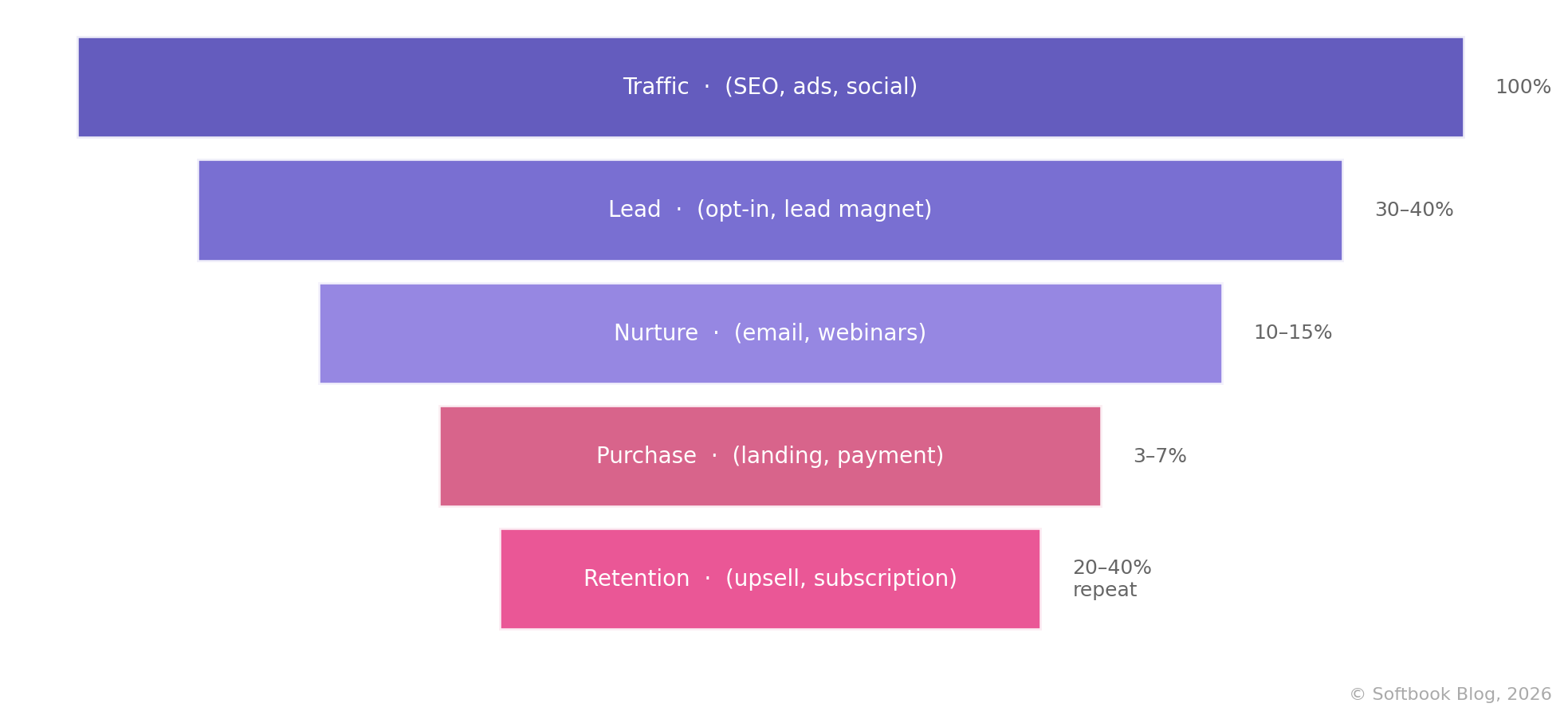
A sales funnel is the path a potential student takes from first contact to purchase (and repeat purchases). Without a funnel, you rely on luck. With a funnel — on a system.
5 Funnel Stages
Stage 1 — Traffic. People discover you through SEO blogs, social media (Instagram, TikTok, YouTube), targeted ads, or affiliate programs. Your goal: attract attention and deliver free value.
Stage 2 — Lead. A visitor leaves their contact (email or phone) in exchange for a lead magnet: free webinar, mini-course, PDF guide, or checklist. Good lead magnet conversion: 25–40% of landing page visitors.
Stage 3 — Nurture. A series of 3–7 emails where you deliver value, showcase case studies, student testimonials, and gently lead toward the sale. Nurture duration: 5–14 days.
Stage 4 — Purchase. Selling webinar, email series with deadline, or direct landing page offer. Conversion from nurtured list: 3–7%. From cold traffic: 0.5–2%.
Stage 5 — Retention & Repeat Sales. Upsell, cross-sell, subscription to course library. Retaining an existing customer is 5–7x cheaper than acquiring a new one. 20–40% of students buy again if you offer them the next step.
Funnel Calculation Example
Say you’re selling a course for $100: 1,000 ad clicks (CPC $0.15) → $150 budget. 300 webinar signups (30% conversion). 150 attendees (50% show-up rate). 8–10 sales (5–7% conversion). Revenue: $800–$1,000. First launch ROI: 430–560%. And that’s without organic traffic and repeat sales, which compound over time.
Step 3. Create a Landing Page That Converts
A course landing page isn’t an “about the course” page. It’s a selling tool with clear structure. Average EdTech landing page conversion: 3–5%. Well-optimized: 8–15%.
Selling Landing Page Structure
- Hero section: headline with outcome (not “Marketing Course”, but “Increase Sales by 40% in 8 Weeks”), subheadline, CTA button, trust signal.
- Pain block: describe the customer’s situation — make it relatable.
- Curriculum: modules with specific outcomes for each.
- Social proof: student testimonials (video > text), graduate count, results in numbers.
- About the instructor: your expertise — not a biography, but why YOU are qualified to teach this.
- Pricing & packages: anchoring effect — the middle tier looks attractive next to the premium.
- FAQ & CTA: address final objections and repeat the call to action.
Collecting Social Proof from Scratch
No testimonials yet? Offer the first batch (5–10 students) free or discounted access in exchange for a detailed review. After completion, ask for a video testimonial — it converts 2–3x better than text.
A/B Testing Your Landing Page
Don’t guess — test. Three elements for your first A/B test: headline, CTA button, and pricing structure. Minimum sample: 100 visitors per variant. Even improving conversion from 3% to 5% increases revenue by 67% with the same traffic.
Step 4. Set a Price That Sells
Course pricing is one of the hardest challenges. Too low devalues the product and reduces student motivation (free course completion rate: 5–10%, paid: 30–70%). Too high without social proof scares people off.
5 Knowledge Monetization Models
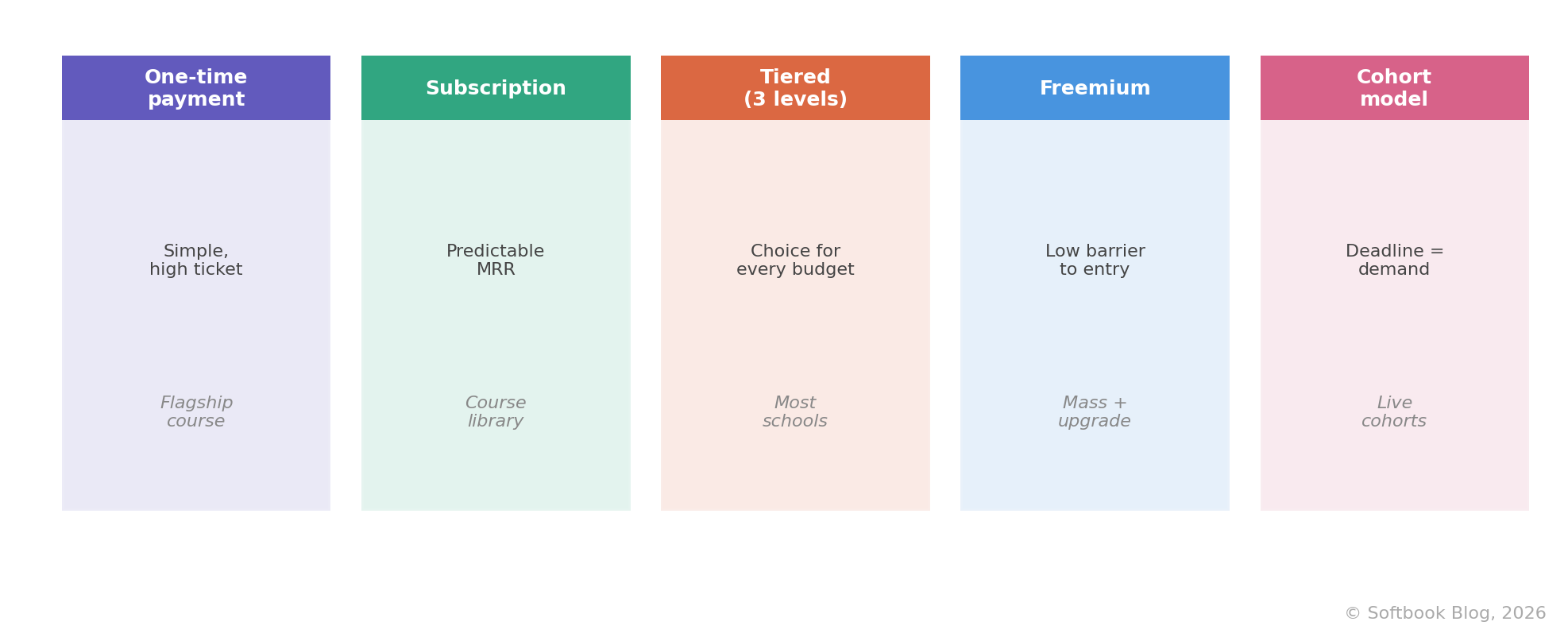
One-time payment — student pays once, gets access. Range: $49–$497 for international markets.
Subscription — monthly payment for access to a course library. Creates predictable revenue (MRR). Range: $9–$49/mo.
Tiered model — 3 levels: basic (video only), standard (+ feedback), premium (+ mentorship). Most effective for the majority of online schools.
Freemium — free mini-course, paid full access. Low entry barrier, but requires quality free content.
Cohort model — enrollment in groups with fixed start dates. Deadline creates demand, group dynamics boost completion.
Starter Price Formula
Calculate: how many hours does the student save thanks to your course? Multiply by their hourly rate. That’s the maximum price. Starter price: 10–20% of that number.
Step 5. Drive Traffic: Channels That Work
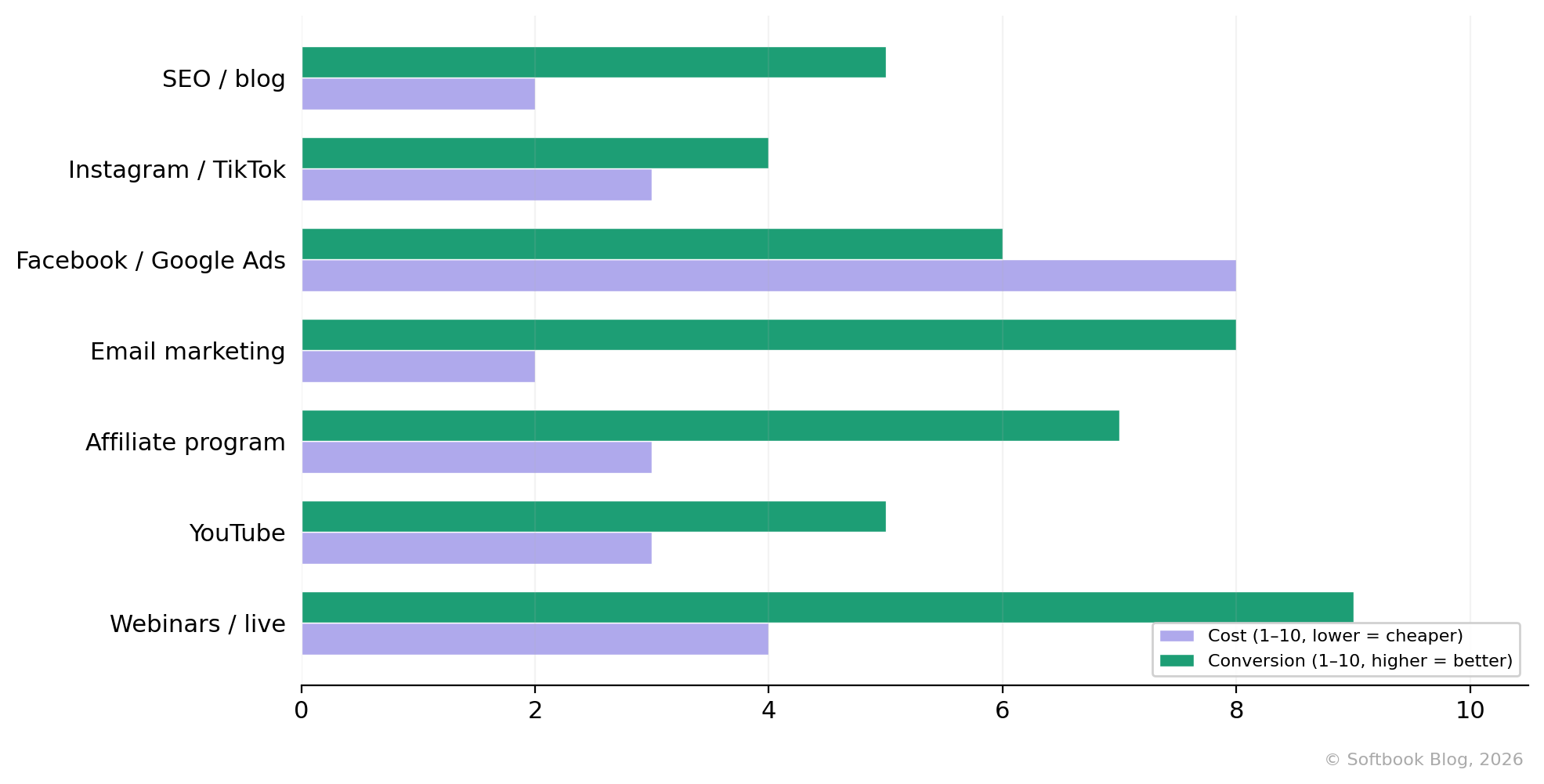
No traffic = no leads = no sales. But student acquisition channels differ in cost, conversion, and speed of results.
Organic Channels (Long-term)
SEO blog. Write articles answering your audience’s questions. In 3–6 months, the blog starts bringing free traffic. SEO for online schools is a compounding investment.
YouTube. Free educational videos → course link in description. Longer play, but higher trust and deeper audience connection.
Instagram / TikTok. Short-form content for awareness and warming. Great for B2C: fitness, beauty, soft skills, languages.
Paid Channels (Fast Results)
Facebook / Google Ads. Targeted ads deliver fast traffic but require budget. Starter budget: $10–20/day. Target your lead magnet, not the course directly — this lowers CPA by 3–5x.
Affiliate program. Invite bloggers and experts to recommend your course for a % of sales (15–30%). Low risk — you pay only for results. Most modern LMS platforms let you set up an affiliate program right inside the system.
Most Effective Channel: Email Marketing
Email campaigns deliver the highest purchase conversion across all channels — 3–8% from a nurtured list. Build your list through lead magnets and webinars, then nurture with automated sequences.
Email Sequence Structure for Course Sales
Email 1 (day 0): Welcome — thank them, deliver the lead magnet. Email 2 (day 2): Value — practical tip. Email 3 (day 4): Case study — student result with numbers. Email 4 (day 6): Problem — what happens when you DON’T solve it. Email 5 (day 8): Solution — introduce the course. Email 6 (day 10): Offer with deadline. Email 7 (day 11): Last call.
Healthy sequence open rate: 30–50% for early emails, 20–35% for later ones. Click rate: 5–15%.
Step 6. Automate Your Sales
Manual sales don’t scale. Sales automation means your funnel works 24/7 without your involvement.
What to Automate First
Email sequences: welcome series (5–7 emails), nurture series, follow-up for non-buyers. Chatbots: automated replies in Telegram and Facebook Messenger, lead collection through quizzes. Webinars: record an “evergreen” webinar as an automatic selling tool.
Choose an LMS platform with built-in automation: behavior-triggered email campaigns, chatbots, CRM with segmentation. An all-in-one solution saves $50–150/mo compared to assembling a stack of separate services (Mailchimp + Zapier + separate CRM + separate chatbot).
Step 7. Retain Students and Sell Again
Acquiring a new student costs 5–7x more than selling again to an existing one. Student retention and repeat sales are part of your knowledge monetization strategy — not a “bonus.”
How to Boost Course Completion Rates
Learning gamification: points, rewards, leaderboards. Look for a platform with game scenarios, not just badges — a full-fledged motivation system boosts completion rates by 30–50%. Community: built-in social network or Telegram group. Feedback: assignment reviews, live Q&A sessions.
Repeat Sales Strategies
Upsell: next level (advanced course, mentorship).
Cross-sell: complementary courses.
Subscription: course library with monthly payment — predictable MRR.
Referral program: discount or bonus for each referred friend.
Retention Metrics to Track
Course completion rate — target: 40–70%. NPS — target: 50+. LTV — if LTV = $200, CPA up to $60–70 is justified. Churn rate for subscriptions — benchmark: 5–8%.
7 Mistakes That Kill Online Course Sales
- Selling the course, not the result. People don’t need “a 10-week course with 48 lessons.” They need transformation.
- Skipping the nurture stage. Direct ads to cold audience: 0.5–2%. Through lead magnet + email: 3–7%. A 3–5x difference.
- Underpricing. A $10 price signals “this isn’t serious.” Better to sell 50 at $100 than 200 at $10.
- Single acquisition channel. Minimum 2–3 channels: organic + paid + email list.
- No deadline. “Course available forever” = “I’ll buy someday” = never.
- Ignoring existing students. The cheapest sales are repeat ones.
- Manual work instead of automation. Automation lets your funnel work 24/7.
FAQ: Common Questions About Selling Courses
How much can you earn from online courses?
The average course creator earns $500–$5,000/mo. Top schools: $10,000–$50,000/mo. The key factor is funnel quality and repeat sales.
What’s the best platform for selling courses?
It depends on your audience and needs. Look for: local payment system support (critical for UA/RU markets), built-in CRM and email automation (so you don’t assemble a stack of separate services), native language support, flat pricing with no sales commissions. Key: test 2–3 platforms on free trials before committing.
How to sell without an advertising budget?
Start with free channels: SEO blog, YouTube, Instagram Reels. Build an email list through lead magnets. With just 500 subscribers, you can run your first launch. Affiliate programs require no upfront costs.
Should I sell before or after creating the course?
Ideally, before. Run a pre-sale: landing page, curriculum, early access discount. If people buy — create. This reduces risk by 10x.
How many leads do I need for the first launch?
Minimum 200–300 leads. At 3–7% conversion: 6–21 sales. At $100 per course: $600–$2,100 revenue.
How to run a selling webinar?
60–90 minutes. First 40–50 minutes: pure value. 15–20 minutes: transition to the course. Last 10 minutes: offer with deadline. Conversion: 5–15% of attendees.
Should I offer a money-back guarantee?
Yes. A guarantee (7–30 days) increases conversion by 20–35% and is used by fewer than 5% of buyers.
Summary: 30-Day Action Plan
Week 1: define your target audience, run 5–10 interviews, formulate your offer.
Week 2: create a lead magnet and landing page. Start building your email list.
Week 3: set up a nurture email sequence (3–5 emails). Launch initial traffic ($10/day).
Week 4: run your first selling webinar. Collect testimonials and optimize the funnel.
Selling online courses is a skill that improves with every launch. Your first launch is rarely perfect. But it gives you data, testimonials, and experience that make each subsequent launch more effective. The biggest mistake is waiting for the perfect moment. Launch, analyze, improve. Knowledge monetization is a marathon, not a sprint.
You know more than you think. It’s time to share. Share what you know.
© Softbook Blog, 2026. softbook.app/blog
Articles are good, but social media posts are faster!
Subscribe to us and be the first to receive tips and tricks
on promoting your online school!

Earn money on your knowledge and experience with
Softbook!
to the platform for setting up your own school!

 Book a demo call now!