

- Main
- Development of educational products
- How to Create an Online School From Scratch: Step-by-Step Guide 2026
How to Create an Online School From Scratch: Step-by-Step Guide 2026
The online education market is valued at $185 billion in 2026, growing 14-16% year over year. But the statistics also tell another story: roughly 70% of new online schools close within their first year. The reason isn’t that the market is oversaturated — it’s that founders skip critical steps at launch, from niche validation to building a sales funnel.
This guide is a concrete action plan for anyone who wants to create an online school that generates revenue rather than just consuming time. You’ll get step-by-step instructions with real numbers, checklists, and examples. Whether you’re an expert, coach, tutor, or entrepreneur — every step is adapted for today’s market realities.
Want to walk this path with a mentor? Softbook Academy offers a dedicated course
“Online School: From Idea to Profit”
It complements this guide with video lessons, templates, and feedback from practitioners.
Step 1. Choose a Niche and Validate Demand
The biggest mistake beginners make is starting with course creation. The correct sequence: first find an audience with a problem, then offer a solution in the form of education.
How to find a profitable niche
A profitable niche sits at the intersection of three factors: your expertise, market demand, and the audience’s willingness to pay. Verify each one:
Expertise. List 5-10 topics where you have hands-on experience and proven results. Not certificates or diplomas — real case studies: ‘helped 30 clients lose 5+ kg,’ ‘built a sales team from 0 to 15 reps.’
Demand. Check Google Trends, Ahrefs, or SEMrush. Look for queries like ‘course [topic],’ ‘learn [skill],’ ‘how to [result].’ If monthly search volume exceeds 500 queries in your target market — demand exists.
Willingness to pay. Check whether paid products exist in your niche. Browse Udemy, Coursera, Skillshare, and find competing online schools. If competitors exist and they’re selling — the market is alive.
Validate your niche in 7 days
Don’t spend months on research. Here’s a rapid validation plan:
Days 1-2: Create a landing page or social media post describing your course. Include the problem, the promised result, and the price.
Days 3-5: Run $30-50 in ads or post 5-7 times in relevant communities. Collect pre-orders or webinar registrations.
Days 6-7: Analyze results. If you collected 15-20 webinar registrations or 3-5 pre-orders — the niche works. Fewer than 5 leads? Adjust your positioning or topic.
Examples of profitable niches in 2026
Niches with consistent growth across global markets:
IT & digital skills: programming, data analytics, UX/UI design, no-code development, prompt engineering. Average course price: $70-280.
Business & entrepreneurship: e-commerce launch, marketplace selling, SMM for business, financial literacy. Average price: $50-190.
Health & wellness: nutrition, fitness programs, mental health, yoga. High audience engagement, subscription model works well.
Creative skills: photography, video editing, illustration, calligraphy. Lower average price ($35-95) but large audience volume.
Languages & test prep: English for IT, business language courses, international exam preparation. Steady demand with clear seasonality.
Key insight: the most profitable niches are those where the learning outcome directly impacts the student’s income. People pay more when they see a clear link between the course and their earnings.
Step 2. Define the Format and Course Structure
Format determines how much you can earn and how scalable your school will be. Let’s review the main options.
Online learning formats
|
Format |
When to use |
| Pre-recorded video courses | Maximum scalability. Create once — sell indefinitely. Ideal for your first product. |
| Cohort-based learning | Groups of 15-30 with deadlines and feedback. Higher price ($200-500), but requires your time per cohort. |
| Mentoring / coaching | One-on-one or small groups of up to 5. Highest price ($500-2,000+), but least scalable. |
| Microlearning | Short 5-10 minute lessons. Best for corporate training and mobile audiences. |
| Blended (hybrid) | Pre-recorded lessons + live Q&A sessions. Balances scalability and engagement. |
Course structure: the “Hero’s Journey” formula
An effective course takes the student from problem to result through clear stages. Use this framework:
Module 1 — Awareness. The student understands where they are now and sees a clear picture of the desired outcome. Duration: 2-3 lessons.
Modules 2-5 — Transformation. Step-by-step skill building. Each module ends with a practical assignment. One module = one specific outcome.
Final module — Integration. The student applies everything learned in a real project and receives feedback.
Optimal scope for your first course: 5-8 modules, 20-35 lessons of 7-15 minutes each. Don’t try to include everything — a compact course with a strong outcome beats a lengthy one without specifics.
Step 3. Create the Learning Content
Content is the heart of your online school. The quality of your recorded materials directly impacts course completion rate and referral volume.
Minimum equipment setup
You don’t need a $5,000 studio to start. Here’s a budget kit that’s enough for professional results:
Camera: a smartphone with a 12 MP+ camera (iPhone 13+ or Samsung S21+). For talking-head videos, this is sufficient.
Microphone: a lavalier mic ($15-30) or a USB mic like Fifine K669 ($35-50). Audio quality matters more than video quality.
Lighting: a 26 cm ring light ($20-30) or natural window light (free). The key is even illumination on your face.
Screen recording: use OBS Studio (free) or Loom ($0-12.50/mo) for screencasts.
Total startup budget: $50-120.
Lesson formats that work
Talking head + slides — the most popular format. 30% of the time on camera, 70% slides with key points. Tools: Google Slides or Canva.
Screencast with voiceover — perfect for technical courses. Show your screen and narrate each step. Tools: OBS Studio, Loom.
Animated explanations — for complex concepts. Tools: Doodly, Vyond, or even Canva with animation features.
The 7-minute rule: average lesson length before attention drops significantly. If a topic is complex, split it up. Two 8-minute lessons are better than one 16-minute marathon.
Supplementary materials for engagement
A course isn’t just video. Add workbooks (PDF/Google Docs), checklists for each module, quizzes after each section (10-15 questions), and templates with real examples for practice. These materials boost course completion rates by 35-40%.
Step 4. Choose a Platform for Your Online School
Your platform (LMS — Learning Management System) is the foundation of your school. It determines how students experience the course, how you accept payments, and how you scale your business.
What to look for when choosing an LMS
Student limits. A critical parameter. Some platforms cap active students and charge extra for every additional one. As your school grows, this can double or triple your costs.
Pricing model. Fixed price or pay-as-you-go? A transparent model with no billing surprises is essential for financial planning.
Payment systems. For global sales, you need Stripe and PayPal integration. For regional markets, look for local payment gateway support.
Content protection. Video protection against downloading and unauthorized access is a must-have if you invest time in quality content.
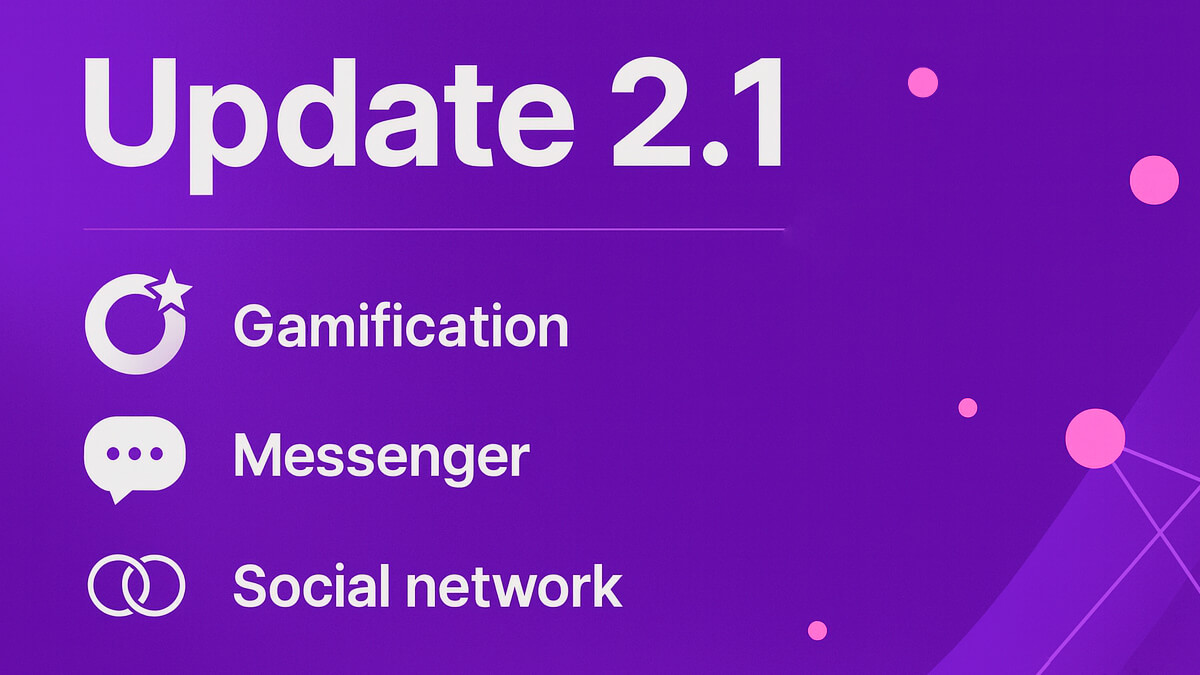
Engagement tools. Gamification (points, badges, leaderboards), built-in social network, messaging — all of these boost engagement and reduce churn.
Automation. Email sequences, reminders, automatic certificates, chatbots — these save dozens of hours every month.
Softbook — a platform with unlimited students
If you’re looking for an LMS with fixed pricing and unlimited students on every plan, take a look at Softbook. Plans start at $39/mo (Mini) and include unlimited students, video protection, and integration with global payment systems (Stripe, PayPal, Fondy, LiqPay, WayForPay).
Pro ($89/mo) and Max ($159/mo) plans add: built-in CRM, gamification with points and rewards, a social network for students, email automations, and chatbots. The platform operates in 57 countries with 24/7 support.
For comparison: competitors limit active students to 1,000-5,000 on mid-tier plans and charge extra for each additional student. With 3,000 students, the cost difference can reach $100-200 per month.
Step 5. Build Your Sales Funnel
Creating the course is 40% of the work. The remaining 60% is attracting and converting your audience into buyers. Statistics show that 90% of online schools that closed in their first year had quality content but no sales system. A sales funnel is exactly the system that turns casual visitors into paying students.
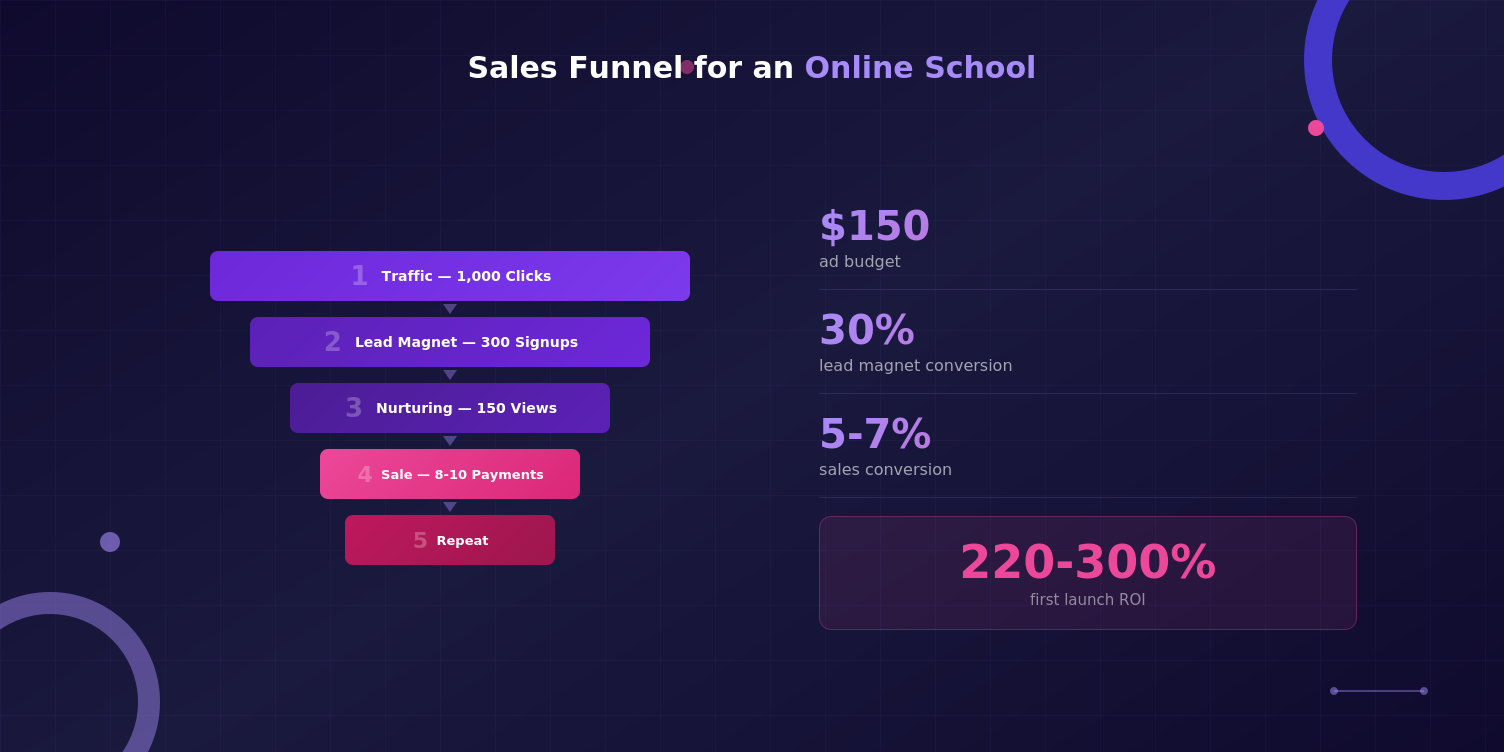
Basic funnel for an online school
Stage 1 — Traffic. Social media (Instagram, TikTok, YouTube), SEO blog, paid ads. Goal: drive people to a free offer.
Stage 2 — Lead magnet. A free webinar, mini-course, PDF guide, or checklist in exchange for an email. Good lead magnet conversion: 25-40% of landing page visitors.
Stage 3 — Nurturing. A series of 3-5 emails where you deliver value, share case studies, and gently lead toward the sale. Duration: 5-10 days.
Stage 4 — Sale. A selling webinar, deadline-driven email sequence, or direct offer. Conversion from a warmed list: 3-7%.
Stage 5 — Repeat purchase. Upsells (next-level course), cross-sells (related courses), subscriptions. Retaining an existing customer is 5-7x cheaper than acquiring a new one.
Sample funnel calculation
Let’s say you launch a course priced at $60:
1,000 ad clicks (CPC $0.15) → $150 ad spend
300 webinar registrations (30% conversion)
150 webinar views (50% show-up rate)
8-10 sales (5-7% conversion)
Revenue: $480-600 on ~$150 ad spend
First-launch ROI: 220-300%. And that’s without repeat sales and organic traffic, which will add up over time.
Step 6. Price Your Course
Pricing is one of the trickiest tasks for new online schools. Here’s a practical approach.
Three pricing models
One-time payment — the student pays once and gets lifetime access. The simplest model to start with. Range: $35-190.
Subscription — monthly payment for access to a library of courses. Creates predictable revenue (MRR). Range: $7-20/mo.
Tiered pricing — multiple packages with different access levels. Example: Basic (lessons only) — $50, Standard (+ graded assignments) — $100, Premium (+ mentoring) — $200.
How to set your price: a formula
Course price = (Value of the result for the student) x 10-20%. If your course helps a freelancer increase their income by $350/mo, a fair price is $35-70. This gives the student a 5-10x ROI, making the purchase a no-brainer.
Don’t underprice ‘just to start.’ A $7 course is perceived as unserious, has lower completion rates, and attracts unqualified students.
Step 7. Launch and Gather Feedback
Your first launch isn’t the finish line — it’s the beginning of an iterative process.
Soft launch strategy
Don’t try to sell to thousands right away. Your first cohort is your focus group:
Size: 15-30 students. Enough for meaningful feedback, but manageable.
Price: 30-40% discount from planned price, with the condition of detailed feedback after each module.
Format: cohort-based — everyone goes through the course simultaneously. This builds community and keeps you in the loop.
What to track after launch
Completion rate. Industry average: 15-20%. Good result: 40-60%. Below 15% signals a content or structure problem.
NPS (Net Promoter Score). Ask students: ‘How likely are you to recommend this course?’ (1-10). NPS above 50 is excellent.
Drop-off points. At which lesson do students stop? This signals content that needs reworking or simplifying.
Free-to-paid conversion. If you offer a free trial, track how many people upgrade to the full version.
Step 8. Scale Your School
After a successful first launch, it’s time to scale.
Horizontal scaling
Add new courses for your existing audience. If your first course was ‘SMM for Beginners,’ logical follow-ups include ‘Advanced SMM,’ ‘Paid Advertising,’ or ‘Content Strategy.’ Each new course increases customer LTV (lifetime value).
Vertical scaling
Increase both price and value. Add premium packages with mentoring, corporate licenses, and certification. A $70 course can evolve into a $350-600 program with personal support.
Automation — the key to scale
At this stage, automation becomes critical. Set up automated email sequences for new students, reminders about incomplete lessons, automatic certificate issuance, and chatbots to handle common questions.
Modern LMS platforms like Softbook include built-in automation tools: email campaigns, chatbots, and CRM. This lets you skip external services and save $50-150/mo on subscriptions.
Common Mistakes When Creating an Online School
1. Perfectionism at launch. A ‘perfect’ course you spend 6 months recording is worse than a ‘good enough’ one launched in 6 weeks. Early students buy your expertise, not Hollywood production quality.
2. No email list. Social platforms can change algorithms overnight. Your email list is your asset. Start collecting emails from day one, even if the course isn’t ready yet.
3. Topic too broad. A ‘marketing course’ sells worse than ‘Email Marketing for E-commerce Stores Doing Under $25K/Month.’ The narrower the niche, the easier it is to find your audience and sell.
4. Ignoring community. Students who interact with each other complete the course 2-3x more often. Create a chat, forum, or use the built-in social network on your platform.
5. Wrong platform choice. A platform capped at 1,000 students seems cheap at the start but becomes a trap as you grow. Choose a solution that scales with your school.
6. No analytics from day one. If you aren’t tracking conversions, traffic sources, and student behavior, you’re making decisions blindly. Set up Google Analytics, Facebook Pixel, and UTM tags before your first launch.
7. Copying competitors instead of creating unique value. Study what others do, but find your own angle. Your uniqueness lies in your experience, methodology, and personality. The market doesn’t need another copy — it needs a fresh approach to solving the problem.
FAQ: Common Questions About Creating an Online School
How much does it cost to launch an online school?
Minimum budget: $100-200 for equipment + $39-89/mo for an LMS platform + $150-300 for initial ad testing. Total: $300-600 to get started.
How long does it take to create the first course?
With a systematic approach: 4-8 weeks. One week for niche and structure, 2-4 weeks for content recording, 1-2 weeks for platform setup and funnel building.
Which platform should I choose for launch?
Look for platforms with global payment system support, transparent fixed pricing, and no student caps. Pay attention to built-in automation tools — they’ll save you both time and money.
Can I launch a school without personal expertise?
Yes, as a producer. You find the expert, handle recording logistics, marketing, and sales. Standard split: 40-50% to the expert, 50-60% to the producer. For your first project, though, we recommend starting with your own topic — it’s easier to control quality and timelines.
Checklist: Launch Readiness for Your Online School
Before your first launch, make sure you have everything in place:
☐ Niche selected and validated (15+ leads or pre-orders)
☐ Course structure finalized (5-8 modules, each with a concrete outcome)
☐ At least 70% of lessons recorded (you can finish the rest during the first cohort)
☐ Supplementary materials prepared (workbooks, checklists, quizzes)
☐ LMS platform configured (course uploaded, payments connected, automations running)
☐ Sales page or landing page ready (course description, curriculum, price, testimonials or case studies)
☐ Email funnel set up (lead magnet, nurture sequence, sales email)
☐ Ad budget allocated (minimum $100-150 for the first test)
☐ Community created (Telegram group, platform’s built-in social network, or Discord)
☐ Legal setup completed (business registered, terms of service published)
If you’ve checked 8 out of 10 — you’re ready to launch. Don’t wait for the perfect moment; it doesn’t exist. Launch, collect feedback, improve.
Conclusion: Your 30-Day Action Plan
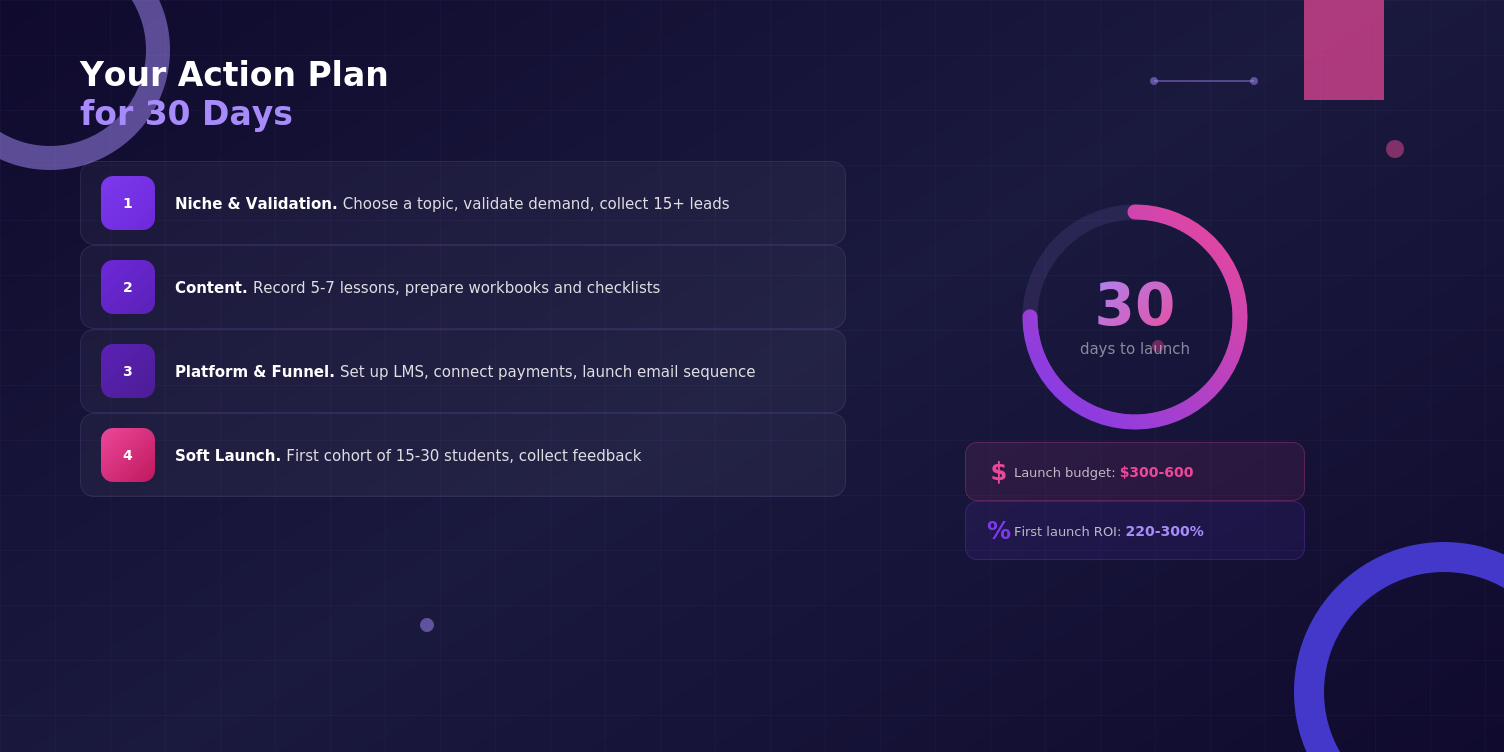
Creating an online school is not a one-time event — it’s a process. Here’s your concrete plan:
Week 1: Choose a niche and run validation. Define the format and course structure.
Weeks 2-3: Record the first 5-7 lessons. Prepare supplementary materials.
Weeks 3-4: Set up the platform, upload content, build the sales funnel.
Weeks 4-5: Run a soft launch with the first cohort. Gather feedback.
Online education is one of the few industries where you can build a profitable business with minimal investment, working from anywhere in the world. The key is to start with the right niche, choose a reliable platform, and follow the plan step by step.
The online learning market continues to grow, and competition is still significantly lower than in the most saturated markets. That means now is the best time to launch. Every week you delay is students going to your competitor.
Ready to start? Create your first course on Softbook — the free trial lets you explore all features with no risk.
Want a deeper dive into every step? Take our full course
“Online School: From Idea to Profit” at Softbook Academy
It includes video lessons, document templates, financial models, and personal feedback from experienced practitioners.
Articles are good, but social media posts are faster!
Subscribe to us and be the first to receive tips and tricks
on promoting your online school!


Earn money on your knowledge and experience with
Softbook!
to the platform for setting up your own school!

 Book a demo call now!