
Sales Funnels for an Online School

While a school is small, sales run on manual work: you message everyone who left a request, remind them to pay, grant access yourself. That works up to a dozen students. Beyond that, manual work becomes a ceiling — you physically can’t walk everyone through. A sales funnel removes that ceiling: it carries a student from the first touch to the purchase on its own, along a script you set.
What a sales funnel is
A sales funnel is a sequence of steps a prospective student moves through toward a purchase, where the transitions between steps happen automatically. A person leaves their email — they get a series of messages. They pay — they receive access and enter the next scenario. You set the logic once, and it then runs for every new contact without you.
Important: a funnel doesn’t “switch sales on from zero”. It scales what already works. First confirm your offer sells manually, and only then automate — otherwise you’ll just deliver a weak offer to more people faster.
What stages a funnel has
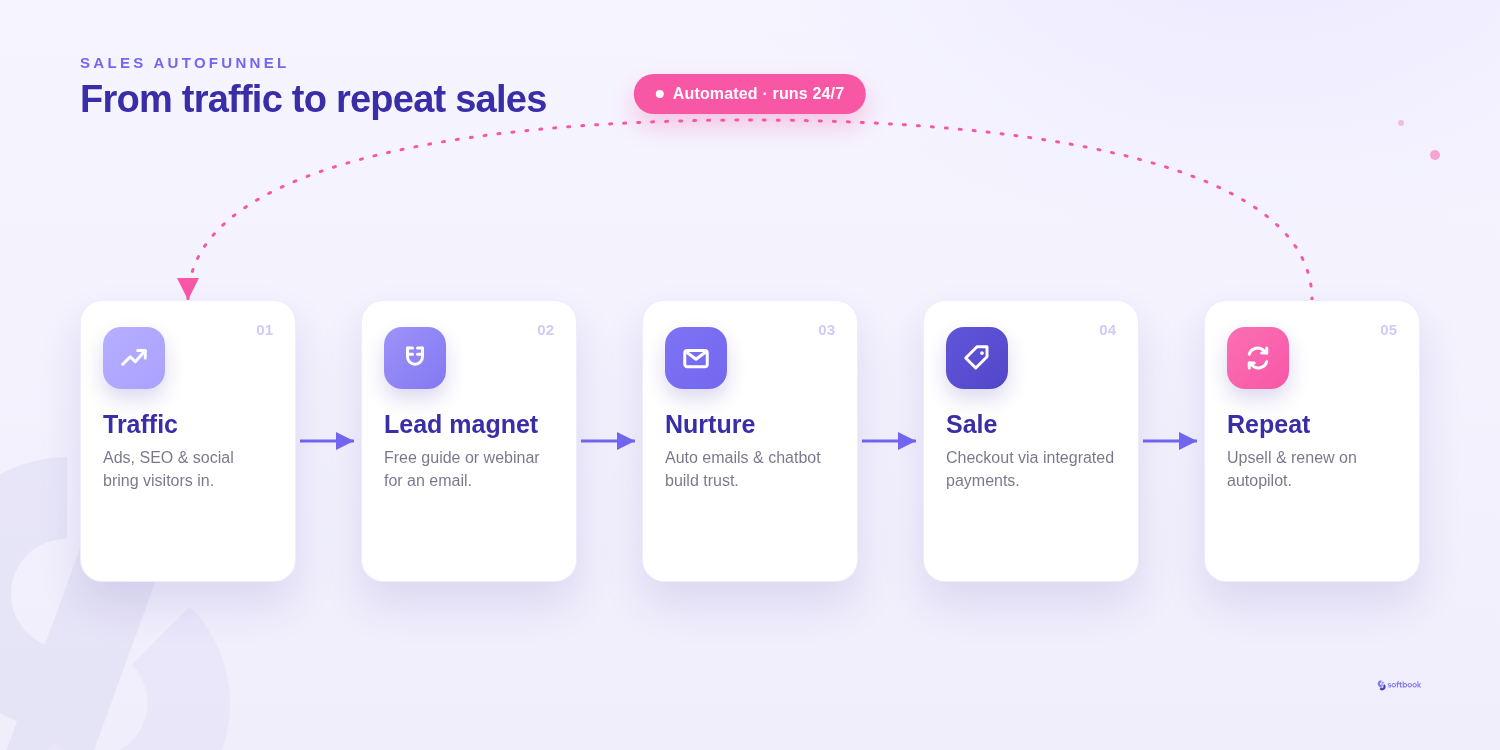
A classic funnel for an online school has several stages.
Lead magnet — free value in exchange for a contact: a checklist, a mini-lesson, a webinar. It brings warm contacts rather than random ones.
Capture — a page with a form where the person leaves an email or Telegram.
Nurture — a series of emails or messages that remove objections and show the course’s value.
Offer and payment — a concrete offer with the option to pay right away.
Access and onboarding — after payment the student automatically receives the course and a first “where to start” message.
Each stage has one job: move the person to the next step. If a stage loses them, that’s where the funnel “leaks” — and the stats show it.
Which triggers to use
Automation is built on triggers — events that launch an action. The most useful for a school: a form submission (start the nurture), payment or an order (grant access, begin onboarding), enrollment in a group, the start or completion of a lesson (for example, offering the next course to someone who just reached the end). The trigger is the “when”, the action is the “what happens in response”. If you want a deeper look at automation in general, start with the guide to automating an online school.
How it works in Softbook
The hardest part of a funnel is assembling it from several services so they don’t break at the seams: the landing page in one, email in another, payment in a third, CRM in a fourth. Contacts get lost at every seam.
In Softbook the funnel lives in one system. The visual automation builder is assembled by dragging on a canvas: trigger → action → branch by condition, with step-by-step pass-through statistics that show exactly where people drop off. The landing page with the capture form is built here too, and the product form is embedded in the page, so payment and automatic access happen on a single screen. Nurture runs through email and Telegram campaigns with interactive buttons, and all contacts and deals sit in the built-in CRM — on the same student base as the learning. No need to stitch four services together: the funnel is built where the course lives.
How to measure it
A funnel isn’t “felt”, it’s counted. Look at the conversion of each stage separately: how many left a contact, how many finished the nurture, how many paid. A weak stage shows up as a sharp drop between steps — and that’s what to fix first, rather than rebuilding the whole funnel. Step-by-step pass-through statistics point straight to these spots. Often the weak spot is the emails themselves: why a campaign may fail to sell is covered in 5 reasons your email doesn’t sell.
How many emails the chain needs is a question of sufficiency, not quantity: as many as it takes to remove the main objections and reach the offer. Usually that’s a few messages, not dozens.
A funnel isn’t a magic “sales” button — it’s a way to scale what already works by hand. Build clear stages, attach simple actions to the right triggers, and watch the conversion of each step. The biggest win comes when the whole funnel sits in one place: then it doesn’t break at the seams, and you can see where to tune it.
Ready to build your first funnel? Try Softbook free — 30 days of full access, cancel anytime.
Frequently asked questions
What is a sales funnel?
A sequence of steps a student moves through toward a purchase, where the transitions happen automatically along a set script: form → nurture → offer → payment → access.
What stages does a funnel have?
Lead magnet, capture, nurture, offer with payment, access and onboarding. Each stage moves the person to the next step.
Which triggers should I use?
A form submission, payment or an order, enrollment in a group, the start or end of a lesson. A trigger launches an action: grant access, send an email, offer the next course.
How do I measure a funnel?
Look at the conversion of each stage separately and find the sharp drop between steps - that's the weak spot. In Softbook, step-by-step pass-through statistics show it.
How many emails should the chain have?
As many as it takes to remove the main objections and reach the offer. Usually a few messages, not dozens.