
How to Make Money with Online Courses

Online courses are often sold as “passive income while you sleep”. The honest answer is humbler: a course is a product, and it earns by the same rules as any other. The good news — you already have the knowledge, and the infrastructure is cheap. Let’s break down which monetization models work, what really affects income, and where to start to make your first sale.
If you are only planning to move from an idea to sales, start with the complete guide on how to sell online courses.
Models for monetizing knowledge
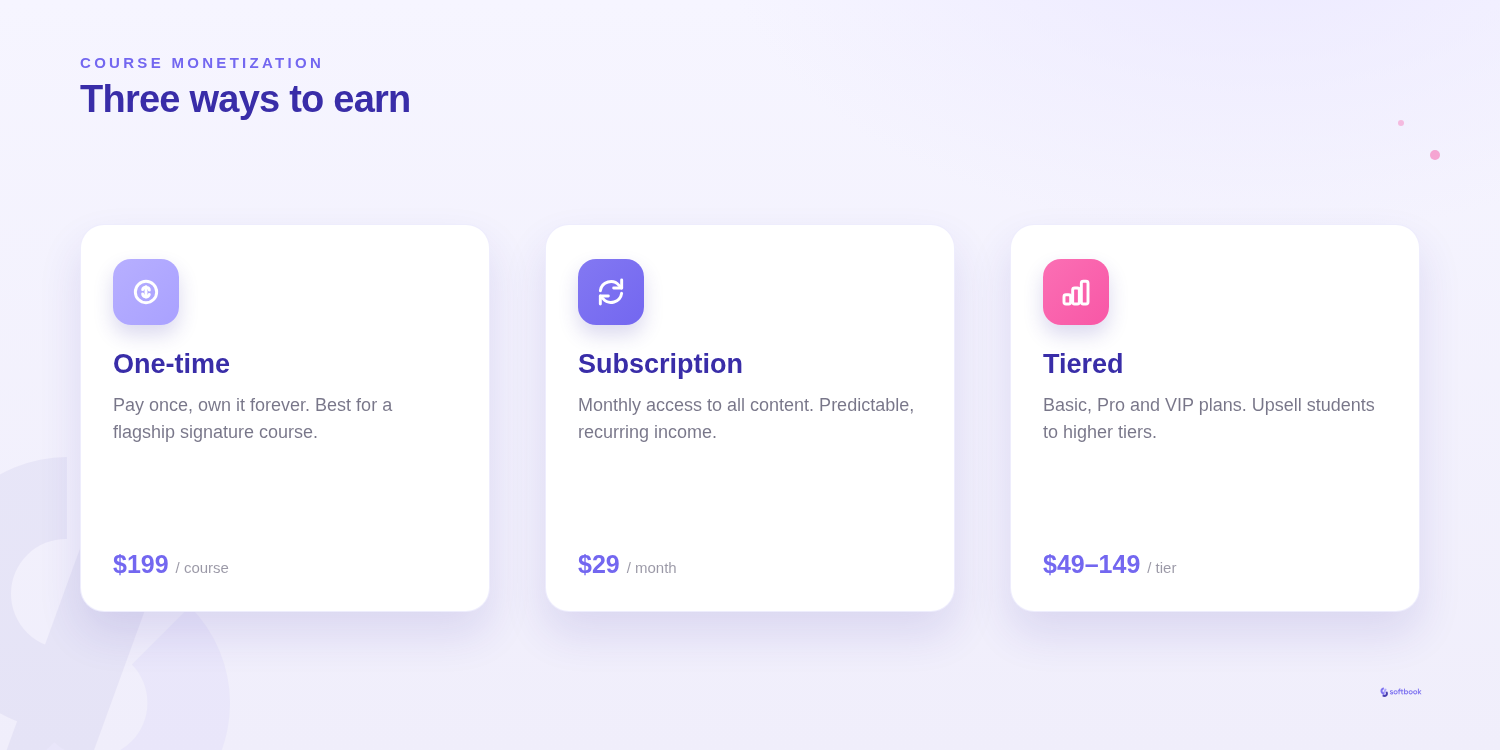
A course isn’t the only way to monetize expertise. More often a combination works.
A one-time course. The classic: the student pays once and gets access to the program. It suits a topic with a clear, finished result — “build a portfolio”, “master a tool”.
Subscription or membership. The student pays monthly for access to a library of materials, new lessons or a community. It works where the topic lives and updates, and the value is in regularity.
Coaching and consulting. Your time as a product: reviews, mentoring, one-on-one sessions. Priced higher than a course, but it doesn’t scale without limit — time is finite.
Community and support. Access to a closed space with you, other members and feedback. Often sold as a premium format on top of a course.
Strong schools almost always combine models: a one-time course at the entrance, a subscription or community for those who want more, consulting for the premium segment.
What actually affects income
Income from a course isn’t one number but the product of several. How many people see you, how many of them buy, at what price, and how many buy again. You can lift each factor: a warmer audience, a clearer offer, a justified price, repeat sales to those who already bought. That’s why promises of “earn X in a month” are worthless: two authors with the same course will get different results depending on these components. Aim at your own factors, not someone else’s numbers. If you have doubts about pricing, see how to price your course without undervaluing it.
How to make your first sale
The most common mistake is spending six months recording the “perfect” big course and only then checking whether anyone will buy it. Safer the other way around: make a small product with one clear result, open sales to a warm audience (even a small one) and watch the response. The first sale matters more than perfection: it confirms the topic is needed and gives you something to build on.
A large audience up front isn’t required. First sales often come from a few dozen people who trust you. You can grow the audience in parallel — once you’ve confirmed the product sells.
How it works in Softbook
Earning depends not only on content but on how easy it is for the student to pay. If the course is in one service, payment in another and access granted by hand, you lose part of your buyers at every seam.
In Softbook, you can build a course page and add a product form. The checkout flow, including any redirect to a payment service, depends on your provider and settings. Softbook supports 8 payment integrations: Monobank, LiqPay, WayForPay, Portmone, Hutko, Stripe, PayPal and Przelewy24. Countries, currencies, fees and onboarding requirements depend on your provider. Before launch, check payment processing, the product-to-course connection and access rules. After a course, you can offer students their next product; contacts and deals remain in the school’s CRM. Current payment integrations. How to set up payment and course access.
Making money with online courses is real — not through “passive income while you sleep”, but because you build a product and a sales system. Combine monetization models, work on your own income factors instead of someone’s promises, and reach your first sale with a small product rather than a perfect big one. You already have the knowledge — what’s left is making it easy to pay for.
Want to test your idea in practice? Try Softbook free — 30 days of full access, cancel anytime.
Frequently asked questions
How much can you make with online courses?
There's no fixed number: income depends on audience size, conversion, price and repeat sales. Two authors with the same course will get different results. Work on those components, not on someone's promises.
What knowledge monetization models exist?
A one-time course, subscription/membership, coaching and consulting, a closed community. Strong schools usually combine several.
What sells better - a course or a subscription?
It depends on the topic. A finished result fits a one-time course; a topic that lives and updates fits a subscription. They often work together.
How do I make my first sale?
Make a small product with one clear result and open sales to a warm audience. The first sale matters more than a perfect big course.
Do I need an audience in advance?
A large one, no. First sales often come from a few dozen people who trust you. You grow the audience in parallel.