
How to Sell Online Courses: Complete Knowledge Monetization Guide

Selling requires both a useful course and a path from first contact to purchase. Plan your offer, audience acquisition and checkout as carefully as you plan the lessons. A funnel helps you see where people stop.
This guide covers knowledge monetization for course creators, coaches, trainers and online schools, from audience research to repeat sales. It offers practical steps, measurement methods and illustrative calculations to help test your own offer.
If you haven’t chosen a platform for selling courses yet, we recommend reading our guide “How to Create an Online School from Scratch” first. If you already have a platform — let’s move to sales.
Step 1. Define Your Target Audience and Their Pain
Before thinking about online course marketing, you need to answer three questions: who are you selling to, what problem are you solving, and why is your course the best option for this person.
Ideal Student Profile
A common mistake is describing the audience too broadly: “women 25–45 who want to grow.” That’s not a profile — it’s demographics. An ideal student profile includes a specific pain, a specific situation, and a specific desired outcome.
Bad profile example: “Entrepreneurs who want to increase sales.”
Good profile example: “An e-commerce store owner with $2K–$8K/month revenue who spends on ads but can’t figure out why landing page conversion is below 2%. Wants to systematically increase sales without raising the ad budget.”
How to Find Your Audience’s Pain
Run 10–15 deep interviews with potential students. Ask: what have you tried? What didn’t work? How much are you willing to invest in a solution? Study comments in niche groups, forums, and under competitor videos. Check what questions people ask on Google (via AnswerThePublic or AlsoAsked). Use the findings to shape your offer, then measure conversion with your own audience.
How It Works in Softbook
Test audience needs before producing the course. In Softbook, you can prepare a landing page, form and email series in one account. Contacts and responses indicate interest. Test willingness to pay separately with a specific offer and purchase terms.
Step 2. Build Your Course Sales Funnel
A sales funnel is the path a potential student takes from first contact to purchase (and repeat purchases). Without a funnel, you rely on luck. With a funnel — on a system.
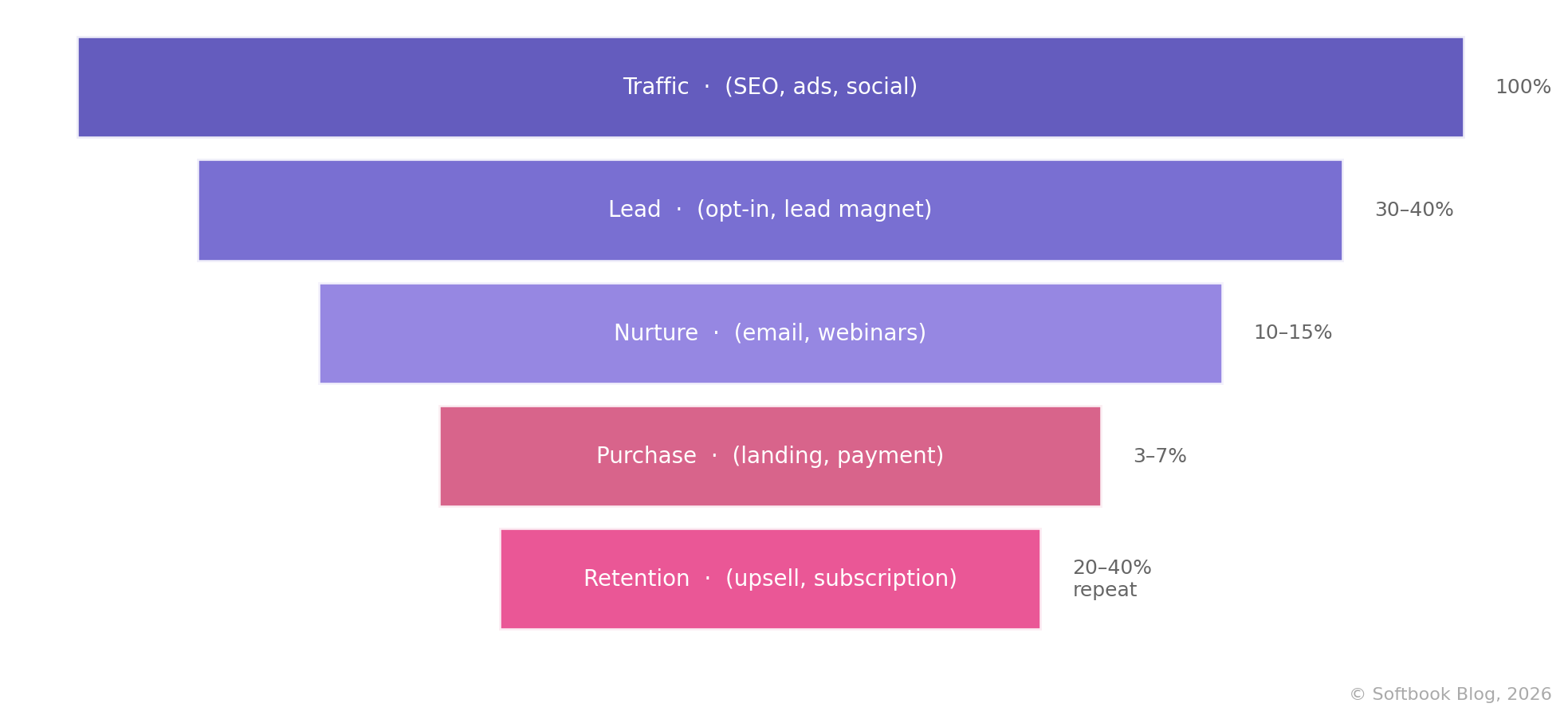
5 Funnel Stages
Stage 1 — Traffic. People discover you through SEO blogs, social media (Instagram, TikTok, YouTube), targeted ads, or affiliate programs. Your goal: attract attention and deliver free value.
Stage 2 — Lead. A visitor shares a contact in exchange for a webinar, mini-course, guide or checklist. Lead conversion is the number of visitors who submit a contact divided by page visitors over the same period. Compare like-for-like traffic sources and assess lead quality separately.
Stage 3 — Nurture. A series of 3–7 emails where you deliver value, showcase case studies, student testimonials, and gently lead toward the sale. Nurture duration: 5–14 days.
Stage 4 — Purchase. Offer the course on a page, in a webinar or through an email series. Purchase conversion is buyers divided by people in a defined group over the same period. Measure visitors, subscribers and webinar attendees separately because they enter at different points.
Stage 5 — Retention and repeat sales. Help students complete their current task, then offer a relevant next course, consultation or library subscription. Measure the share of repeat buyers and the cost of those sales separately from acquiring a new audience.
Funnel Calculation Example
Illustrative calculation, not a forecast. A page receives 1,000 visitors; 300 submit a contact, 150 attend a webinar and 10 buy a $100 course. Lead conversion is 30%, attendance among registrants is 50%, and purchases among attendees are 6.7%. Revenue is $1,000. To assess the launch result, deduct refunds and all costs: advertising, production, team, platform and fees.
How It Works in Softbook
The funnel above is assembled from several tools — and in most schools they’re scattered across different services, where data gets lost at the seams. In Softbook the whole funnel runs from one panel:
- The lead magnet lives on a landing page you build in the built-in editor: a block library, a preview across 5 screen sizes, and one-click page duplication to A/B-test two headline versions.
- The capture form writes the contact straight into the built-in CRM — no exports, no manual transfers.
- You write the nurture sequence in a block-based email editor: templates in 8 languages (uk, ru, en, es, fr, de, pl, pt) without machine translation, with AI assistance at the layout level.
- A visual automation builder moves people between stages: a trigger (form submitted / checkout abandoned) fires the right email or changes the segment.
- Softbook supports 8 payment integrations: Monobank, LiqPay, WayForPay, Portmone, Hutko, Stripe, PayPal and Przelewy24. Countries, currencies, fees and onboarding requirements depend on your provider. Before selling, check payment processing and configured course access rules.
Softbook covers the funnel mechanics — capturing contacts, nurturing, and granting access. The strategy (offer, price, message) is yours.
Step 3. Create a Landing Page That Converts
A landing page explains who the course is for, what students will learn and what the purchase includes. Track your own conversion: buyers divided by page visitors over a defined period. Compare like-for-like traffic sources, devices and offers; a universal percentage without that context is not a useful benchmark.
Selling Landing Page Structure
- Hero section. Name a concrete learning task, such as “Build a promotion plan for your course.” Add a curriculum summary, a next-step button and verified evidence. Do not use a sales-growth guarantee as a headline without supporting evidence.
- Pain block: describe the customer’s situation — make it relatable.
- Curriculum: modules with specific outcomes for each.
- Social proof: student testimonials (video, text or screenshots), graduate count, company logos (for B2B), results in numbers.
- About the instructor: your expertise — not a biography, but why YOU are qualified to teach this.
- Pricing & packages: anchoring effect — the middle tier looks attractive next to the premium one.
- FAQ & CTA: address final objections and repeat the call to action.
Conversion Landing Page Checklist
CTA button visible without scrolling. Headline states a result, not the course name. At least 3 student testimonials. Price is justified (comparison with alternatives). There’s a deadline or limit (early access, seat cap, bonus by date). Page loads in < 3 seconds. There’s a mobile version.
Collecting Social Proof from Scratch
Ask students for honest feedback and permission to publish it. Text and video are both options; choose a format that suits the person. If the reviewer received free or discounted access, disclose that alongside the review. Show real results with their context and do not promise that other students will achieve the same outcome.
A/B Testing Your Landing Page
Test one change at a time, such as the headline. Define the primary metric, traffic allocation and stopping rule before launch. The required sample depends on baseline conversion and the change you want to detect; 100 visitors is not a universally sufficient sample. With little traffic, start by checking page clarity with people from your target audience.
How It Works in Softbook
You build the course landing page in the built-in editor — no developer, no coding: you assemble the page from ready blocks and preview it across 5 screen sizes, then check readability and page behavior on mobile devices. To test two versions of a headline or package structure, you duplicate the page in one click and compare conversion. One detail that matters for sales: the payment page itself is edited like a landing page — the offer, description, and price are visible right on the checkout screen.
Step 4. Set a Price That Sells
Price should reflect the course content, level of support and audience. Test it with a specific offer while accounting for delivery and team costs. Price alone does not establish student motivation or the likelihood of completion.
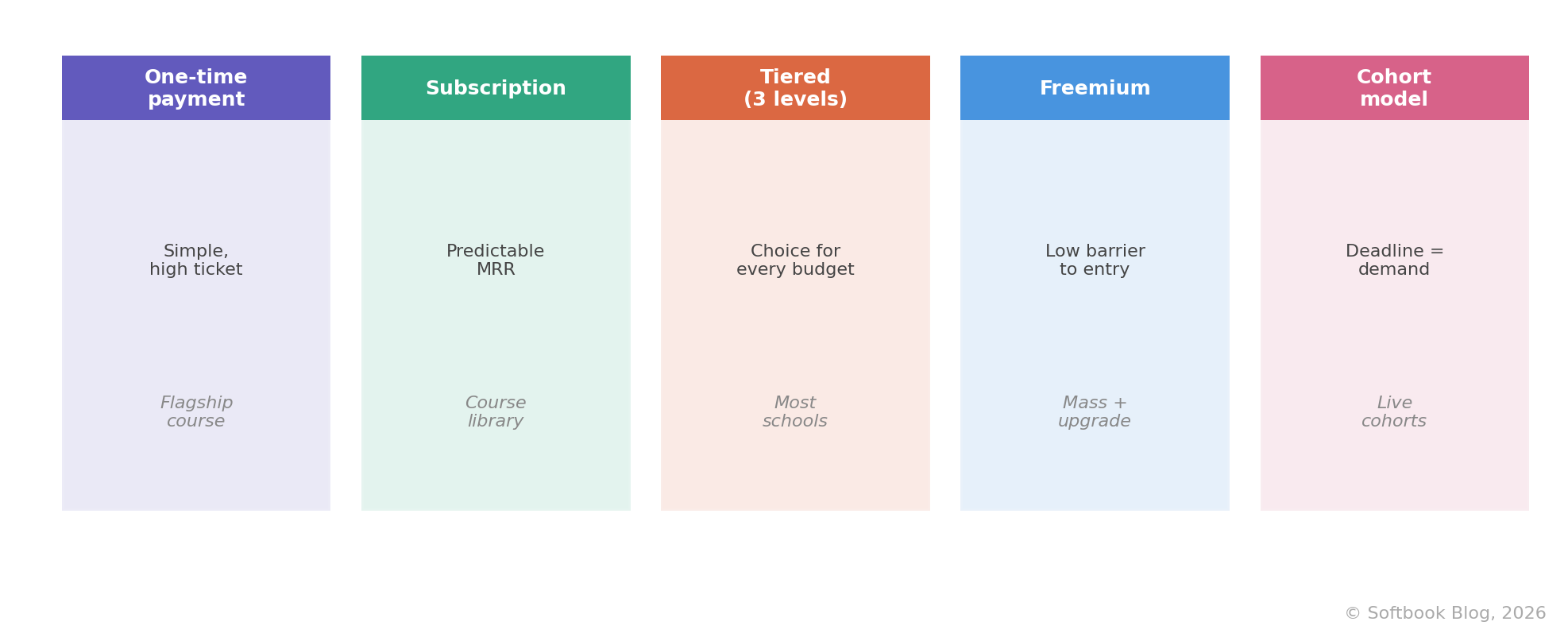
5 Knowledge Monetization Models
One-time payment — the student pays for the course in one payment. State the access period, materials and support included. Set the price according to costs and testing of the specific offer.
Subscription — a recurring payment for access to a course library or updated content. Track monthly recurring revenue (MRR), renewals and cancellations. Explain pricing and access terms before payment.
Tiered model — packages with different amounts of content and support, such as video lessons, lessons with feedback or learning with a mentor. Test which options your audience needs and whether prices cover delivery costs.
Freemium — free mini-course, paid full access. Low entry barrier, but requires quality free content that hooks.
Cohort model — enrollment in groups with defined start dates. Use it when learning requires a shared schedule and mentor support. Base dates and available places on the actual teaching plan and team capacity.
Starter Price Formula
Estimating a course’s value helps shape the offer, but it does not automatically set a maximum or starting price. Discuss the problem, alternatives and budget with potential students. Compare willingness to buy with production, support and sales costs, then test the price with a small offer.
How It Works in Softbook
Each of these models can be set up in Softbook through the product’s payment page — one-time, subscription (with recurring payments), or tiered with several packages. To test price elasticity without changing the price on the landing page itself, you use promo codes: with an expiry period, reusable, and even a promo code stacked on top of an existing discount. That’s how you test how your audience reacts to an offer and separately track how discounts affect customer expectations.
Step 5. Drive Traffic: Channels That Work
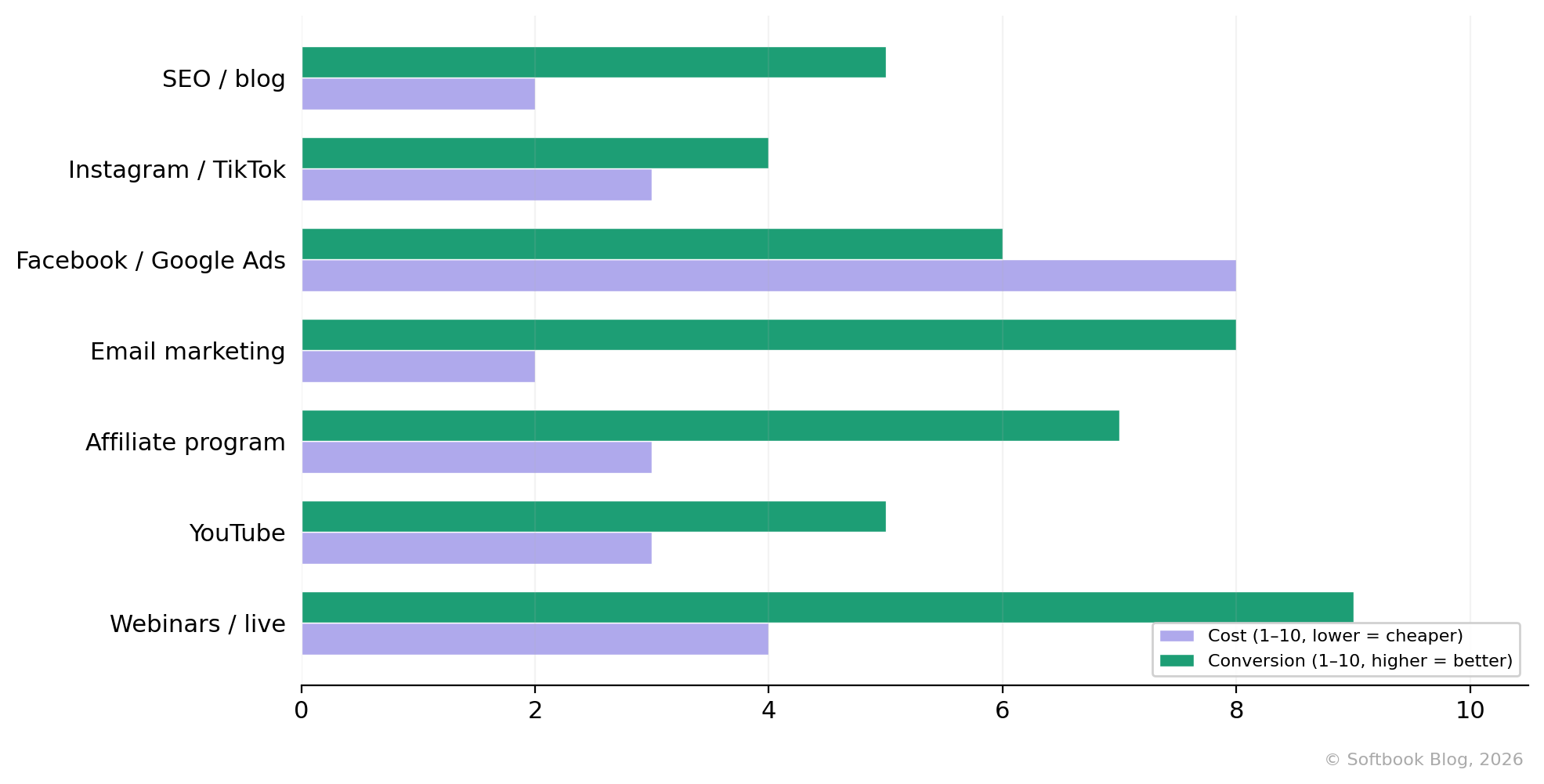
No traffic = no leads = no sales. But student acquisition channels differ in cost, conversion, and speed of results. Below is a comparison of the main channels for online course marketing.
Organic Channels (Long-term)
SEO blog. Write articles that answer audience questions. Track indexing, search impressions, visits and leads. Results and timing depend on the topic, competition, content quality and website condition. Keep the material updated.
YouTube. Free educational videos → course link in the description. A longer play than Instagram, but higher trust and a deeper audience connection.
Instagram / TikTok. Short videos and posts can introduce the course topic. Test formats, reach and visits for your offer. Compare purchases and costs across channels using consistent measurement rules.
Paid Channels (Fast Results)
Facebook / Google Ads. Before an advertising test, define the audience, offer, budget and event to measure. Test direct sales and the lead-magnet path using your own data. Compare cost per buyer and purchase quality, rather than lead cost alone.
Affiliate program. Agree which verified action earns a reward, how refunds are handled and when payouts occur. Set the reward using your offer’s economics rather than a universal percentage.
Email Marketing in the Sales Process
Email helps you continue a conversation with people who agreed to receive your messages. Explain the next step, answer questions and offer a relevant course. If people open but do not buy, check audience fit, the offer, links and checkout. Diagnose the cause with data rather than a universal channel ranking. “5 Reasons Your Email Campaigns Don’t Sell”.
Email Sequence Structure for Course Sales
Email 1 (day 0): Welcome — thank them, deliver the lead magnet, say who you are briefly. Email 2 (day 2): Value — a practical tip they can apply right away. Email 3 (day 4): Case study — a student result or your own experience with concrete numbers. Email 4 (day 6): Problem — what happens when you DON’T solve it. Email 5 (day 8): Solution — introduce the course as the way to solve it. Email 6 (day 10): Offer with deadline — a concrete, time-limited proposal with a discount or bonus. Email 7 (day 11): Last call — a reminder that the deadline is tomorrow.
Evaluate delivery, clicks and purchases within your segments. Define each denominator, such as unique clicks divided by delivered emails. Compare the same message types and periods; opens alone do not establish interest or purchase intent.
How It Works in Softbook
Traffic from different channels rolls up into one analytics panel: UTM tags show where a student came from, and the landing-to-payment conversion sits right next to it — no stitching reports together from several services. You nurture the list you built from lead magnets and webinars in the built-in email editor, and keep segmentation on CRM tags: different segments get different emails.
Step 6. Automate Your Sales
Automation can handle recurring funnel tasks, such as emails and reminders. Your team still needs to check settings, results and exceptions. For a detailed breakdown of which processes to automate first, see our guide “Online School Automation”.
What to Automate First
Email sequences: a welcome series for new subscribers (5–7 emails), a pre-launch nurture series, a follow-up series for non-buyers. Chatbots: automated replies to common questions, lead capture through quizzes and mini-surveys. Webinars: record an “evergreen” webinar that works as an automatic selling tool.
One platform reduces the number of separate tools you need to connect. Check that the subscription includes the features you need, and account separately for storage, extra email volume, payment fees and team work. Compare the full budget for your workflow.
How It Works in Softbook
Automation in Softbook is built in a visual editor on a clear logic: trigger → action → conditional branch. A trigger can be a submitted form, a CRM event (a new deal or contact), an order or payment, course enrollment, joining a group, or the start or end of a lesson. In response, the system sends an email, changes a tag, moves a student to another group, or launches the next step of the scenario. Step-by-step progress is visible in the statistics — you see exactly where someone stopped and improve that step.
Step 7. Retain Students and Sell Again
Working with alumni is a distinct part of sales. Check whether they need further learning, what they buy again and what it costs to support that process. Use your school’s data to compare costs for new and repeat buyers.
How to Boost Course Completion Rates
Choose learning support according to the course tasks. Points, badges or rankings can be part of a learning activity but do not guarantee completion. A community provides space for discussion. Assignment reviews, answers and live sessions provide support. Evaluate participation and outcomes with your audience.
Repeat Sales Strategies
Upsell: offer the next level (advanced course, mentorship) to students who completed the basic course.
Cross-sell: recommend complementary courses. If a student finished “SMM for Beginners” — offer “Targeted Advertising” or “Content Strategy.”
Subscription: offer a course library with recurring payments if your audience needs ongoing access. Track MRR, renewals, cancellations and the costs of producing and supporting content.
Referral program: offer a discount or bonus for each referred friend. Your students are your best ambassadors.
How It Works in Softbook
Retention also runs on the same tools you already have. You set up gamification through reward and scoring scenarios — not just badges, but a managed motivation system; you can also award points manually when needed. Communication happens in the school’s built-in social network: student profiles, a feed, posts. And repeat sales run on that same CRM and automation module: the “completed the course” segment gets a next-level offer with a promo code, and a post-course offer fires right after the final lesson.
Retention Metrics to Track
Measure completion as the share of students who meet defined criteria among those who have had enough time to learn. Collect recommendation feedback and reasons for ratings. LTV represents customer value under a defined method; allowable acquisition cost also requires margin, refund and payback data. For subscriptions, separately measure the share of the starting customer cohort that cancels during the period. Compare these metrics with your history and goals.
7 Mistakes That Kill Online Course Sales
- Selling the course, not the result. People don’t need “a 10-week course with 48 lessons.” They need a result: more income, a new skill, a solved problem. Sell the transformation.
- Leaving the purchase path untested. One audience may only need a clear offer; another may need answers and time to decide. Test direct sales and the lead-magnet path separately, comparing purchases and costs under the same rules.
- Leaving price and scope untested. Price alone does not establish course quality. Check that the value and purchase contents are clear and that the price covers delivery and support costs. Compare scenarios after costs, rather than by sales count alone.
- A single acquisition channel. Dependence on one traffic source increases exposure to changes in reach. Test additional channels and collect contacts with audience consent, allowing for resources and costs.
- No deadline. Choose ongoing sales or enrollment with a start date according to the learning format. Use deadlines, discounts or seat limits only when they reflect the offer’s real terms.
- Ignoring existing students. Check whether alumni need another course or additional support. Measure repeat purchases, costs and revenue separately; they are not necessarily cheaper than acquiring new customers.
- Manual work instead of automation. If you send every email and every reminder by hand — you sell only while you’re awake. Automation lets the funnel work 24/7.
FAQ: Common Questions About Selling Courses
How much can you earn from online courses?
Revenue depends on buyer numbers, price and repeat sales. Profit also depends on refunds and all operating costs. Test your own offer on a small scale; a universal creator income figure is not a reliable forecast.
What’s the best platform for selling courses?
It depends on your audience and needs. Look for: local payment systems (critical for UA/RU markets), a built-in CRM and email automation (so you don’t assemble a stack of separate services), native-language support, flat pricing with no sales commissions. Key: test 2–3 platforms on free trials before committing.
How to sell without a big advertising budget?
Start with channels where you can demonstrate expertise: articles, videos and conversations with your audience. Collect contacts with consent and test interest in a specific offer. There is no universal subscriber count for a first sale; even without advertising spend, time and work are required.
Should I sell before or after creating the course?
A pre-sale helps test demand before full course production. Clearly state what is ready, what the buyer will receive later and when, and the payment and refund terms. Check that you can deliver those commitments. If people do not buy, revise the offer before spending more.
How many leads do I need for the first launch?
There is no universal minimum lead count. Define the price, costs and purchases needed to test the offer. Your first test provides an initial conversion estimate; a lead target based on it is a scenario, not a sales guarantee.
How to run a selling webinar?
Start with a useful explanation or practical task, then present the curriculum and purchase terms, leaving time for questions. Test the length with your audience. Measure attendance among registrants and purchases among attendees separately. Reuse the recording while its content and terms remain current.
Should I offer a money-back guarantee?
Refund terms should be clear before purchase and comply with the rules applicable to your sale. Describe the process, timing and terms the school can actually honor. Do not promise a risk-free purchase or guaranteed conversion growth.
Summary: 30-Day Action Plan
Week 1: define your target audience, run 5–10 interviews, formulate your offer (a result, not a curriculum).
Week 2: create a lead magnet and a landing page. Start building your email list.
Week 3: set up a nurture email sequence (3–5 emails). Launch initial traffic: organic or paid ($10/day).
Week 4: run your first selling webinar or launch a sales series. Collect testimonials and optimize the funnel.
After launch, collect data on leads, purchases, costs and student feedback. Identify what to change and test it in the next launch. Experience helps you ask better questions, but each launch still needs its own evaluation.
You know more than you think. It’s time to share. Share what you know.
Ready to start? Try Softbook free for 30 days.
Frequently asked questions
How much can you earn from online courses?
Revenue depends on buyer numbers, price and repeat sales. Profit also depends on refunds and all operating costs. Test your own offer on a small scale; a universal creator income figure is not a reliable forecast.
What's the best platform for selling courses?
It depends on your audience and needs. Look for: local payment systems (critical for UA/RU markets), a built-in CRM and email automation (so you don't assemble a stack of separate services), native-language support, flat pricing with no sales commissions. Key: test 2–3 platforms on free trials before committing.
How to sell without a big advertising budget?
Start with channels where you can demonstrate expertise: articles, videos and conversations with your audience. Collect contacts with consent and test interest in a specific offer. There is no universal subscriber count for a first sale; even without advertising spend, time and work are required.
Should I sell before or after creating the course?
A pre-sale helps test demand before full course production. Clearly state what is ready, what the buyer will receive later and when, and the payment and refund terms. Check that you can deliver those commitments. If people do not buy, revise the offer before spending more.
How many leads do I need for the first launch?
There is no universal minimum lead count. Define the price, costs and purchases needed to test the offer. Your first test provides an initial conversion estimate; a lead target based on it is a scenario, not a sales guarantee.
How to run a selling webinar?
Start with a useful explanation or practical task, then present the curriculum and purchase terms, leaving time for questions. Test the length with your audience. Measure attendance among registrants and purchases among attendees separately. Reuse the recording while its content and terms remain current.
Should I offer a money-back guarantee?
Refund terms should be clear before purchase and comply with the rules applicable to your sale. Describe the process, timing and terms the school can actually honor. Do not promise a risk-free purchase or guaranteed conversion growth.