
How to Tame Negativity: 5 Tips to Turn Feedback into a Growth Tool

Negative feedback can hurt, especially after you’ve carefully prepared lessons, materials and assignments. A disappointed or angry comment can make you doubt your work. But even harsh criticism can offer useful insight if you know how to handle it.
Feedback signals what could be improved, clarified or made more engaging. Your response also shows other learners that you’re open to dialogue and willing to solve problems. Even an unpleasant comment can help you strengthen your school’s reputation and build trust.
Today, we’ll go through 5 practical tips to help you deal with criticism, maintain inner calm, and make sure negative feedback works for you — not against you.
Take a Deep Breath — and Don’t Delete It
Your first impulse when seeing a harsh or unfair review might be to hit “Delete” and pretend it never existed. But it’s worth pausing. A deep breath can help you avoid reacting emotionally, and a calm mind lets you see the bigger picture.
Prospective students read reviews carefully before buying a course. And if they see only glowing praise with no trace of criticism, it can raise suspicions. In today’s information-driven world, a “perfect” reputation can seem artificial. On the other hand, a few well-reasoned — even unpleasant — comments show that you’re working with real people, not just curating a polished image.
Leaving a negative comment visible gives you a chance to show openness and professionalism. A potential customer can see both the critique and your calm, polite offer to solve the problem. That can build more trust than deleting the comment without explanation.
Before responding, reread the comment, pause, drink some water or take a short walk. This small ritual helps separate emotions from facts. Then consider whether the feedback points to something you can improve.

Respond Calmly and Openly
Respond calmly and honestly. Avoid arguing or defending your reputation with excuses.
First, check the feedback: is this a one-off or recurring issue? What facts does the comment contain? Then apply the 3P rule — Public → Private → Proof:
Public — reply briefly under the comment. Thank them for raising the issue and give a follow-up time.
Private — discuss technical or organizational details with the author in a private channel.
Proof — confirm publicly that you resolved the issue. Explain what changed.
Consider an illustrative scenario with an imagined school, “LinguaStep”. It runs a conversational English intensive. After week two, a student posts:
“The schedule keeps changing, yesterday’s speaking club was canceled just an hour before it started, and the chat replies came half a day later. I expected more stability for the price.”
The administrator confirmed schedule changes in two groups and delayed notifications, then replied calmly:
“Thank you for pointing this out. We apologize for the last-minute cancellation — that was our oversight. We’re already updating the schedule and notification policy. Please DM us so we can find a convenient time slot for you. We’ll follow up with an update by 6:00 PM tomorrow.”
Privately, the school offered alternative slots, a recording of the previous club session and a short one-on-one teacher session. The next day, it posted an updated schedule and a cancellation policy (“no later than 24 hours in advance”). It also announced an extra open weekend speaking club for everyone affected.
A possible outcome: The student may update her comment after the issue is resolved. The public follow-up lets other learners see what the school changed.
Why did it work? The team took responsibility, set an update deadline and changed the schedule, policy and notifications. Relevant compensation supported speaking practice. A public follow-up showed other students the solution.
Think of Criticism as a Free Audit
Even unpleasant comments can reveal what needs attention. Treat them as a free audit: listen carefully and look for useful details.
Instead of focusing only on the emotional side of the feedback, try to “decode” it. What exactly didn’t work? How often does it happen? Where did the student face difficulties — in the content, assignments, communication? And most importantly — what solution are they hoping to see?
It’s helpful to log these signals in a simple table: date, group, module, type of issue, severity. If you do this consistently, within a few weeks you’ll start seeing a clear picture of what needs urgent attention.
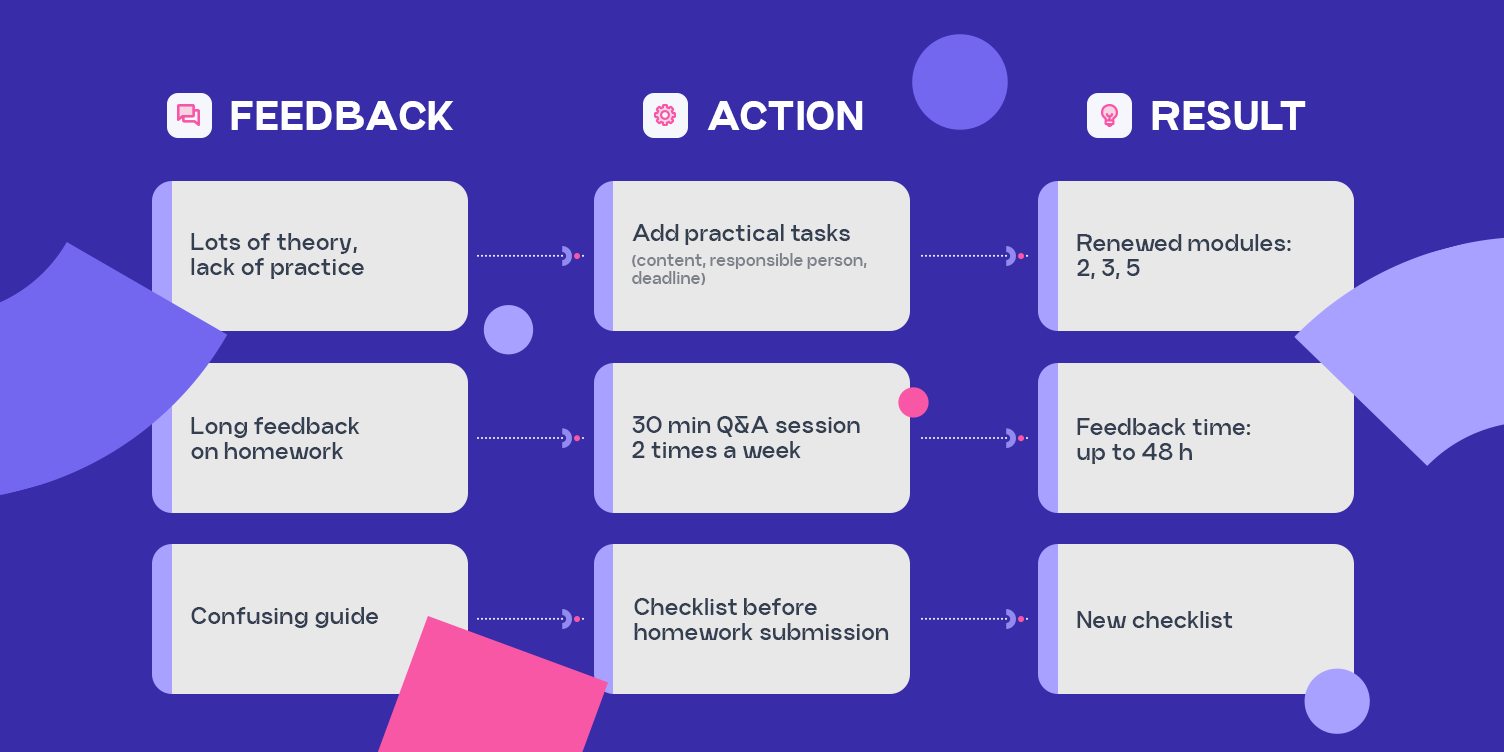
Here is another illustrative scenario. An illustration school receives comments such as “Too much theory, not enough practice” and “Feedback on homework is delayed.” The team groups the comments to see whether feedback and grading clarity need attention.
They decided to start with quick fixes:
- added a practical task and “before/after” examples to each module;
- introduced a weekly 30-minute Q&A session instead of long email threads;
- created a mini checklist for homework (common mistakes, file requirements).
After making changes, track feedback turnaround time and repeat questions in the chat. Compare them with your earlier records to see whether the changes helped. Use criticism to choose what to improve, then check the result.
Show That You’re Evolving
The best thing you can do after fixing an issue or improving your program is to share it. Not just so the person who gave the feedback sees the result, but so all your students know their voices matter.
This can be simple — like a short community post or email: “Thanks for your feedback on Module 3. We’ve updated the exercises, added examples, and revised the homework instructions. The new version is now available in your dashboard.”
Mark updates within the course: label items as “new,” date the change or list updates at the start of the lesson. This shows learners that the program continues to evolve.
How a school responds to criticism and keeps its word also shapes the brand. We cover that in the piece on a recognizable course brand.
And don’t forget to “close the loop” with the person who left the comment. A quick “Your suggestion helped us improve the course” can turn a former critic into a loyal advocate. After all, real change is the strongest proof that you’re listening — and taking action.
Collect More Positive Feedback
A negative comment always stands out more when it’s alone. But when surrounded by dozens of warm, sincere reviews, its impact fades. That’s why instead of waiting for “kind words” to show up randomly, you should make gathering positive feedback a regular part of your process.
Ask after a positive experience, while the student is still engaged. This might mean finishing a course, presenting a project or receiving a certificate. A small win, such as completing a difficult task, also creates an opportunity. “We’d love to hear your thoughts” can invite the student to share that experience.

A personal touch also works wonders: when a curator or teacher reaches out directly, the chances of receiving a thoughtful and heartfelt response increase dramatically. To make it easier, offer a simple form or a few guiding questions — this helps structure the feedback and makes it easier for you to use later.
You can even add a bit of motivation: access to a bonus lesson, entry into a discount raffle, or simply a public thank-you in the community. Just make sure it feels like genuine appreciation, not like you’re “buying” a review.
And don’t forget to share this feedback with your audience. When potential students see a whole “bank” of success stories, they view your school as a place that truly values and supports its learners. In that context, even the harshest comment fades into the background of a vibrant, supportive community of happy students.
Reviews and reputation are part of a school’s sales system. How to build that system end to end is covered in our guide to selling online courses.
Where to react fast — and never lose a single signal
The advice above only works when the reaction is fast and visible. When reviews, replies and student contacts live in different places, the loop — heard it, fixed it, announced it — breaks exactly where it’s hardest to put back together.
In Softbook, communication with students sits in one place. The messenger works like the apps people already use — reply to a specific message, react, pin — so you can respond to a sharp comment quickly and to the point, without sending the person off to another service. The school feed and student profiles let you “close the loop” publicly, as the advice above suggests: post what you changed after the feedback and pin it, so other students see their voice matters.
And so criticism doesn’t slip through, you can tag dissatisfied students in the built-in CRM and gather them into a separate segment — for a win-back campaign or a personal offer. That turns a negative review into the start of a conversation rather than the end of one.
Even successful brands receive negative feedback. What matters is how you respond.
Use comments to find improvements. Leave criticism visible, reply calmly and explain your next steps. Look for recurring issues, fix them and share updates. Keep collecting positive stories from the students you’ve helped.
A strong reputation grows when you listen, acknowledge problems and act. Your response can turn criticism into visible progress.
Want to keep reviews and replies in one place? Try Softbook free for 30 days.
Frequently asked questions
How should I respond to a negative review?
Calmly and openly: thank them for the signal, acknowledge the problem without excuses, give a deadline and invite them to a private channel for details. Then come back with proof you've fixed it.
Should I delete bad reviews?
No. Nothing but praise looks suspicious. Reasoned criticism alongside a measured reply builds trust better than a "perfect" reputation.
How do I collect more positive reviews?
Ask at the moment of success — after course completion, a project defense or a certificate. A personal note from a curator and a short form with a few questions raise your odds.
How do I turn criticism into improvement?
Log feedback in a table (date, module, problem type), look for recurring signals and close the most frequent ones first. Criticism is a free audit of your course.
How do I react to reviews quickly?
Keep communication in one place. In Softbook the messenger with replies and reactions, plus the school feed, let you respond and show changes publicly without switching between services.