
Gamification in learning: elements and how to use them in an online course

Gamification in learning is the use of game elements, such as points, badges, leaderboards and visible progress, in a course that is not a game. An online school uses it to keep students moving through lessons on their own schedule. It is built from clear rules: which action earns what, and where the student sees the result.
Key takeaways
- Gamification rewards learning actions: finished lessons, passed tests, accepted homework.
- The core elements are points, badges, leaderboards, progress and unlockable stages.
- Every reward should stand for real progress, or students stop valuing it.
- Adults respond to restrained mechanics: milestones, completion badges, a personal score.
- Start with one or two mechanics and add more once you see how students react.
What is gamification in learning?
Gamification in learning means adding game mechanics, like points, badges and leaderboards, to a course so that progress becomes visible and rewarding. The course stays a course. You borrow the parts of games that hold attention: a clear goal, a visible score and the feeling of moving forward. The short version is in our glossary.
Gamification is not the same as game-based learning. In game-based learning the lesson itself is a game, for example a simulation or a quiz battle. Gamification leaves your lessons as they are and adds a layer of rules on top: finish this, get that.
Why does an online course need gamification?
An online course needs gamification because nobody is in the room to notice when a student slows down. A teacher in a classroom sees an empty chair. In a self-paced course the student simply stops opening lessons, and the first signal you get is silence.
Gamification gives the student small, frequent signs that the effort counts. A badge after the first module, points for each accepted assignment, a place on the group leaderboard. The big result of a course, a new skill or a finished project, arrives weeks later. Points and badges arrive today, and that makes the next lesson easier to start. Students who have already gone quiet need a reminder email, and that is a job for email marketing for online schools.
For the school, the same rules work as a map of student behavior. If almost nobody earns the badge for module 3, that module is where people stall. You see it in your own statistics without running a survey. If the same module stalls in every group, the cause may be in the online course structure and lessons, not in the rewards.
What are the elements of gamification in learning?
The elements of gamification in learning are points, badges and rewards, leaderboards, progress indicators, unlockable stages and challenges. Most courses need two or three of them, not all six.
| Element | What it does in a course | Good fit | Watch out for |
|---|---|---|---|
| Points | Score each useful action | Lessons, tests, homework | Points for every click lose meaning fast |
| Badges and rewards | Mark a milestone with a named award the student keeps | Finished module, finished course, first accepted assignment | Too many badges turn into noise |
| Leaderboards | Rank students by points or rewards | Cohorts that start together | Show a top list, not the whole group, so nobody sits at the bottom in public |
| Progress indicator | Shows how much of the course is done | Any course | A long course feels endless without milestones in between |
| Unlockable stages | Open the next part after a result | Multi-stage programs | A lock that feels like punishment instead of a goal |
| Challenges and streaks | Reward regular practice over time | Languages, fitness, daily habits | Pressure: one missed day shouldn't wipe out weeks of work |
Does gamification work for adult learners?
Yes, gamification works for adults when the tone fits the audience. A common doubt sounds like this: "My students are busy professionals, they don't care about badges." What they don't care about is childish decoration. The sense of progress and small wins matters at any age.
Adults prefer restrained forms. A completion badge for each module, a personal score they can check, access to the next stage as the reward. Bright icons and a cartoon mascot belong in a children's course. A leaderboard can work for adults too, especially in a cohort with a shared start date, but give people a way to stay out of the spotlight: a top 10 instead of a full ranking.
The test is simple: does the mechanic respect the student's time? If a reward tells them something true about their progress, it does.
How to add gamification to an online course: step by step
- Pick the behavior you want more of. Finishing lessons, submitting homework, passing the final test. Write it down as one sentence.
- Choose one or two elements. Points work for routine actions, badges for milestones. Leaderboards come later, once you have a group that studies together.
- Tie every reward to real progress. Each reward needs a rule a student could read out loud: "Complete module 1", "Get your first homework accepted".
- Decide what students see. Their own score, a page with available rewards, a leaderboard. Showing rewards in advance turns them into goals.
- Name rewards in the language of your course. A baking course can give "First loaf" instead of "Level 1". Names make badges worth keeping.
- Tell students in the first lesson. A rule nobody knows about motivates nobody.
- Check the numbers after the first group. Which rewards almost nobody earns, and which everyone gets without effort. Adjust the rules, not the course.
How do you know gamification is working?
Gamification is working when students earn your rewards at the pace you planned and the actions behind them happen more often. Check three things after each group.
First, how many students earn the first reward. If only a few do, the first step is too hard or comes too late. Second, where earning stops. The last badge most students get points to the lesson where they drop off. Third, whether rewards follow real work. If more homework gets submitted and accepted, the points for accepted homework are doing their job.
Compare the same course before and after you switch gamification on, not different courses with each other. Different topics and audiences move at different speeds, and that comparison tells you nothing about the mechanics.
What mistakes make gamification backfire?
Gamification backfires when rewards stop meaning anything. If points come for logging in or clicking through a page, students learn that the score has nothing to do with learning, and they ignore it.
The second mistake is adding everything at once. Points, ten badge types, two leaderboards and streaks in the first week clutter the interface and hide the course itself. One or two working mechanics beat a dozen. Gamification is the seasoning, not the main dish.
The third is forgetting the first days of the course. Most students decide whether to continue early, and that's where student onboarding and a first easy reward help most. Rewards support a course that is already engaging; they don't replace good lessons.
How do you set up gamification in Softbook?
Softbook is a platform for online schools: courses, sales, CRM, email and Telegram campaigns, and a website builder in one place. You can add unlimited students, and the platform takes no commission on your sales. Rewards, points and two leaderboards are part of the same online course platform and run on rules you set for your courses and groups.
- Turn gamification on. In Gamification → Settings, enable "Enable gamification" and click "Save settings".
- Create a reward. Open Rewards and click "Create scenario". Enter the reward name and description (students see both), upload your own image or keep the default one, and limit the reward to specific student groups if you need to. With "Show rewards before they're earned" switched on, students see upcoming rewards in their profile as goals.
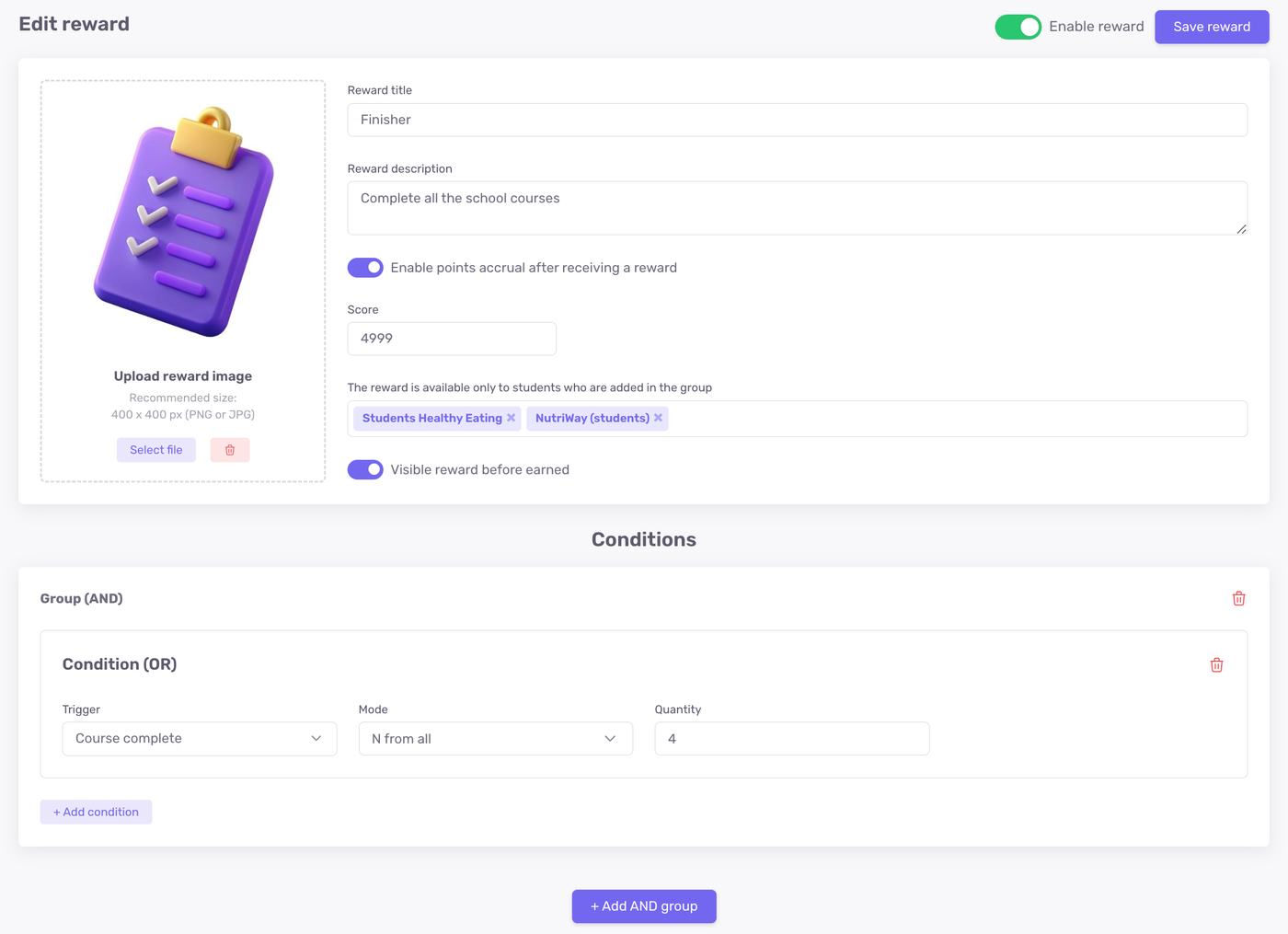
- Set the rule. Rewards have 7 triggers: lesson started, lesson completed, course completed, test passed, test failed, homework accepted, homework rejected. In the Mode field you choose a specific course or lesson, or a number, for example "complete 3 courses". Conditions inside one group work as OR, separate groups added with "+Add AND group" work as AND. The "Scenario Preview" block lists in plain words what a student has to do.
- Add points. In Points, click "Create scenario" and set "Points to credit". Points have 9 triggers: the same 7 plus "Registered in school via link" and "Purchase of a specific product". A reward can also credit points if you turn on "Enable points accrual after receiving a reward".
- Switch on leaderboards. "Show points leaderboard for students" and "Show rewards leaderboard for students" add a "Leaderboards" section to the student account. You choose how many places it shows: top 10, top 25, top 50 and so on. Leaderboards sit next to the feed and group chats in the community features.
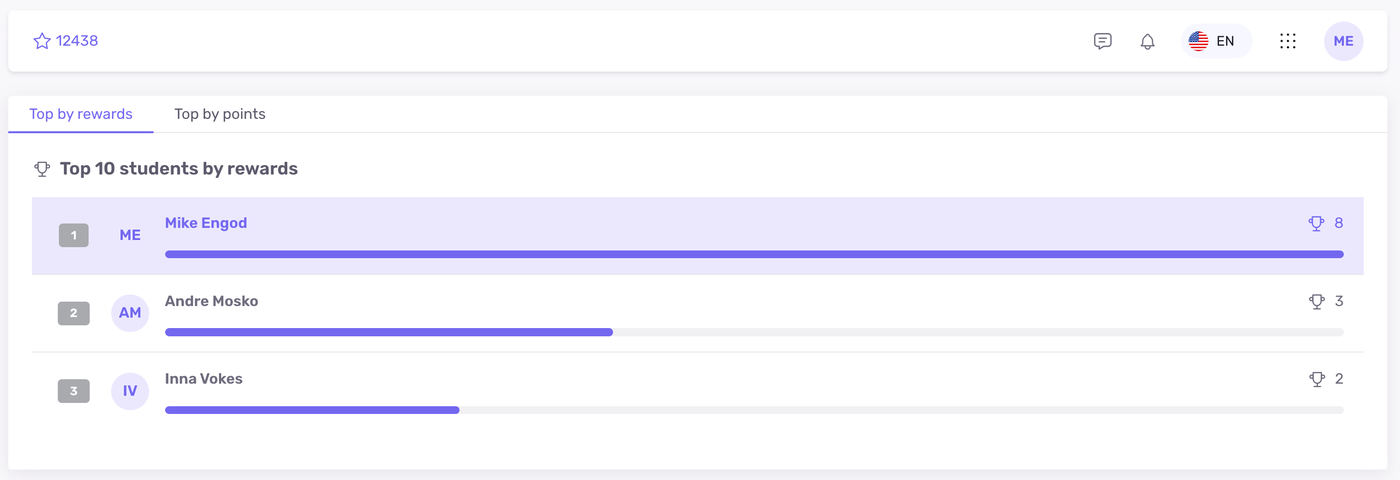
- Watch the results. Statistics lists every student with their points and rewards, with search by email. Gamification is also one of the report categories in the dashboard builder in analytics.
One limit to plan for: registration via link and product purchase are triggers for points only, rewards don't have them. If you want to mark a student's second purchase, credit points for it, or give the badge for a learning step instead, such as completing the first lesson of the new course.
Set up your first reward on a course you already have. Try Softbook free for 30 days, no card required.
Related reading
Frequently asked questions
What is gamification in learning?
Gamification in learning is the use of game elements, such as points, badges, leaderboards and visible progress, in a course that is not a game. The lessons stay the same. A layer of rules on top rewards useful actions, like finishing a lesson or passing a test, so students see their progress and have a reason to open the next lesson.
What are examples of gamification in an online course?
Common examples are points for each completed lesson, a badge for finishing a module, a leaderboard for a group that started together, and a new stage that opens after the student passes a test. Most courses work well with two or three of these. Every reward should be tied to real progress, otherwise students quickly stop paying attention to it.
Does gamification work for adults?
Yes, if the tone fits. Adults ignore childish decoration but still value a sense of progress and small wins. Restrained mechanics work best: a completion badge for each module, a personal score, access to the next stage as a reward. If you use a leaderboard, show a top list rather than a full ranking, so nobody ends up at the bottom in public.
How many gamification elements should a course have?
Start with one or two. Points for routine actions and badges for milestones cover most courses. Add a leaderboard once you have a group that studies on the same schedule. After the first group finishes, check which rewards almost nobody earns and which come too easily, and adjust the rules before adding new mechanics.
Can I add gamification to an existing course in Softbook?
Yes. Gamification in Softbook is set up for the school, not built into a single course, so you can add it to courses you already have. Turn it on in Gamification settings, then create rewards and point rules with triggers such as lesson completed, test passed or homework accepted, and choose a specific course or a number of courses for each rule.