
EdTech statistics 2026: 132 figures on the market, AI and learning, with sources

By Softbook Research · Updated: November 23, 2026
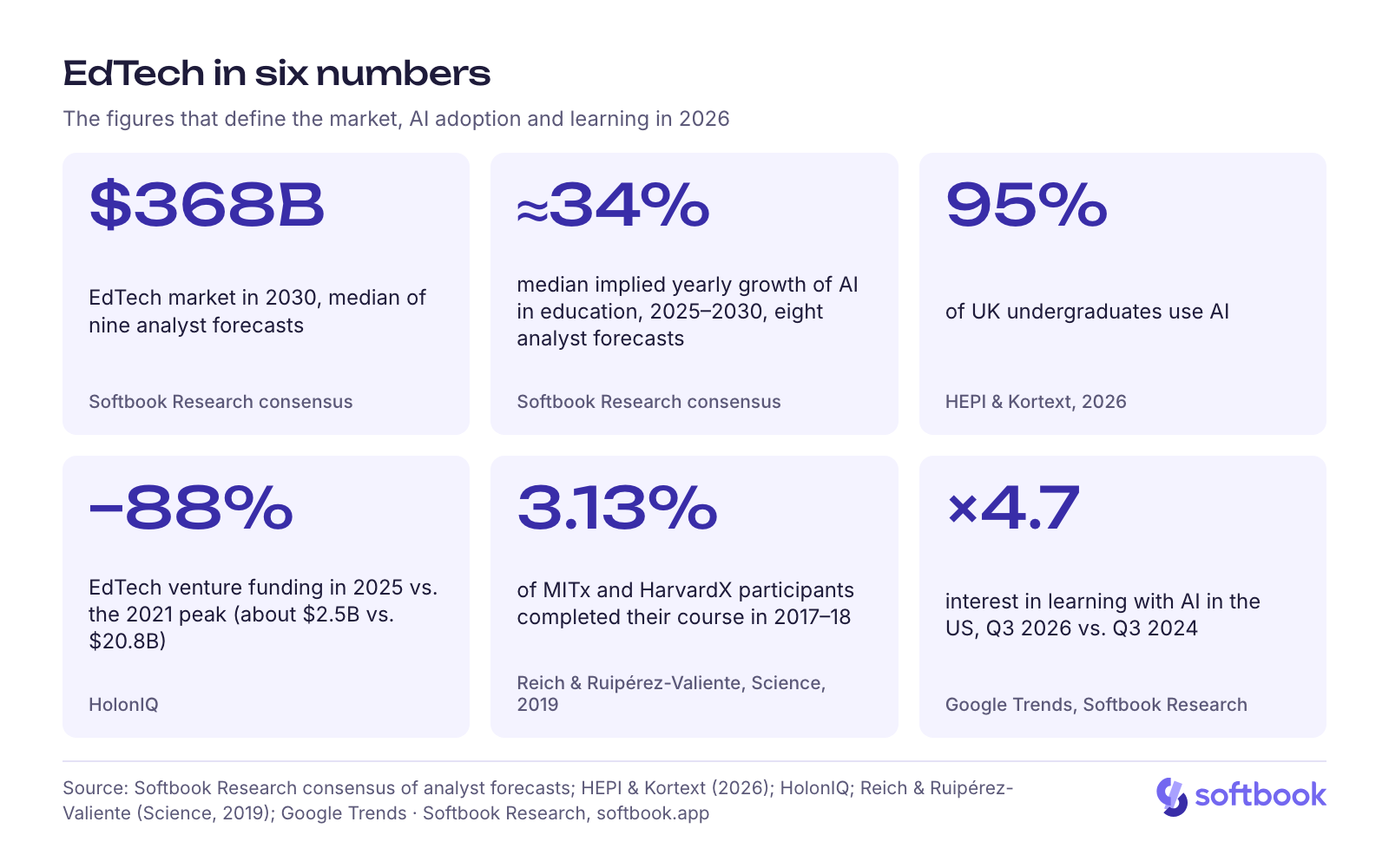
EdTech statistics for 2026 describe a market that analysts expect to nearly double, from about $189 billion in 2025 to $368 billion in 2030 (median of nine forecasts), while venture funding in 2025 was 88% below its 2021 peak. AI is the fastest-growing segment, and 95% of UK undergraduates already use it. Every figure below links to its source.
Key takeaways
- Analysts expect the global EdTech market to grow from about $189 billion in 2025 to $368 billion in 2030, with median implied growth of 13.4% a year between 2025 and 2030 (Softbook Research consensus of nine analyst forecasts).
- AI in education grows fastest: from $6.7 billion in 2025 (median of eight analysts) at a median implied growth of about 34% a year to 2030, yet it is only about 3.5% of EdTech.
- 95% of UK undergraduates use AI and 94% use it in assessed work (HEPI & Kortext, 2026).
- EdTech venture funding fell from a $20.8 billion peak in 2021 to about $2.5 billion in 2025, almost eight times lower (HolonIQ).
- Only 3.13% of participants (people who registered and opened the course) in MITx and HarvardX courses on edX completed the course in 2017–18, against 46% of participants in the paid verified track (Reich & Ruipérez-Valiente, Science, 2019).
- In a trial with about 1,000 high-school students, a plain chatbot lowered exam scores without AI by 17%, and a version with teaching guardrails removed the harm (Bastani et al., PNAS, 2025).
- Interest in learning with AI grew 4.7 times in the US in two years, while interest in online courses grew 38% (Softbook Demand Index, Google Trends, July–September 2026 against 2024).
How we selected these statistics
Every figure on this page passed four checks. It comes from the original research, report, dataset or company filing; for corporate events we also use reporting by established news outlets. It has a date and a context, such as a year, a country, a sample size or a market definition. It is rated high or medium confidence. High means we read the figure on the primary source. Figures marked † are preprints, or figures we confirmed through an excerpt or summary of the original; we also mark source pages that contradict themselves. And it still stood on our cut-off date, October 21, 2026.
We left out retracted papers, vendor figures without a published method, numbers we could not trace to an original source and forecasts that sit far outside the others. The traps we met most often are listed in Statistics we left out.
How to read the tables. One row is one statistic: one measured quantity from one source, and a forecast’s start value, end value and growth rate count as one row. In total, the tables hold 132 statistics from 91 external sources plus Softbook’s own calculations and index. Market forecasts are estimates from paid analyst reports with closed methods, not measurements. Rows marked "Softbook Research calculation" are our own arithmetic on published figures; the method is in The online learning market to 2030. "Year" is the year the figure describes; where fieldwork dates are not published, it is the publication year. Compare two figures only when they count the same people in the same way.
How big is the EdTech market in 2026?
The global EdTech market was worth about $189 billion in 2025 by the median of nine analyst estimates, and the same median puts it at $368 billion in 2030. Single estimates for 2025 range from $187 billion to $280 billion, because analysts draw the market’s borders in different places.
Global EdTech: consensus and analyst estimates
| Statistic | What was measured | Source | Year |
|---|---|---|---|
| $189B in 2025 to $368B in 2030 | Global EdTech market, Softbook consensus: median of 9 analyst forecasts, each normalized to 2025 and 2030; 2030 interquartile range $353B–397B; median implied growth 2025–2030, 13.4% a year | Softbook Research calculation | 2025–2030 |
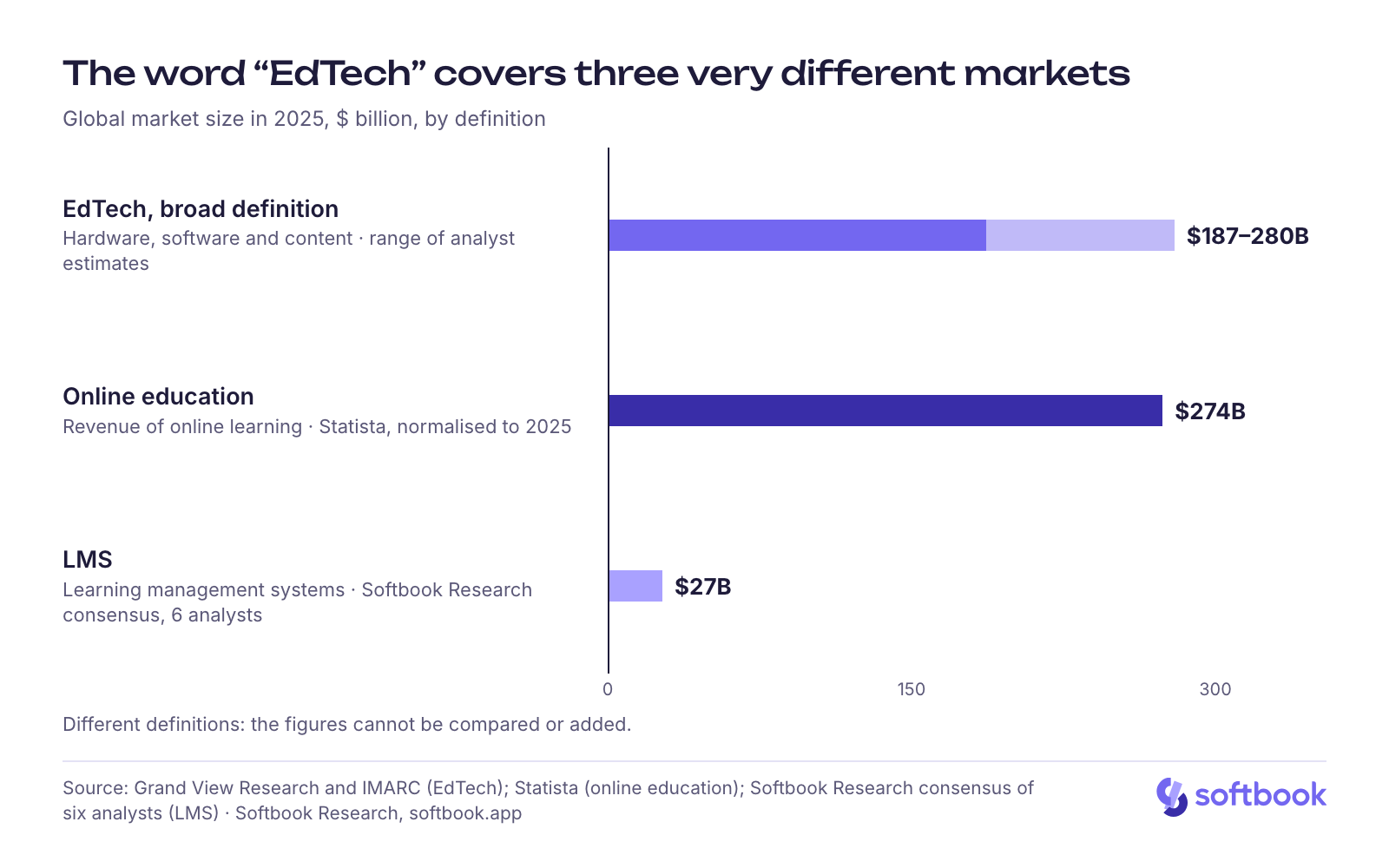
| $187B–280B | Spread of published 2025 estimates for global EdTech; the gap comes from different definitions (hardware, content, corporate training in or out) | Grand View Research, 2026; IMARC, 2026 | 2025 |
| $348B / $369B / $375B | Softbook scenarios for EdTech in 2030: conservative, base, AI-accelerated (direct AI growth only). A fourth scenario, $408B, is a hypothesis: AI would have to trigger a replacement cycle of platforms and content | Softbook Research calculation | 2030 |
| About $6B (+1.6%) | What even fast growth of the AI segment itself adds to the 2030 EdTech market, because AI was about 3.5% of EdTech in 2025 | Softbook Research calculation | 2030 |
| $187.0B in 2025 to $437.5B in 2033 | Global EdTech: hardware, software and content for K-12, higher education and business; 10.8% a year in 2026–2033 | Grand View Research, 2026 | 2025 |
| $279.8B in 2025 to $760.0B in 2034 | Global EdTech; 11.39% a year in 2026–2034; hardware 46.4% of revenue. The largest base of the nine, an outlier by size | IMARC, 2026 | 2025 |
| $189.15B in 2025 to $588.72B in 2034 | Global EdTech: platforms, digital classrooms, LMS, AI tools; 13.45% a year | Fortune Business Insights, 2026 | 2025 |
| +$201.06B in 2025–2030 | Growth of global EdTech (hardware, content, software) at 16.2% a year; the base size is not published | Technavio, 2026 | 2025–2030 |
| $197.3B in 2025 to $353.1B in 2030 | EdTech and smart classrooms; 12.3% a year | MarketsandMarkets, 2025 | 2025 |
| $210.08B in 2026 to $634.13B in 2035 | Global EdTech; 13.09% a year. The page shows two different 2025 values, $185.36B and $210.08B | Precedence Research, 2026 † | 2026 |
| $198.34B in 2025 to $821.15B in 2034 | Global EdTech; the stated growth rate is 13.4% a year, but the published values imply about 17.1% | Straits Research, 2026 † | 2025 |
| $187.1B in 2025 to $724.6B in 2035 | Global EdTech; 14.5% a year. The same page carries a second, inconsistent set of figures | Research Nester, 2025 † | 2025 |
By region and country
Country figures come from different reports with different definitions, so they don’t add up to the global total.
| Statistic | What was measured | Source | Year |
|---|---|---|---|
| Asia-Pacific 34%, North America 33%, Europe 25% | Regional shares of global EdTech revenue (about); the rest of the world about 8% | Fortune Business Insights, 2026 | 2025 |
| China 13%, Germany 8%, UK 7% | Country shares of global EdTech revenue (about) | Fortune Business Insights, 2026 | 2025 |
| 17.7% a year | Growth of EdTech in Asia-Pacific, the fastest-growing region, 2025–2030 | Technavio, 2026 | 2025–2030 |
| $9.80B in 2024 to $32.40B in 2033 | Germany, online education platforms; 12.7% a year | IMARC † | 2024 |
| $7.88B in 2024 to $21.70B in 2033 | France, EdTech; 11.91% a year | IMARC † | 2024 |
| $4.50B | Spain, EdTech; 11.40% a year in 2026–2034 | IMARC † | 2025 |
| €311.7M in 2024 to €397.8M in 2028 | Poland, online education (consumer revenue) | Statista † | 2024 |
| $6.04B in 2025 to $15.60B in 2034 | Brazil, EdTech; 11.12% a year | IMARC | 2025 |
| $4.9B in 2025 to $14.6B in 2034 | Mexico, EdTech; 12.76% a year | IMARC † | 2025 |
| $14.78B in 2025 to $29.24B in 2030 | China, EdTech and smart classrooms | MarketsandMarkets † | 2025 |
Learning management systems and other frames
| Statistic | What was measured | Source | Year |
|---|---|---|---|
| $27.0B in 2025 to $56.7B in 2030 | Learning management systems (LMS), Softbook consensus: median of 6 analysts; 2030 interquartile range $50.6B–63.2B; median implied growth 2025–2030, 17.5% a year, faster than EdTech overall | Softbook Research calculation | 2025–2030 |
| $28.6B in 2025 to $123.8B in 2033 | LMS; 20.2% a year; academic users 60.6% of revenue | Grand View Research, 2026 | 2025 |
| $30.07B in 2025 to $88.41B in 2032 | LMS; 16.6% a year; North America $12.54B, Europe $7.36B growing 19.1% a year | MarketsandMarkets, 2026 | 2025 |
| $24.09B in 2025 to $104.04B in 2034 | LMS; 16.1% a year; North America 42.7%, Europe 26.7% | Fortune Business Insights, 2026 | 2025 |
| $27.13B in 2025 to $54.86B in 2031 | LMS, excluding authoring tools and internal portals; 12.45% a year | Mordor Intelligence, 2026 | 2025 |
| $26.8B in 2025 to $100.6B in 2034 | LMS; 15.84% a year; North America more than 43.2% | IMARC, 2026 | 2025 |
| $281.0B in 2026 to $321.3B in 2031 | Worldwide online education revenue, a narrower definition than EdTech; 2.72% a year; online university education $188.1B | Statista Market Insights, 2026 | 2026 |
| $369.7B in 2025 to $731.8B in 2034 | Global e-learning: technology and content for academic, corporate and government users; 7.65% a year; North America more than 35% | IMARC, 2026 | 2025 |
| About $10 trillion by 2030 | All spending on education and training worldwide; 4.4% a year; workforce training 6.5% a year | HolonIQ via QS, 2025 † | 2030 |
| $21.06B in 2025 to $50.82B in 2031 | Online language learning; 15.83% a year | Mordor Intelligence † | 2025 |
The forecasts agree on direction and disagree on size, so quote any figure together with its analyst and its definition. The full consensus table, the normalization method and the four scenarios are in The online learning market to 2030.
How big is the AI in education market?
AI in education was a market of about $6.7 billion in 2025 by the median of eight analysts, and it is expected to grow about 34% a year to $27.7 billion in 2030. That makes it the fastest-growing EdTech segment and still a small one, about 3.5% of the market.
| Statistic | What was measured | Source | Year |
|---|---|---|---|
| $6.7B in 2025 to $27.7B in 2030 | AI in education, Softbook consensus: median of 8 analysts; median implied growth 2025–2030, about 34% a year (33.8%); 2030 interquartile range $16.6B–33.8B | Softbook Research calculation | 2025–2030 |
| About 3.5% in 2025, about 7.7% in 2030 | AI’s share of the EdTech market, base scenario | Softbook Research calculation | 2025–2030 |
| $4.8B–7.4B | Interquartile range of the 8 analysts’ 2025 estimates for AI in education, around the $6.7B median; the spread depends on what each analyst counts as AI. Individual estimates are in the rows below | Softbook Research calculation | 2025 |
| $8.3B in 2025 to $57.2B in 2033 | AI in education; 25.9% a year in 2026–2033; North America 37.5% | Grand View Research, 2026 | 2025 |
| $9.58B in 2026 to $136.79B in 2035 | AI in education, including AI features inside LMS and services; 34.52% a year; higher education about 45% of demand | Precedence Research, 2026 | 2026 |
| $6.4B in 2025 to $79.6B in 2034 | AI in education; 31.35% a year in 2026–2034 | IMARC, 2026 | 2025 |
| $2.21B in 2024 to $5.82B in 2030 | AI in education, the narrowest definition among the analysts; 17.5% a year; North America about 43% | MarketsandMarkets, 2024 | 2024 |
| $6.90B in 2025 to $41.01B in 2030 | AI in education; 42.83% a year; Asia-Pacific growing 44.2% a year | Mordor Intelligence, 2025 | 2025 |
| $5.50B in 2025 to $70.55B in 2035 | AI in education; 29.07% a year | SNS Insider, 2026 | 2025 |
The growth rates sit closer together than the sizes, which depend on what each analyst counts as AI. Why direct AI revenue barely changes the size of the whole market by 2030 is explained in The online learning market to 2030.
How do students use AI?
Most students in the surveyed countries use AI: 95% of UK undergraduates in the 2026 survey and 86% of students in a 16-country survey in 2024. Among US teens, the share depends on the question asked.
| Statistic | What was measured | Source | Year |
|---|---|---|---|
| 95% | UK undergraduates who use AI in their studies, up from 66% in 2024; N = 1,054, surveyed in December 2025 | HEPI & Kortext, 2026 | 2025 |
| 94% | UK undergraduates who use AI in assessed work (same survey) | HEPI & Kortext, 2026 | 2025 |
| 65% | UK undergraduates who say assessment has changed significantly (same survey) | HEPI & Kortext, 2026 | 2025 |
| 18% | UK full-time students who put AI-generated text directly into their work; earlier survey wave, N = 1,041 | HEPI & Kortext, 2025 | 2025 |
| 86% | Students who use AI in their studies; 3,839 students in 16 countries, July 2024 | Digital Education Council, 2024 | 2024 |
| 54% | Students who use AI weekly (same survey) | Digital Education Council, 2024 | 2024 |
| 58% | Students who feel they lack AI skills (same survey) | Digital Education Council, 2024 | 2024 |
| 66% | Students in the same survey who use ChatGPT | Digital Education Council, 2024 † | 2024 |
| 54% | US teens aged 13–17 who use chatbots for help with schoolwork; N = 1,458, September–October 2025 | Pew Research Center, 2026 | 2025 |
| About 10% | US teens who do all or most of their schoolwork with chatbot help (same survey) | Pew Research Center, 2026 | 2025 |
| 26% | US teens aged 13–17 who have used ChatGPT for schoolwork, up from 13% in 2023; N = 1,391, autumn 2024. A different question from the 54% above | Pew Research Center, 2025 | 2024 |
| 18% | US teens who think it is acceptable to use ChatGPT to write essays (2024 survey) | Pew Research Center, 2025 † | 2024 |
| 42% | US college students who use generative AI weekly; more than 3,300 respondents at more than 900 institutions | Tyton Partners, 2025 † | 2025 |
| More than 1 in 3 | Americans aged 18–24 who use ChatGPT | OpenAI, 2025 † | 2025 |
| More than 25% | Messages from ChatGPT users aged 18–24 that relate to learning and schoolwork | OpenAI, 2025 † | 2025 |
| 75% vs 25% | Students who want AI training vs colleges that provide it; in this source, "students" means all Americans aged 18–24 | OpenAI, 2025 † | 2025 |
| About 47% | Student conversations with Claude that were "direct" (asking for an answer or a finished result) rather than collaborative; 574,740 conversations from university email accounts over 18 days | Anthropic, 2025 | 2025 |
The two Pew figures, 26% and 54%, answer different questions (ChatGPT for schoolwork in 2024, any chatbot for help with schoolwork in 2025), so they don’t show a doubling. What this level of use means for course design is in AI in education in 2026: what research proves.
How do teachers and institutions use AI?
60% of US public-school teachers used AI in the 2024–25 school year, and those who use it weekly say it saves them 5.9 hours a week. In educators’ conversations with Claude, preparing course materials is the most common task.
| Statistic | What was measured | Source | Year |
|---|---|---|---|
| 60% | US public-school teachers who used AI during the 2024–25 school year; more than 2,000 teachers, April 2025 | Gallup & Walton Family Foundation, 2025 | 2025 |
| 32% | US public-school teachers who use AI weekly (same survey) | Gallup & Walton Family Foundation, 2025 | 2025 |
| 5.9 hours a week | Time that weekly AI users say AI saves them, about six weeks over a school year; self-reported, not measured | Gallup & Walton Family Foundation, 2025 | 2025 |
| 68% | US K-12 teachers who had not received AI training (same survey) | Gallup & Walton Family Foundation, 2025 † | 2025 |
| 36% | Teachers who used AI in their work, OECD average, TALIS 2024 (self-reported) | OECD TALIS 2024, 2025 | 2024 |
| 57% | Educator conversations with Claude about developing curricula and course materials; about 74,000 conversations, May–June 2025 | Anthropic, 2025 | 2025 |
| 48.9% | Grading-related educator conversations with Claude that Anthropic classified as automation-heavy; the data doesn’t show whether the teacher later reviewed the result | Anthropic, 2025 † | 2025 |
| 30% | US faculty who use generative AI weekly | Tyton Partners, 2025 † | 2025 |
| 47% | US faculty who redesigned assessment because of AI, 2026 edition | Tyton Partners, 2026 † | 2026 |
| 57% | US higher-education institutions where AI is a strategic priority, up from 49% a year earlier; about 800 respondents, November 2024 | EDUCAUSE, 2025 † | 2024 |
| 2% | US higher-education institutions with new funding for AI (same study) | EDUCAUSE, 2025 † | 2024 |
The time savings are self-reported. Preparing materials with AI is the common case; the number to watch is grading: Anthropic classified 48.9% of grading-related conversations as automation-heavy; the data doesn’t show whether the teacher later reviewed the result. More in AI in education in 2026: what research proves.
What does research say about AI and learning?
Field trials find that AI tutors help, modestly: 0.06–0.08 SD a year in the longest US school trial, and lower exam scores when students use a chatbot without guardrails. Trials in Nigeria and Ghana reported gains of 0.31 and 0.37 SD, respectively. Differences in subject, duration and testing prevent a direct ranking of these results by the resources available to learners. An effect of 0.3 SD means the average student in the AI group moved about a third of a standard deviation of test scores above the comparison group.
| Statistic | What was measured | Source | Year |
|---|---|---|---|
| 0.06–0.08 SD a year | Learning gains from a Khan Academy program that included the Khanmigo AI tutor, used as a coach in remedial math; two-year cluster RCT in 18 Tennessee schools; similar to Khan Academy without AI; 2023 version of the tutor | Oreopoulos & Low, NBER, 2026; EdWorkingPapers, 2026 | 2026 |
| 17% (median student) | The median student wrote to the tutor in 17% of exercise sessions with a mistake, although 96% of students tried it at least once (same trial) | Oreopoulos & Low, NBER, 2026 | 2026 |
| −17% | Exam score without AI for students who practiced with a plain chatbot, compared with a control group; about 1,000 high-school math students in Turkey. A version with teaching guardrails scored about the same as the control | Bastani et al., PNAS, 2025 | 2025 |
| +48% and +127% | Practice scores with a plain chatbot and with a guarded tutor, compared with the control group (same trial) | Bastani et al., PNAS, 2025 | 2025 |
| +0.31 SD | Composite score (English, AI knowledge, digital skills) after a six-week after-school program with Microsoft Copilot and a teacher present, Edo State, Nigeria, 2024; +0.23 SD in English; the team estimates it beats 80% of interventions in its database of RCTs | De Simone et al., World Bank, 2025 † | 2024 |
| +0.37 SD | Math scores after eight months of Rori, a math tutor on WhatsApp; about 1,000 students in grades 3–9, 11 schools, Ghana; about $5 per student; preprint | Henkel et al., 2024 † | 2024 |
| +4 pp | Topic mastery when human tutors received AI suggestions (Tutor CoPilot); +9 pp for students of the lowest-rated tutors; 900 tutors and 1,800 K-12 students, US; about $20 per tutor a year; preprint | Wang et al., 2024 | 2024 |
| 0.73–1.3 SD | Median learning gains (quantile regression) with a GPT-4 tutor compared with an active-learning class; one Harvard physics course, two weeks, 194 students analyzed | Kestin et al., Scientific Reports, 2025 † | 2023 |
| g = 0.271 | Average effect of intelligent tutoring systems in US schools; 18 studies, 77 effects, 11 systems; lower in rural schools; preprint | Leite et al., 2025 † | 2025 |
| 0.37 SD and 0.288 SD | Average effect of human tutoring in schools: 2020 version of the meta-analysis (96 RCTs) and a later revision | Nickow, Oreopoulos & Quan, NBER | 2020 |
| 36% | Effects in education RCTs that are smaller than 0.05 SD, which is why a gain of 0.1 SD in a real school counts as meaningful | Kraft, Educational Researcher, 2020 | 2020 |
The best-documented gains so far come from AI used alongside a teacher, and AI that hands out answers can make students learn less. The studies differ in design, so they don’t prove that teacher-supported AI beats an autonomous tutor. The full review, with the limits of each study, is AI in education in 2026: what research proves about AI tutors and what is hype.
Which learning methods have the strongest evidence?
In learning science, practice testing and spaced practice have the strongest evidence, and feedback comes close behind. Gamification shows positive effects on learning outcomes (g = 0.49); its effects on motivation and behavior were less stable in the more rigorous studies. These meta-analyses don’t compare it directly with quizzes or feedback.
| Statistic | What was measured | Source | Year |
|---|---|---|---|
| 2 of 10 | Study techniques rated "high utility" in a review of hundreds of studies: practice testing and distributed practice; rereading, highlighting and summarizing rated "low" | Dunlosky et al., 2013 | 2013 |
| g = 0.499 | Effect of tests and quizzes in real classrooms; 222 studies, 48,478 students | Yang et al., Psychological Bulletin, 2021 | 2021 |
| g = 0.74 | Spaced retrieval practice compared with massed practice; 29 studies | Latimier, Peyre & Ramus, 2021 † | 2021 |
| g = 0.42 | Interleaved practice compared with blocked practice; 59 studies, 238 effects; 0.67 with paintings, small in mathematics | Brunmair & Richter, 2019 | 2019 |
| d = 0.48 | Effect of feedback; 435 studies, 994 effects, more than 61,000 participants; depends heavily on how informative the feedback is | Wisniewski, Zierer & Hattie, 2020 | 2020 |
| g = 0.49 | Gamification, cognitive learning outcomes (19 studies, 1,686 participants); motivation g = 0.36 and behavior g = 0.25, both less stable in the more rigorous studies | Sailer & Homner, 2020 | 2020 |
| 89.1% | Educators who believe in teaching to learning styles, a myth; 37 studies, 15,405 people, 18 countries; the share is not falling | Newton & Salvi, 2020 | 2020 |
| More than 160 years | How long versions of the "learning pyramid" (10% of what we read, 90% of what we teach) have circulated, with no empirical origin | Letrud & Hernes, 2018 | 2018 |
These effects were measured on learning, not on course completion. How to build them into a course is in Online course completion rates: why 3% of MIT and Harvard MOOC participants finished, and what actually helps.
What are online course completion rates?
Online course completion rates depend on who is counted: 3.13% of MITx and HarvardX participants on edX (people who registered and opened the course) completed the course in 2017–18, 46% of participants in the paid verified track did, and the median across 221 MOOCs was 12.6%.
| Statistic | What was measured | Source | Year |
|---|---|---|---|
| 5.13% | Registrations that earned a certificate in the first 17 HarvardX and MITx courses, 2012–13 (43,196 of 841,687 registrations, not unique people). A different sample from the 3.13% below | HarvardX & MITx, 2014 | 2012–13 |
| 3.13% | Participants in MITx and HarvardX courses on edX (people who registered and opened the course) who completed the course in 2017–18, down from about 6% in 2014–15; 565 course runs, 12.67 million registrations by 5.63 million people. A different sample from the 5.13% above | Reich & Ruipérez-Valiente, Science, 2019 | 2017–18 |
| 46% | Participants in the paid verified track who completed the course, 2017–18 (56% in 2016–17); a self-selected group, so payment is not shown to cause finishing | Reich & Ruipérez-Valiente, Science, 2019 | 2017–18 |
| 12.6% | Median completion rate across 221 MOOCs, range 0.7%–52.1%; higher in shorter courses and with automatic assessment; in the courses with weekly activity data, the first two weeks were the critical period | Jordan, IRRODL, 2015 | 2015 |
| No effect on completion | Planning and self-regulation prompts in 247 courses with about 250,000 learners over 2.5 years; effects on early engagement were an order of magnitude smaller than expected | Kizilcec et al., PNAS, 2020 | 2020 |
| +40% (relative) | Likelihood of finishing a MOOC with a voluntary commitment device (limits set in advance on time spent on distracting websites); +24% time on the course, +0.29 SD grades; reminders and distraction blocking had no effect | Patterson, JEBO, 2018 | 2018 |
All of these figures come from free open courses. Independent schools rarely publish completion data with a method, so compare your own numbers only with the same denominator. The full analysis of denominators is in Online course completion rates.
How much is invested in EdTech?
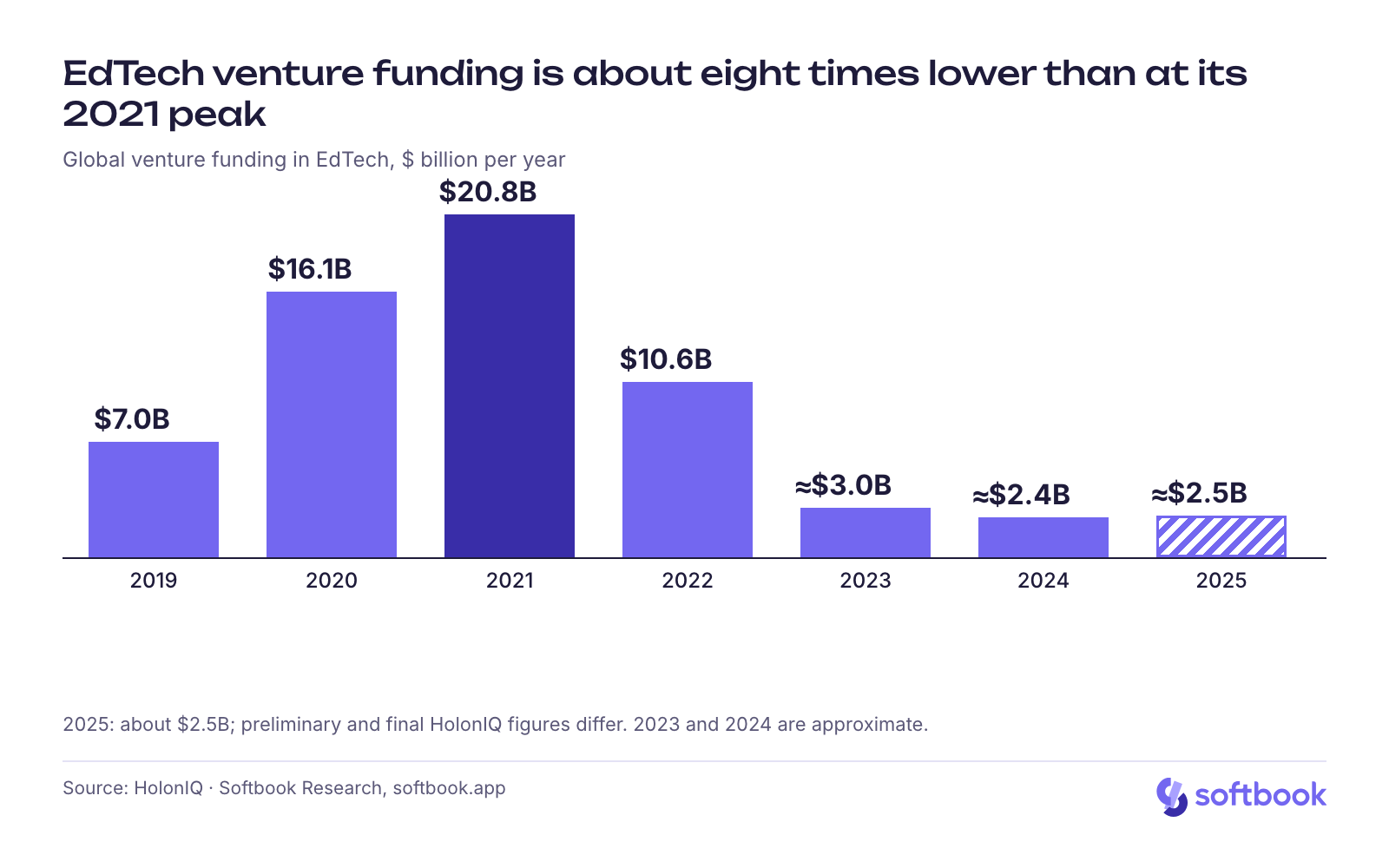
EdTech venture funding peaked at $20.8 billion in 2021 and fell to about $2.5 billion in 2025, almost eight times lower, according to HolonIQ. The first half of 2026 brought $1.0 billion, 26% less than the first half of 2025.
Venture funding
| Statistic | What was measured | Source | Year |
|---|---|---|---|
| $7.0B, $16.1B, $20.8B, $10.6B, about $3.0B, about $2.4B | Global EdTech venture funding by year, 2019 to 2024; 2021 was the peak | HolonIQ; HolonIQ, 2020; HolonIQ, 2026 | 2019–2024 |
| About $2.5B (−88%) | Global EdTech venture funding in 2025, almost eight times below the 2021 peak; HolonIQ’s preliminary and final 2025 figures differ | HolonIQ, 2026 | 2025 |
| $1.0B | EdTech venture funding in the first half of 2026, 26% below the first half of 2025 | HolonIQ, 2026 | H1 2026 |
| 38%, 36%, 22% | Shares of 2025 EdTech deals by count: workforce training, K-12, higher education | HolonIQ, 2026 | 2025 |
| 87% | Early-stage share of 2025 EdTech deals | HolonIQ, 2026 | 2025 |
| About 410 | Education M&A deals in 2025, including schools, childcare and universities as well as digital learning companies | HolonIQ, 2026 | 2025 |
Company results after the boom
These are figures from company filings and press coverage, not assessments of the companies.
| Statistic | What was measured | Source | Year |
|---|---|---|---|
| $22B; stake at zero | Byju’s: valued at $22 billion in 2022; in 2024 BlackRock marked its own stake at zero. This is one investor’s valuation of its stake, not a new valuation of the company | TechCrunch, 2024 † | 2022–2024 |
| About $945M | Debt of 2U, former owner of edX, at its Chapter 11 filing, July 2024 | Bloomberg, 2024 | 2024 |
| −48% in a day | Chegg share price after the company said ChatGPT was hurting new customer growth, May 2, 2023 | CNBC, 2023 | 2023 |
| −31% | Chegg subscribers in Q1 2025 (3.2 million), with revenue down 30%; the company pointed to Google AI Overviews | Chegg, SEC filing, 2025 | Q1 2025 |
| −39% | Chegg revenue for full-year 2025, $376.9M | Chegg, press release, 2026 † | 2025 |
| −9% consumer, +6% enterprise | Udemy revenue in 2025: consumer $265.8M, enterprise $524.1M | Udemy, Form 10-K, 2026 | 2025 |
The data suggest that much of the market’s growth is money moving between its parts rather than new money: consumer content lost revenue while corporate learning held up. These sources don’t measure the exact share. The full picture is in The online learning market to 2030.
What is happening in corporate learning and skills?
Companies spend about $395 billion a year on training worldwide, and Training Industry estimates the budget will grow only 1.1% in 2026, while employers expect 39% of workers’ core skills to change by 2030.
| Statistic | What was measured | Source | Year |
|---|---|---|---|
| $394.5B to $398.8B (+1.1%) | Global corporate training spending, 2025 and 2026 estimate, internal and external training; North America $186.4B | Training Industry, 2026 | 2025–2026 |
| $102.8B | US training expenditures in 2025, up about 5%; organizations with 100 or more employees | Training magazine, 2025 † | 2025 |
| 40 hours | Training hours per employee in the US in 2025, down from 47 a year earlier (same survey) | Training magazine, 2025 † | 2025 |
| +$131.01B in 2024–2029 | Growth of the corporate e-learning market at 12.7% a year; Asia-Pacific accounts for 29% of the growth | Technavio, 2024 | 2024–2029 |
| 170M created, 92M displaced | Jobs created and displaced worldwide by 2030, net +78 million; survey of more than 1,000 employers in 55 economies | World Economic Forum, 2025 | 2025–2030 |
| 39% | Workers’ core skills expected to change by 2030 | World Economic Forum, 2025 | 2030 |
| 59 of 100 | Workers who will need training by 2030; 11 of them are unlikely to receive it | World Economic Forum, 2025 | 2030 |
| 63% | Employers who name skills gaps as the main barrier to transforming their business | World Economic Forum, 2025 | 2025 |
| 29.5% | US work hours that could be automated by 2030, against 21.5% without generative AI | McKinsey Global Institute, 2023 | 2030 |
| Up to 12 million | Occupational transitions in Europe by 2030, 6.5% of employment | McKinsey Global Institute, 2024 | 2030 |
| About 1 in 3 | Adults at level 1 or below in literacy; 160,000 adults in 31 countries | OECD Survey of Adult Skills, 2024 † | 2023 |
| 12 per minute | Enrollments in generative AI courses on Coursera in 2025, up from 8 in 2024 and 1 in 2023 | Coursera Global Skills Report, 2025 † | 2025 |
With training budgets estimated to grow about 1% a year, the data suggest that corporate e-learning grows largely by taking money from other training formats rather than from new budgets. These sources don’t measure the exact share. That shift is analyzed in The online learning market to 2030.
How is AI in education regulated?
The main hard deadline is December 2, 2027: from that date, EU AI Act obligations for high-risk AI systems apply, and these include AI used in education for admission, evaluating learning outcomes and proctoring exams, according to the European Commission. School and university rules lag behind student use.
| Statistic | What was measured | Source | Year |
|---|---|---|---|
| December 2, 2027 | Date from which EU AI Act obligations apply to high-risk AI systems listed in Annex III, which include AI used in education for admission, evaluating learning outcomes and proctoring exams; moved from August 2, 2026 | European Commission, AI Act FAQ | 2027 |
| Under 10% | Schools and universities with formal guidance on generative AI, out of more than 450 surveyed (universities 13%, schools 7%) | UNESCO, 2023 † | 2023 |
| 13 years | Minimum age for using generative AI tools in the classroom proposed in UNESCO’s first global guidance, September 2023 | UNESCO via StateScoop, 2023 † | 2023 |
| 19% | US public-school teachers who say their school has an AI policy | Gallup & Walton Family Foundation, 2025 | 2025 |
| 22% | US higher-education institutions with an institution-wide AI strategy, late 2024 | EDUCAUSE, 2025 † | 2024 |
| 23% to 39% | US higher-education institutions with AI usage guidelines, a year earlier and late 2024 | EDUCAUSE, 2025 † | 2024 |
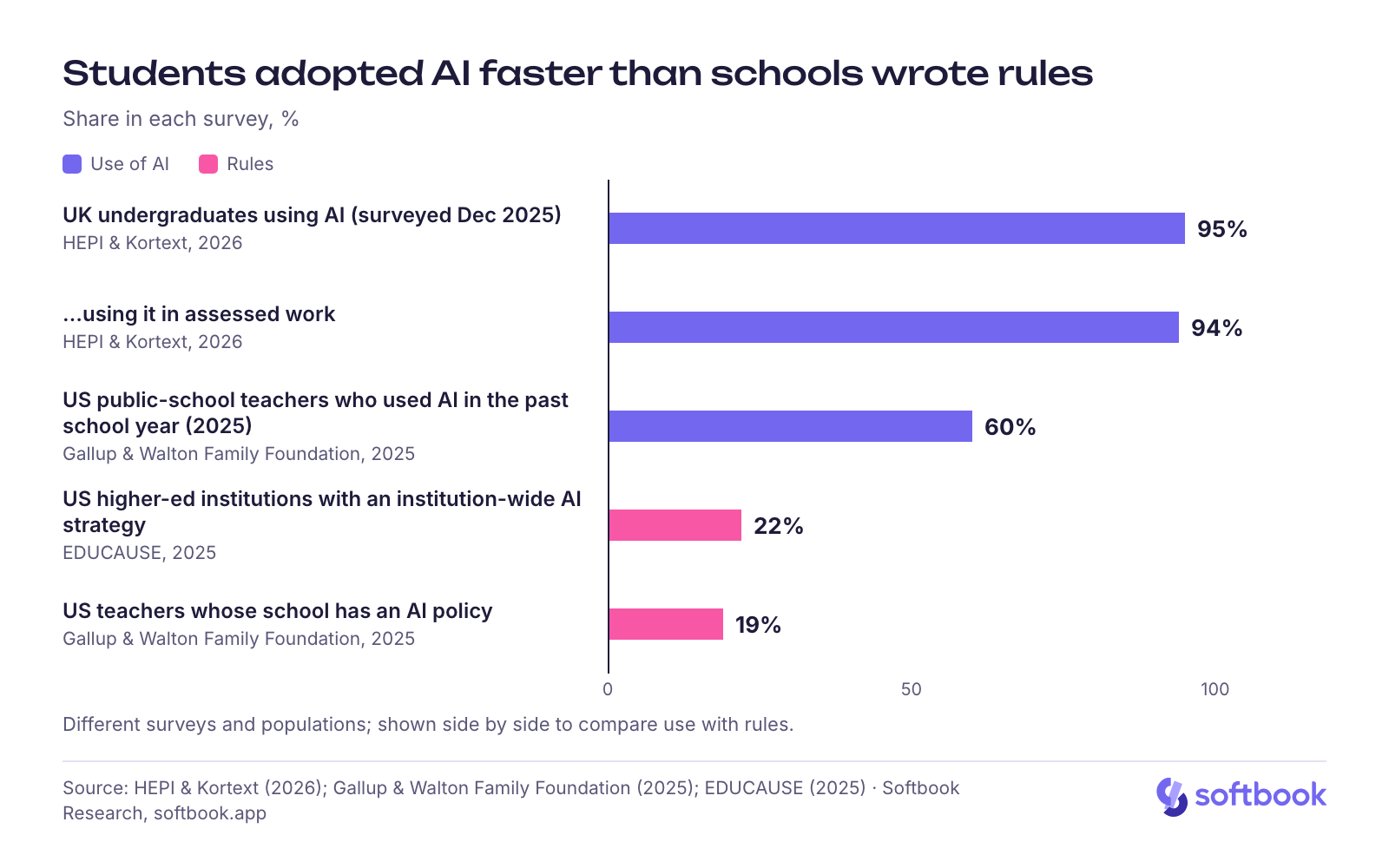
Students’ use of AI is close to universal, while written rules cover a minority of schools and universities. What a short AI policy for a course should contain is in AI in education in 2026: what research proves.
What does the Softbook Demand Index show?
Interest in learning with AI grew 4.7 times in the US, 9.5 times in the UK and 3.4 times in Germany between July–September 2024 and July–September 2026, according to the Softbook Demand Index. The index now covers ten markets; the figures below are for the first four, the US, the UK, Germany and France.
The index uses Google Trends relative search interest on a 0–100 scale, which is not search volume. In each market's language we grouped queries into baskets, for example "AI tutor", "learn with AI" and "ChatGPT for studying" for learning with AI, and "online courses" and "online learning" for online courses. Ambiguous searches and course-platform brand terms were excluded; searches that name an AI assistant, such as "ChatGPT for studying", were kept. We compared average weekly values for July–September of each year. Data were pulled on October 21 and November 23, 2026.
| Statistic | What was measured | Source | Year |
|---|---|---|---|
| ×4.7 | US: interest in learning with AI, July–September 2026 compared with July–September 2024 | Softbook Demand Index, Google Trends | 2024–2026 |
| ×9.5 | UK: interest in learning with AI, same period | Softbook Demand Index, Google Trends | 2024–2026 |
| ×3.4 | Germany: interest in learning with AI, same period | Softbook Demand Index, Google Trends | 2024–2026 |
| Measurable in Q3 2026 | France: interest in learning with AI in French was below the Google Trends reporting threshold in Q3 2024 and Q3 2025 | Softbook Demand Index, Google Trends | 2024–2026 |
| +38%, +40%, −9%, −8% | Interest in online courses over the same period: US, UK, Germany, France | Softbook Demand Index, Google Trends | 2024–2026 |
| About 7–8% | Interest in learning with AI as a share of interest in online courses in July–September 2026 (US, UK, Germany), up from 1–2% two years earlier | Softbook Demand Index, Google Trends | 2024–2026 |
| −24% | US interest in learning with AI, July–September 2026 compared with a year earlier: two-year growth was not a straight line | Softbook Demand Index, Google Trends | 2025–2026 |
| +49% and +27% | Interest in online certificates, UK and US, July–September 2024 to 2026 | Softbook Demand Index, Google Trends | 2024–2026 |
Learning with AI is still a niche, about 7–8% of the interest in online courses in the US, the UK and Germany, and its growth was not a straight line. The full method and the results for six more markets, Spain, Mexico, Brazil, Poland, Ukraine and Kazakhstan, are in The online learning market to 2030. Across all ten markets, interest in classic online courses grew only in the US and the UK.
Statistics we left out (and why)
These figures circulate widely. We checked each one and kept it out of the tables.
- "ChatGPT strongly improves learning, g = 0.867." The meta-analysis behind it was widely cited and was retracted in April 2026 over discrepancies in the number of studies, their weighting and the inclusion of a study that had itself been retracted (retraction notice).
- "Students who wrote with ChatGPT remembered 12% of their essay, against 89%." It circulates in a secondary retelling of an OECD report. We could not trace it to a primary source.
- "Cohort courses finish at 85%, self-paced courses at 5–15%." It circulates in marketing blogs. We could not trace it to a primary source.
- "The AI in education market will reach $1.2 trillion by 2035." This is one analyst’s forecast, and its 2025 base is about seven times the median of the other analysts. We don’t quote its figures in the tables.
- "The EdTech market is worth $X", with no definition. Three different markets share the name. Broad EdTech with hardware, software and content is $187–280 billion in 2025, depending on the analyst. Online education revenue (Statista) is $281 billion in 2026, about $274 billion back-calculated to 2025, and grows 2.7% a year. Learning management systems, the software schools and companies run courses on, are about $27 billion. Total spending on education and training, about $10 trillion by 2030, is a fourth frame again.
- "Corporate e-learning will reach $335 billion by 2030." That forecast (Grand View Research) would equal about 80% of all corporate training spending worldwide, which was $394.5 billion in 2025 and grows about 1% a year. Its definition is broader than training, so we don’t use it as the size of corporate learning.
- "Teen use of AI for school doubled from 26% to 54%." Pew asked different questions: ChatGPT for schoolwork in 2024, any chatbot for help with schoolwork in 2025.
- "MIT proved that ChatGPT damages the brain." The study is a preprint with 54 participants, 18 of them in the key session, with EEG recorded while they wrote (Kosmyna et al., 2025). It doesn’t measure brain damage.
- "An AI tutor delivers two sigma." Benjamin Bloom’s 1984 "two sigma" effect of one-to-one tutoring has never been replicated, and the original interventions included more than tutoring (von Hippel, 2024). Human tutoring in schools averages 0.29–0.37 SD across RCTs.
- "Only 3% of online learners finish." The 3.13% describes participants who registered and opened MITx and HarvardX courses on edX in 2017–18. It doesn’t describe paid courses, corporate training or online learners in general.
Who publishes Softbook Research?
Softbook Research publishes market data and reviews of evidence for people who build online courses. The series includes the online learning market to 2030, AI in education research, online course completion rates and predictions for the future of learning.
Softbook is a platform for online schools: courses, sales, CRM, email and Telegram campaigns, and a website builder in one place. You can add unlimited students, and the platform takes no commission on your sales. On our online course platform, authors build courses with tests that have 8 question types and retakes, homework with teacher feedback and analytics that flag students at risk of dropping out.
How to cite these statistics
Softbook Research (2026). EdTech statistics 2026: 132 figures on the market, AI and learning, with sources. Softbook. https:/
/ softbook. app/ blog/ en/ edtech- statistics/
If you quote a single figure, cite its primary source from the table, and this page as the compilation that led you to it.
Charts and data on this page are free to reuse with credit to Softbook Research and a link to this page (CC BY 4.0).
Build your next course around the methods with the strongest evidence: quizzes, spaced lessons and feedback. Try Softbook free for 30 days, no card required.
Related reading
- Online learning market 2026: the $368B EdTech forecast for 2030 and what AI really changes
- AI in education in 2026: what research proves about AI tutors and what is hype
- Online course completion rates: why 3% of MIT and Harvard MOOC participants finished, and what actually helps
- The future of learning: predictions for 2027–2030
Sources
Sources are listed in the order they first appear in the tables. Titles are given as published where we have them; otherwise a short description.
- Grand View Research (2026). Education Technology Market Size, Share & Trends Report, 2026–2033. https:/
/ www. grandviewresearch. com/ industry- analysis/ education- technology- market - IMARC Group (2026). Edtech Market Size, Share, Trends and Forecast, 2026–2034. https:/
/ www. imarcgroup. com/ Edtech- Market - Fortune Business Insights (2026). Edtech Market Size, Share & Industry Analysis. https:/
/ www. fortunebusinessinsigh ts. com/ edtech- market- 111377 - Technavio (2026). Edtech Market Analysis, Size, and Forecast 2026–2030. https:/
/ www. technavio. com/ report/ edtech- market- industry- analysis - MarketsandMarkets (2025, September 3). EdTech and Smart Classrooms Market, press release. https:/
/ www. marketsandmarkets. com/ PressReleases/ educational- technology- ed- tech. asp - Precedence Research (2026, updated September 28). Educational Technology Market Size and Forecast 2026 to 2035. https:/
/ www. precedenceresearch. com/ educational- technology- market - Straits Research (2026, updated September 11). EdTech Market. https:/
/ straitsresearch. com/ report/ education- technology- market - Research Nester (2025, October 3). EdTech Market. https:/
/ www. researchnester. com/ reports/ education- technology- market/ 3403 - IMARC Group. Germany Online Education Platforms Market. https:/
/ www. imarcgroup. com/ germany- online- education- platforms- market - IMARC Group. France EdTech Market. https:/
/ www. imarcgroup. com/ france- edtech- market - IMARC Group. Spain EdTech Market. https:/
/ www. imarcgroup. com/ spain- edtech- market - Statista Market Insights. Online Education, Poland. https:/
/ www. statista. com/ outlook/ emo/ online- education/ poland - IMARC Group. Brazil EdTech Market. https:/
/ www. imarcgroup. com/ brazil- edtech- market - IMARC Group. Mexico EdTech Market. https:/
/ www. imarcgroup. com/ report/ es/ mexico- edtech- market - MarketsandMarkets. Educational Technology (Ed Tech) Market, China. https:/
/ www. marketsandmarkets. com/ Market- Reports/ geography/ educational- technology- ed- tech- market/ China - Grand View Research (2026). Learning Management System Market Report. https:/
/ www. grandviewresearch. com/ industry- analysis/ learning- management- systems- market - MarketsandMarkets (2026, January). Learning Management System (LMS) Market. https:/
/ www. marketsandmarkets. com/ Market- Reports/ learning- management- system- market- 1266. html - Fortune Business Insights (2026, updated October 5). Learning Management System Market. https:/
/ www. fortunebusinessinsigh ts. com/ industry- reports/ learning- management- system- market- 101376 - Mordor Intelligence (2026, updated July 23). Learning Management System Market. https:/
/ www. mordorintelligence. com/ industry- reports/ learning- management- system- market - IMARC Group (2026, updated July 29). Learning Management System Market. https:/
/ www. imarcgroup. com/ learning- management- system- market - Statista Market Insights (2026). Online Education, Worldwide. https:/
/ www. statista. com/ outlook/ emo/ online- education/ worldwide - IMARC Group (2026, updated June 26). E-Learning Market. https:/
/ www. imarcgroup. com/ e- learning- market - HolonIQ (2025). 2025 Global Education Outlook, as reported by QS. https:/
/ www. qs. com/ insights/ 2025- global- education- outlook - Mordor Intelligence. Online Language Learning Market. https:/
/ mordorintelligence. com/ industry- reports/ online- language- learning- market - Grand View Research (2026). AI in Education Market Report. https:/
/ www. grandviewresearch. com/ industry- analysis/ artificial- intelligence- ai- education- market- report - Precedence Research (2026, updated October 8). AI in Education Market. https:/
/ www. precedenceresearch. com/ ai- in- education- market - IMARC Group (2026, October 7). AI in Education Market. https:/
/ www. imarcgroup. com/ ai- in- education- market - MarketsandMarkets (2024, November). AI in Education Market. https:/
/ www. marketsandmarkets. com/ Market- Reports/ ai- in- education- market- 200371366. html - Mordor Intelligence (2025, updated November 21). AI in Education Market. https:/
/ www. mordorintelligence. com/ industry- reports/ ai- in- education- market - SNS Insider (2026, July 29). Global AI in Education Market, press release. https:/
/ www. snsinsider. com/ press- release/ global- ai- in- education- market - HEPI & Kortext (2026, March 12). Student Generative AI Survey 2026, HEPI Report 199. https:/
/ www. hepi. ac. uk/ wp- content/ uploads/ 2026/ 03/ HEPI- Report- 199- Gen- AI- Survey- 2026. pdf - HEPI & Kortext (2025, February 26). Student Generative AI Survey 2025. https:/
/ www. hepi. ac. uk/ reports/ student- generative- ai- survey- 2025/ - Digital Education Council (2024). What students want: key results from the DEC Global AI Student Survey 2024. https:/
/ www. digitaleducationcounc il. com/ post/ what- students- want- key- results- from- dec- global- ai- student- survey- 2024 - Digital Education Council (2024). How students use AI: the evolving relationship between AI and higher education. https:/
/ www. digitaleducationcounc il. com/ post/ how- students- use- ai- the- evolving- relationship- between- ai- and- higher- education - Pew Research Center (2026, February 24). How Teens Use and View AI. https:/
/ www. pewresearch. org/ internet/ 2026/ 02/ 24/ how- teens- use- and- view- ai/ - Pew Research Center (2025, January 15). About a quarter of U.S. teens have used ChatGPT for schoolwork. https:/
/ www. pewresearch. org/ short- reads/ 2025/ 01/ 15/ about- a- quarter- of- us- teens- have- used- chatgpt- for- schoolwork- double- the- share- in- 2023/ - Tyton Partners (2025). Time for Class 2025. https:/
/ tytonpartners. com/ time- for- class- 2025/ - OpenAI (2025, February 20). College students and ChatGPT. https:/
/ openai. com/ global- affairs/ college- students- and- chatgpt/ - Anthropic (2025, April 8). Anthropic Education Report: How university students use Claude. https:/
/ www. anthropic. com/ research/ anthropic- education- report- how- university- students- use- claude - Gallup & Walton Family Foundation (2025, June 25). Six weeks a year: how AI gives teachers time back. https:/
/ www. waltonfamilyfoundatio n. org/ learning/ six- weeks- a- year- how- ai- gives- teachers- time- back - Walton Family Foundation (2025, June 25). The AI dividend: new survey shows AI is helping teachers reclaim valuable time. https:/
/ www. waltonfamilyfoundatio n. org/ the- ai- dividend- new- survey- shows- ai- is- helping- teachers- reclaim- valuable- time - OECD (2025, October). Results from TALIS 2024: country notes. https:/
/ www. oecd. org/ en/ publications/ 2025/ 10/ results- from- talis- 2024- country- notes_ eafd703e/ french- community- of- belgium_ 3aee860a. html - Anthropic (2025, August 27). Anthropic Education Report: How educators use Claude. https:/
/ www. anthropic. com/ research/ anthropic- education- report- how- educators- use- claude - Tyton Partners (2026, June 15). Time for Class 2026, press release. https:/
/ www. globenewswire. com/ news- release/ 2026/ 06/ 15/ 3311604/ 0/ en/ Tyton- Partners- Releases- 2026- Time- for- Class- Report- The- AI- Tipping- Point- From- Monitoring- Students- to- Engaging- Them. html - EDUCAUSE (2025). 2025 EDUCAUSE AI Landscape Study: introduction and key findings. https:/
/ www. educause. edu/ content/ 2025/ 2025- educause- ai- landscape- study/ introduction- and- key- findings - Oreopoulos, P., & Low, N. (2026). One Click Away: AI Tutoring with Khanmigo in a Two-Year School Experiment. NBER Working Paper 35620. https:/
/ www. nber. org/ papers/ w35620 - Oreopoulos, P., & Low, N. (2026). One Click Away: AI Tutoring with Khanmigo in a Two-Year School Experiment. EdWorkingPaper ai26-1551. https:/
/ edworkingpapers. com/ ai26- 1551 - Bastani, H., Bastani, O., Sungu, A., et al. (2025). Generative AI without guardrails can harm learning. PNAS 122(26). https:/
/ www. pnas. org/ doi/ 10. 1073/ pnas. 2422633122 - De Simone, M. E., et al. (2025). From Chalkboards to Chatbots. World Bank Policy Research Working Paper 11125 (blog summary). https:/
/ blogs. worldbank. org/ en/ education/ From- chalkboards- to- chatbots- Transforming- learning- in- Nigeria - Henkel, O., Horne-Robinson, H., Kozhakhmetova, N., & Lee, A. (2024). Effective and scalable math support: evidence on the impact of an AI math tutor in Ghana. arXiv 2402.09809 (preprint). https://arxiv.org/abs/2402.09809
- Wang, R. E., Ribeiro, A. T., Robinson, C. D., Loeb, S., & Demszky, D. (2024). Tutor CoPilot. arXiv 2410.03017 (preprint). https://arxiv.org/abs/2410.03017
- Kestin, G., Miller, K., Klales, A., Milbourne, T., & Ponti, G. (2025). Randomized controlled trial of an AI tutor in a Harvard physics course. Scientific Reports 15:17458. https:/
/ pmc. ncbi. nlm. nih. gov/ articles/ PMC12179260/ - Leite, W. L., et al. (2025). Meta-analysis of intelligent tutoring systems in US schools. arXiv 2511.04997 (preprint). https:/
/ arxiv. org/ abs/ 2511. 04997v1 - Nickow, A., Oreopoulos, P., & Quan, V. (2020; later revision). Meta-analysis of tutoring RCTs. NBER Working Paper 27476. https:/
/ www. nber. org/ papers/ w27476 - Kraft, M. A. (2020). Interpreting effect sizes of education interventions. Educational Researcher 49(4). https:/
/ edworkingpapers. com/ ai19- 10 - Dunlosky, J., Rawson, K. A., Marsh, E. J., Nathan, M. J., & Willingham, D. T. (2013). Improving students’ learning with effective learning techniques. Psychological Science in the Public Interest 14(1). https:/
/ www. psychologicalscience. org/ news/ releases/ which- study- strategies- make- the- grade. html - Yang, C., Luo, L., Vadillo, M. A., Yu, R., & Shanks, D. R. (2021). Testing (quizzing) boosts classroom learning: a systematic and meta-analytic review. Psychological Bulletin 147(4). https:/
/ scholars. hkbu. edu. hk/ en/ publications/ testing- quizzing- boosts- classroom- learning- a- systematic- and- meta- / - Latimier, A., Peyre, H., & Ramus, F. (2021). A meta-analytic review of the benefit of spacing out retrieval practice episodes on retention. Educational Psychology Review 33. https:/
/ doi. org/ 10. 1007/ s10648- 020- 09572- 8 - Brunmair, M., & Richter, T. (2019). Similarity matters: a meta-analysis of interleaved learning and its moderators. Psychological Bulletin 145. https:/
/ www. psychologie. uni- wuerzburg. de/ fileadmin/ 06020400/ 2019/ Brunmair_ Richter_ in_ press_ _ 2019_ META- ANALYSIS_ OF_ INTERLEAVED_ LEARNING. pdf - Wisniewski, B., Zierer, K., & Hattie, J. (2020). The power of feedback revisited: a meta-analysis of educational feedback research. Frontiers in Psychology. https:/
/ www. frontiersin. org/ articles/ 10. 3389/ fpsyg. 2019. 03087/ full - Sailer, M., & Homner, L. (2020). The gamification of learning: a meta-analysis. Educational Psychology Review 32(1). https:/
/ link. springer. com/ article/ 10. 1007/ s10648- 019- 09498- w - Newton, P. M., & Salvi, A. (2020). How common is belief in the learning styles neuromyth, and does it matter? Frontiers in Education. https:/
/ www. frontiersin. org/ articles/ 10. 3389/ feduc. 2020. 602451/ full - Letrud, K., & Hernes, S. (2018). Excavating the origins of the learning pyramid myths. Cogent Education 5(1). https:/
/ doi. org/ 10. 1080/ 2331186X. 2018. 1518638 - Harvard University & MIT (2014). HarvardX and MITx: The First Year of Open Online Courses. https:/
/ dash. harvard. edu/ entities/ publication/ 73120378- c4cd- 6bd4- e053- 0100007fdf3b - Reich, J., & Ruipérez-Valiente, J. A. (2019). The MOOC pivot. Science 363(6423). https:/
/ webs. um. es/ jruiperez/ papers/ journals/ 2019_ Science_ MOOCPivot_ postprint. pdf - Jordan, K. (2015). Massive open online course completion rates revisited: assessment, length and attrition. IRRODL 16(3). https:/
/ www. irrodl. org/ index. php/ irrodl/ article/ view/ 2112 - Kizilcec, R. F., Reich, J., Yeomans, M., et al. (2020). Scaling up behavioral science interventions in online education. PNAS 117(26). https:/
/ pmc. ncbi. nlm. nih. gov/ articles/ PMC7334459 - Patterson, R. W. (2018). Can behavioral tools improve online student outcomes? Journal of Economic Behavior & Organization 153. https:/
/ ecommons. cornell. edu/ entities/ publication/ 0ccc8fbd- c323- 4536- b4a3- dd587b4f643c - HolonIQ. Global EdTech Venture Funding, 2010–2023 (chart). https:/
/ index. holoniq. com/ charts/ HCH9SDLD3Q3OW3LON7VV/ Global- EdTech- Venture- Funding%2C- 2010- 2023- (Billion- USD) - HolonIQ. $16.1B of global EdTech venture capital in 2020. https:/
/ www. holoniq. com/ notes/ 16- 1b- of- global- edtech- venture- capital- in- 2020 - HolonIQ (2026). EdTech venture investment in 2025. https:/
/ www. holoniq. com/ notes/ edtech- hits- 2- 6b- in- investment- as- the- market- stabilizes- bigger- bets- in- ai- and- workforce- training - HolonIQ (2026). $1B in EdTech venture capital to date: funding falls short of last year’s midpoint. https:/
/ www. holoniq. com/ notes/ 1b- in- edtech- venture- capital- to- date- funding- falls- short- of- last- years- midpoint- asia- mena- buck- the- trend - TechCrunch (2024, June 7). BlackRock has slashed the value of its stake in Byju’s to zero. https:/
/ techcrunch. com/ 2024/ 06/ 07/ blackrock- has- slashed- the- value- of- stake- in- byjus- once- worth- 22- billion- to- zero - Bloomberg (2024, July 25). 2U, owner of edX online courses, files for Chapter 11 bankruptcy. https:/
/ www. bloomberg. com/ news/ articles/ 2024- 07- 25/ 2u- owner- of- edx- online- courses- files- chapter- 11- bankruptcy - CNBC (2023, May 2). Chegg drops more than 40% after saying ChatGPT is killing its business. https:/
/ www. cnbc. com/ 2023/ 05/ 02/ chegg- drops- more- than- 40percent- after- saying- chatgpt- is- killing- its- business. html - Chegg, Inc. (2025). First quarter 2025 financial results, Form 8-K exhibit, SEC. https:/
/ www. sec. gov/ Archives/ edgar/ data/ 1364954/ 000136495425000049/ a9901- financialresultsq120. htm - Chegg, Inc. (2026, February 9). Chegg reports 2025 fourth quarter and full-year financial results. https:/
/ www. businesswire. com/ news/ home/ 20260209620934/ en/ Chegg- Reports- 2025- Fourth- Quarter- and- Full- Year- Financial- Results/ - Udemy, Inc. (2026). Annual report on Form 10-K for 2025, SEC. https:/
/ www. sec. gov/ Archives/ edgar/ data/ 1607939/ 000160793926000034/ udmy- 20251231. htm - Training Industry, Inc. (2026). Size of the training industry. https:/
/ trainingindustry. com/ wiki/ learning- services- and- outsourcing/ size- of- training- industry/ - Training magazine (2025, November). 2025 Training Industry Report. https:/
/ trainingmag. com/ 2025- training- industry- report/ - Technavio (2024, December). Corporate E-Learning Market Analysis. https:/
/ www. technavio. com/ report/ corporate- e- learning- market- industry- analysis - World Economic Forum (2025, January). Future of Jobs Report 2025, press release. https:/
/ www. weforum. org/ press/ 2025/ 01/ future- of- jobs- report- 2025- 78- million- new- job- opportunities- by- 2030- but- urgent- upskilling- needed- to- prepare- workforces/ - World Economic Forum (2025). Future of Jobs Report 2025, summary on the EU Digital Skills and Jobs Platform. https:/
/ digital- skills- jobs. europa. eu/ en/ latest/ research/ future- jobs- report- 2025 - World Economic Forum (2025). The Future of Jobs Report 2025: jobs outlook. https:/
/ www. weforum. org/ publications/ the- future- of- jobs- report- 2025/ in- full/ 2- jobs- outlook/ - McKinsey Global Institute (2023, July). Generative AI and the future of work in America. https:/
/ www. mckinsey. com/ mgi/ our- research/ generative- ai- and- the- future- of- work- in- america - McKinsey Global Institute (2024, May). A new future of work: the race to deploy AI and raise skills in Europe and beyond. https:/
/ www. mckinsey. com/ our- research/ a- new- future- of- work- the- race- to- deploy- ai- and- raise- skills- in- europe- and- beyond - OECD (2024, December 10). Survey of Adult Skills 2023. https:/
/ doi. org/ 10. 1787/ b263dc5d- en - Coursera (2025, June). Global Skills Report 2025. https:/
/ blog. coursera. org/ presenting- courseras- 2025- global- skills- report- the- skills- trends- shaping- the- future- of- education- and- employment - European Commission. Navigating the AI Act: frequently asked questions (accessed October 21, 2026). https:/
/ digital- strategy. ec. europa. eu/ en/ faqs/ navigating- ai- act - UNESCO (2023). Survey on generative AI guidance in schools and universities, GCED Clearinghouse. https:/
/ gcedclearinghouse. org/ en/ node/ 130058 - StateScoop (2023, September). UNESCO urges governments to regulate generative AI in schools. https:/
/ statescoop. com/ unesco- urges- governments- regulate- generative- ai- schools/
Cited in "Statistics we left out":
- Wang & Fan (2025). Meta-analysis of ChatGPT and student learning. Humanities and Social Sciences Communications. RETRACTED April 2026 (retraction notice dated April 22, 2026, updated July 2, 2026). https:/
/ www. nature. com/ articles/ s41599- 026- 07310- z - Kosmyna, N., et al. (2025). Your Brain on ChatGPT. arXiv 2506.08872 (preprint). https:/
/ arxiv. org/ abs/ 2506. 08872v1 - von Hippel, P. T. (2024). Two-sigma tutoring: separating science fiction from science fact. Education Next, Spring 2024. https:/
/ www. educationnext. org/ wp- content/ uploads/ 2024/ 03/ ednext_ XIV_ 2_ von_ hippel. pdf - Grand View Research (2026). Corporate E-learning Market Report. https:/
/ www. grandviewresearch. com/ industry- analysis/ corporate- e- learning- market- report
Softbook Research calculations and the Softbook Demand Index: method in Online learning market 2026: the $368B EdTech forecast for 2030 and what AI really changes; Google Trends data pulled October 21 and November 23, 2026.
Frequently asked questions
How big is the EdTech market in 2026?
Analysts put the global EdTech market at about $189 billion in 2025, the median of nine published estimates, and expect about $368 billion in 2030; the median growth implied by each analyst's own figures is 13.4% a year. Single estimates for 2025 range from $187 billion to $280 billion because analysts include different things, such as hardware, content or corporate training. These figures are analyst estimates, not measurements.
How fast is the AI in education market growing?
AI in education is the fastest-growing EdTech segment: about $6.7 billion in 2025 and $27.7 billion in 2030 by the median of eight analysts, with median implied growth of roughly 34% a year. It is still small, about 3.5% of the EdTech market in 2025. Size estimates differ widely by definition, and one outlier forecast of more than $1 trillion should not be quoted.
What percentage of students use AI?
Most university students in the surveyed countries do. In the UK, 95% of undergraduates use AI and 94% use it in assessed work, according to HEPI and Kortext (2026). A 2024 survey of 3,839 students in 16 countries found 86% using AI in their studies. In the US, 54% of teens aged 13–17 use chatbots for help with schoolwork, according to Pew Research Center.
What is the average completion rate for online courses?
There is no single average, because studies divide by different groups. In MITx and HarvardX courses on edX, 3.13% of participants (people who registered and opened the course) completed the course in 2017–18, while 46% of participants in the paid verified track did. Across 221 MOOCs, the median completion rate was 12.6%, with a range of 0.7% to 52.1%. These figures describe free open courses, not paid ones.
How much venture capital goes into EdTech?
EdTech venture funding peaked at $20.8 billion in 2021 and fell to about $2.5 billion in 2025, almost eight times lower, according to HolonIQ. The first half of 2026 brought $1.0 billion, 26% below the first half of 2025. Workforce training accounted for 38% of 2025 deals by count, ahead of K-12 at 36% and higher education at 22%.
Do AI tutors improve learning?
They help, but modestly. In Tennessee, a two-year randomized trial of a Khan Academy program that included the Khanmigo AI tutor measured gains of 0.06–0.08 standard deviations a year, similar to Khan Academy without AI. Trials in Nigeria, with a teacher present, and Ghana reported gains of 0.31 and 0.37 SD, respectively. Differences in subject, duration and testing prevent a direct ranking of these results by the resources available to learners. A plain chatbot without guardrails lowered exam scores by 17% in a trial in Turkey.
When do EU AI Act rules for AI in education apply?
According to the European Commission's AI Act FAQ, obligations for high-risk AI systems listed in Annex III apply from December 2, 2027. In education, this covers AI used for admission, for evaluating learning outcomes and for proctoring exams. The date was moved from August 2, 2026. Course creators who use AI to grade learners in the EU should check with a lawyer how the rules apply to them.
How were these EdTech statistics selected?
Each statistic comes from the original research, report, dataset or company filing; for corporate events we also use reporting by established news outlets. Each has a date and context and is rated high or medium confidence; preprints and figures confirmed through an excerpt or summary are marked. Retracted papers, vendor figures without a published method and outlier forecasts were excluded. Market forecasts are analyst estimates. The data cut-off date is October 21, 2026.