
AI in education in 2026: what research proves about AI tutors and what is hype

Updated: November 17, 2026 · Softbook Research
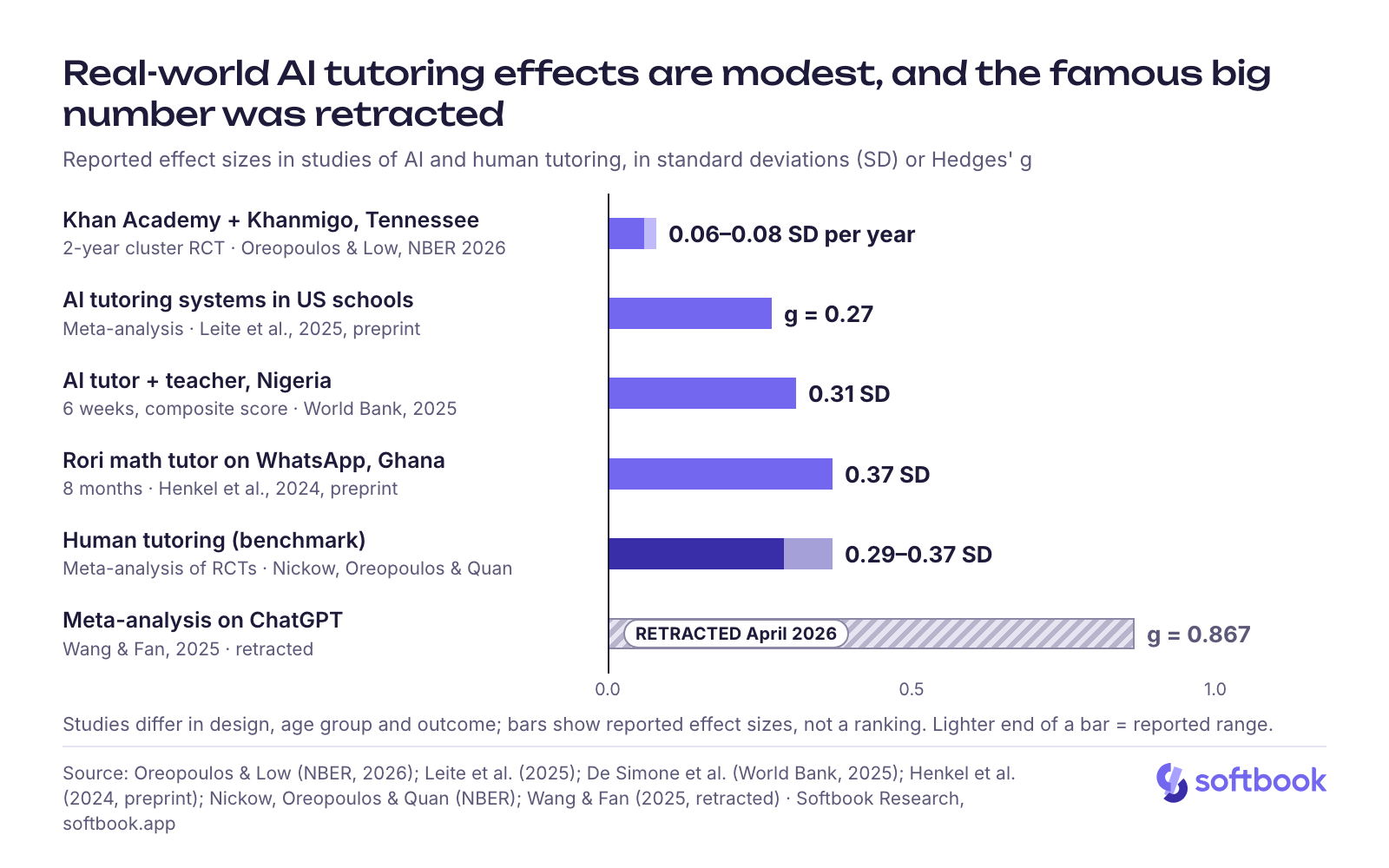
Research shows that AI tutors help students learn, but far less than the headlines suggest. The strongest field trials find small to moderate gains: 0.06–0.08 SD a year in US schools and about 0.3 SD in low-resource settings in Nigeria and Ghana. Without teaching guardrails, AI can make learning worse: students score higher with the chatbot and lower on the exam without it.
Key takeaways
- A two-year randomized trial of a Khan Academy program that included the Khanmigo AI tutor, in 18 US schools, measured gains of 0.06–0.08 SD per year on average, and about 0.14 SD for a full year of active use, in line with what Khan Academy practice without AI has shown (Oreopoulos & Low, NBER, 2026).
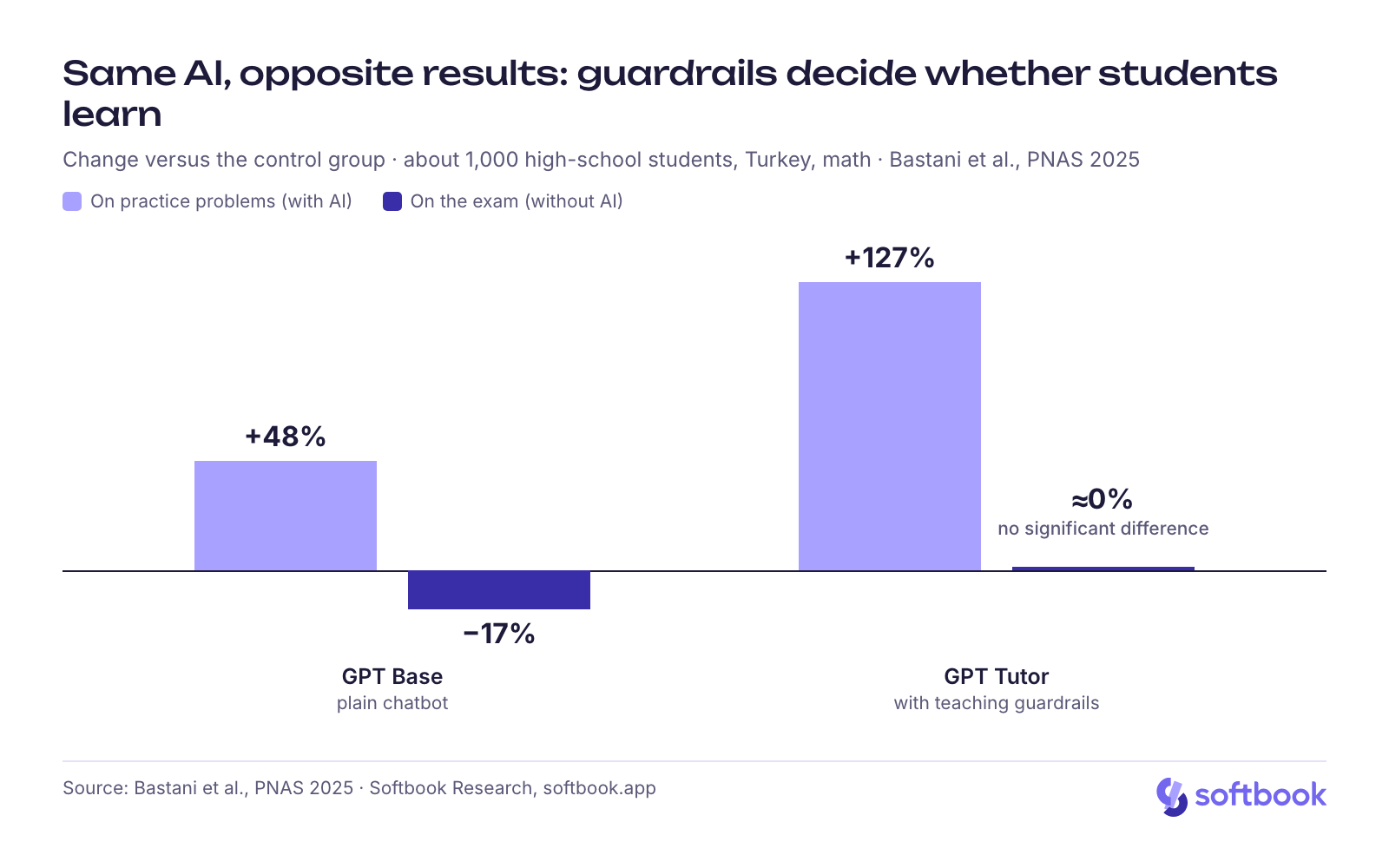
- A plain chatbot raised practice scores by 48% and lowered exam scores without AI by 17%; a version with teaching guardrails removed the harm (Bastani et al., PNAS, 2025).
- Trials in Nigeria and Ghana reported gains of 0.31 SD in six weeks (World Bank, 2025) and 0.37 SD over eight months (Henkel et al., 2024, preprint), respectively. Differences in subject, duration and testing prevent a direct ranking of these results by the resources available to learners.
- AI suggestions to human tutors raised students’ topic mastery by 4 percentage points, and by 9 with the lowest-rated tutors (Tutor CoPilot, Stanford, 2024).
- A widely cited meta-analysis claiming ChatGPT strongly improves learning (g = 0.867) was retracted in April 2026 (retraction notice).
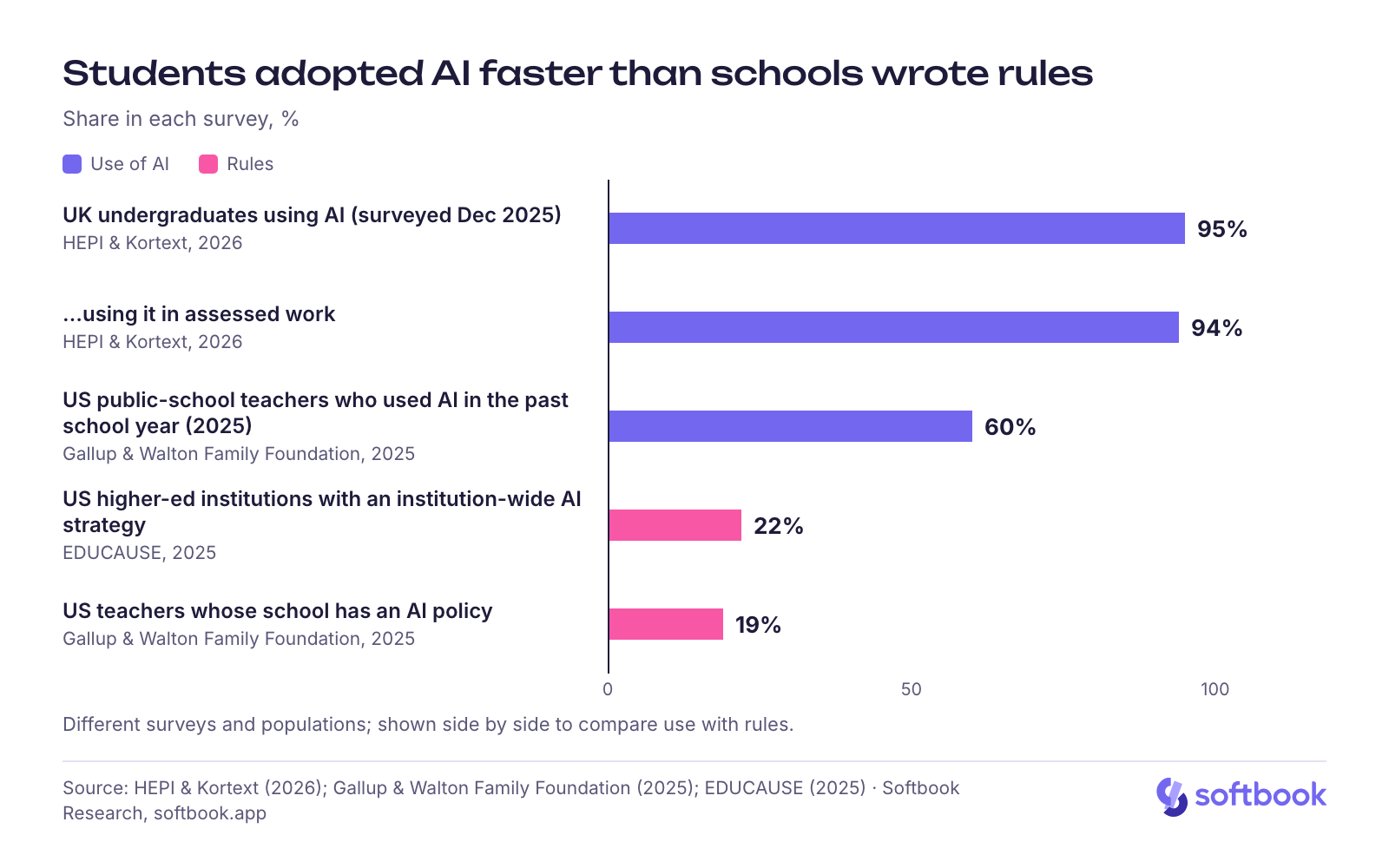
- 95% of UK undergraduates use AI and 94% use it in assessed work (HEPI, 2026), while 22% of US colleges have an institution-wide AI strategy (EDUCAUSE, 2025).
- US teachers who use AI weekly say it saves them 5.9 hours a week (Gallup and Walton Family Foundation, 2025, self-reported).
How we built this review
We collected randomized controlled trials (RCTs) of AI tutors in real schools and courses, meta-analyses and systematic reviews, and large surveys of students and teachers with a published method. The cut-off date is October 21, 2026. We excluded retracted papers (one appears below only as a warning), vendor figures without a method and numbers we could find only in secondary retellings; preprints are labeled as preprints. Most results are effect sizes in standard deviations (SD): how far the average student in the AI group moved compared with the control group, measured against the normal spread of test scores. For scale, 36% of effects in education RCTs are smaller than 0.05 SD (Kraft, Educational Researcher, 2020), so a tenth of a standard deviation in a real school is already a meaningful result, and a claim near 1 SD deserves a hard second look.
Do AI tutors actually improve learning?
AI tutors do improve learning in field trials, but the effect in ordinary schools is small. Trials in Nigeria and Ghana reported gains of 0.31 and 0.37 SD, respectively. Results vary across programs, and these studies cannot isolate how much of that variation comes from the model, the teaching setup or the learners’ resources.
The longest randomized trial in this review is a two-year cluster RCT of a Khan Academy program that included the Khanmigo AI tutor, in 18 schools in Tennessee, where the tutor worked as a coach in remedial math classes. Students gained about 1.3 percentile points per term: 0.06–0.08 SD per year on average, and about 0.14 SD for a full year of active use, in line with what Khan Academy practice without AI has shown (Oreopoulos & Low, NBER Working Paper 35620, 2026). The trial measured the effect of the whole program, not of the AI alone, and it tested the 2023 version of the tutor.
Meta-analyses point the same way. A preprint pooling 18 studies of intelligent tutoring systems in US schools (77 effects, 11 systems) finds an average of g = 0.271, lower in rural schools (Leite et al., 2025). A systematic review of 28 studies with 4,597 school students calls the effect of AI tutoring systems positive but more modest than often assumed (Létourneau et al., npj Science of Learning, 2025).
In Edo State, Nigeria, a six-week after-school program in June and July 2024 used Microsoft Copilot (GPT-4) with a teacher guiding the sessions. It raised a composite score (English, AI knowledge, digital skills) by 0.31 SD and English alone by 0.23 SD. The World Bank team estimates this beats 80% of interventions in its database of RCTs from developing countries and equals about 1.5–2 years of typical learning; the effect grew with every day attended (De Simone et al., World Bank, 2025). In Ghana, according to a 2024 preprint, about 1,000 students in grades 3–9 across 11 schools used Rori, a math tutor on WhatsApp, for two 30-minute sessions a week over eight months. Their scores rose by 0.37 SD at a marginal cost of about $5 per student (Henkel et al., 2024, preprint). Differences in subject, duration and testing prevent a direct ranking of these results by the resources available to learners.
What this means for your course: an AI tutor is a modest supplement to good teaching, not a replacement for it. If your students already have a teacher, structured lessons and practice, expect a modest gain, and measure it.
Why do some AI studies report huge effects?
Huge effects usually come from short studies in a single course, from outcomes measured while AI was still available, or from meta-analyses that mix weak studies. Such results tell you little about what a typical course will see.
A well-designed RCT at Harvard shows a real result with narrow reach. In one physics course in autumn 2023, students who studied with a GPT-4 tutor built on solutions written by experts showed median learning gains more than double those of an active-learning class, 0.73–1.3 SD by quantile regression, over two weeks (Kestin et al., Scientific Reports, 2025). The limits matter as much as the number: one course at one university, a ceiling effect, no measure of what students remembered later, and sample sizes that don’t fully match inside the paper (194 students in the main analysis).
The warning case is a meta-analysis published in May 2025 that reported ChatGPT improves learning with g = 0.867. It was widely cited and then retracted in April 2026 over discrepancies in the number of studies, in how they were weighted and the inclusion of a study that had itself been retracted (retraction notice, Humanities and Social Sciences Communications, 2026; PlagiarismToday, 2026). Before you repeat a big number about AI and learning, check that it doesn’t come from this paper.
Another meta-analysis of 69 ChatGPT experiments from 2022–2024 reports better performance and higher-order thinking, less mental effort and no change in self-efficacy (Deng et al., Computers & Education, 2025). Critics point out that control conditions are poorly described and that many studies may have measured the quality of AI-assisted answers rather than learning (Open Universiteit, 2025).
There is also a yardstick worth keeping. Human tutoring in schools, pooled across 96 RCTs, shows 0.37 SD in the 2020 version of a major meta-analysis and 0.288 SD in a later version (Nickow, Oreopoulos & Quan, NBER). Benjamin Bloom’s famous "two sigma" effect of one-to-one tutoring (1984) has never been replicated, and the original interventions included more than tutoring (von Hippel, Education Next, 2024).
What this means for your course: when a tool promises to double results, ask four questions. How long did the study run? Was the test taken without AI? How many courses and schools were involved? Has the paper been corrected or retracted?
Can AI make students learn less?
Yes. When AI does the thinking for the student, the student gets better at finishing the task and worse at learning from it, and field trials, lab studies and policy reviews agree on this.
The clearest evidence is a field RCT with about 1,000 high-school students in Turkey studying math (Bastani et al., PNAS, 2025). One group practiced with a plain chatbot (GPT Base), another with a version given teaching guardrails (GPT Tutor), and a control group had no AI. On practice problems, GPT Base improved scores by 48% and GPT Tutor by 127% compared with the control group. On the exam, taken without AI, the GPT Base group scored 17% lower than the control. The GPT Tutor group scored about the same as the control: the guardrails removed the harm, but they did not create a lasting gain. The paper’s title says it plainly: generative AI without guardrails can harm learning.
Lab studies show the same mechanism: in a lab RCT with 117 participants, ChatGPT raised essay scores but not knowledge gain or transfer, and the authors describe the pattern as "metacognitive laziness" (Fan et al., British Journal of Educational Technology, 2025). Two preregistered experiments found that large language models did not change learning outcomes on average: asking the AI to explain helped, asking it to solve the problem hurt, and students overestimated how much the AI had helped them (Lehmann, Cornelius & Sting, 2025, preprint).
The OECD reached a similar conclusion in its Digital Education Outlook 2026: without pedagogical support, generative AI improves how well students complete a task but not how much they learn (OECD, 2026).
What this means for your course: the risk sits in AI that hands out answers. Every assignment that a chatbot can complete in one prompt now measures the chatbot, not the student.
Does AI work better with a teacher or instead of one?
The best-documented gains so far come from AI used alongside a teacher. The studies differ in design, so they don’t prove that teacher-supported AI beats an autonomous tutor. The Khanmigo trial shows how little students engaged with a tutor inside a school program.
Tutor CoPilot, tested by a Stanford team, did not talk to students at all. It suggested moves to human tutors during live online sessions with about 1,800 K-12 students from low-income US communities and 900 tutors. Students were 4 percentage points more likely to master a topic, and students of the lowest-rated tutors gained 9 points. Tutors who used it asked more guiding questions and gave fewer ready answers. The cost was about $20 per tutor per year (Wang et al., 2024, preprint). Caveats: the outcome is short-term mastery inside the platform, and the J-PAL summary reports 783 tutors and 1,013 students. The Nigerian program above also ran with a teacher in the room.
In the Khanmigo trial, almost every student (96%) tried the tutor at least once, but the median student wrote to it in only 17% of exercise sessions with a mistake, and most messages were bare answers or clicks on hints (Oreopoulos & Low, 2026). Usage data from universities tells a similar story: in about 574,740 conversations with Claude from university email accounts, roughly 47% were "direct" requests for an answer or a finished result rather than collaborative problem-solving (Anthropic, 2025).
What this means for your course: the cheapest high-value use of AI is on the teaching side. Give AI to the person who prepares lessons and gives feedback, and keep the student’s attention on the practice and on a human who notices when they are stuck.
How many students use AI, and are the rules keeping up?
Almost all university students in the surveyed countries use AI, and most schools and universities still lack clear rules for it. The gap between use and policy is the most stable pattern in the 2024–2026 surveys.
In the UK, 95% of undergraduates use AI and 94% use it in work that is graded, up from 66% using AI in 2024; 65% say assessment has changed significantly (N = 1,054, December 2025, HEPI & Kortext, 2026). In a global survey of 3,839 students in 16 countries, 86% used AI in their studies, 54% weekly and 58% felt they lacked AI skills (Digital Education Council, 2024). In a September–October 2025 survey, 54% of US teens aged 13–17 said they use chatbots for help with schoolwork and about 10% do all or most of their schoolwork that way (Pew Research Center, 2026). In a separate Pew question from autumn 2024, 26% of teens used ChatGPT specifically for schoolwork, and only 18% thought it was acceptable to use it to write essays (Pew Research Center, 2025). These two Pew figures answer different questions, so they don’t show growth from 26% to 54%.
Rules move more slowly. In late 2024, 22% of US higher-education institutions had an institution-wide AI strategy, 39% had usage guidelines (up from 23%) and 2% had new funding for AI (EDUCAUSE, 2025). Only 19% of US public-school teachers say their school has an AI policy (Gallup & Walton Family Foundation, 2025). Back in 2023, UNESCO found formal guidance on generative AI in fewer than 10% of more than 450 schools and universities it surveyed (UNESCO, 2023).
Institutions react first through assessment: in the 2026 edition of Tyton Partners’ survey, 47% of US faculty said they had redesigned assessment because of AI (Tyton Partners, 2026). In Europe, the rules are getting formal. According to the European Commission’s AI Act FAQ, AI systems used in education for admission, evaluating learning outcomes and proctoring exams are high-risk, and the obligations for them apply from December 2, 2027 (European Commission, AI Act FAQ).
What this means for your course: assume your students already use AI and write the rules yourself. A short course policy (what AI may do, what it may not and how work is checked) now belongs in the course design from the first lesson.
How do teachers use AI, and does it save time?
Teachers use AI mostly to prepare materials, and weekly users report saving several hours a week. The savings are self-reported: a strong signal, though nobody measured the hours.
In April 2025, 60% of US public-school teachers had used AI during the school year and 32% used it weekly. Weekly users said it saved them 5.9 hours a week, which the authors translate into about six weeks over a school year (Gallup & Walton Family Foundation, 2025). On average across OECD countries, 36% of teachers in TALIS 2024 reported using AI in their work (OECD TALIS 2024, 2025).
Usage data shows what they do with it. In about 74,000 educator conversations with Claude, 57% were about developing curricula and course materials. Anthropic classified 48.9% of grading-related conversations as automation-heavy. The data doesn’t show whether the teacher later reviewed the result (Anthropic, 2025). That second number deserves attention: delegating materials saves time, while delegating judgment would change what a grade means.
What this means for your course: use AI for the work around teaching (drafts, examples, rewording, admin) and keep decisions about a student’s work with a person. That keeps both the time savings and your students’ trust.
What does the evidence look like side by side?
The evidence on AI in learning comes from very different designs, so the table puts the design and the main limit next to each result. Read it as a map of the evidence; the rows are not ranked.
| Study | Design and sample | Result | Main limit |
|---|---|---|---|
| Khanmigo (Oreopoulos & Low, NBER 2026) | Cluster RCT of a Khan Academy program that included Khanmigo, 18 schools in Tennessee, 2 years, remedial math | 0.06–0.08 SD per year on average; about 0.14 SD for a full year of active use, in line with Khan Academy practice without AI | Working paper; 2023 version of the tutor; measures the whole program, not the AI alone |
| GPT Base and GPT Tutor (Bastani et al., PNAS 2025) | Field RCT, about 1,000 high-school students, Turkey, math | Practice: +48% (Base), +127% (Tutor). Exam without AI: −17% (Base), about 0 (Tutor) | Short horizon, one subject, one country |
| Nigeria (De Simone et al., World Bank 2025) | RCT, after-school program, Edo State, 6 weeks, Copilot with a teacher | +0.31 SD composite, +0.23 SD English | Short, one location, voluntary, teacher present |
| Rori, Ghana (Henkel et al., 2024) | School-level randomization, about 1,000 students, 11 schools, 8 months | +0.37 SD in math; about $5 per student | Preprint; first year only; another version reports about 500 students and 0.36 SD |
| Tutor CoPilot (Wang et al., 2024) | RCT, 900 tutors and 1,800 K-12 students, US, live online sessions | +4 pp topic mastery; +9 pp with lowest-rated tutors | Preprint; short-term outcome; sample sizes differ by version |
| Harvard physics (Kestin et al., Scientific Reports 2025) | Crossover RCT, 194 students analyzed, one course, 2 weeks | Median gains more than double; 0.73–1.3 SD (quantile regression) | One course; retention not measured; sample sizes inconsistent in the paper |
| ITS in US schools (Leite et al., 2025) | Meta-analysis, 18 studies, 77 effects, 11 systems | g = 0.271 | Preprint; lower in rural schools |
| Essay writing (Fan et al., BJET 2025) | Lab RCT, 117 participants, 4 groups | Better essay scores, no gain in knowledge or transfer | One task, lab setting |
| ChatGPT meta-analysis (Wang & Fan, 2025) | Meta-analysis, 51 studies | g = 0.867 | Retracted in April 2026: do not cite as evidence |
Which claims about AI in education are myths?
Four popular claims about AI in education don’t hold up against the data, although each has a grain of truth that makes it easy to repeat.
Myth 1: AI will replace teachers
The best-documented gains so far come from AI working with people (Tutor CoPilot, Nigeria), while students in the Khanmigo trial rarely wrote to the tutor. Teachers use AI to save time on preparation, and the World Economic Forum lists secondary and higher-education teachers among growing occupations to 2030 (WEF Future of Jobs Report 2025).
Myth 2: An AI tutor delivers "two sigma", or ChatGPT nearly doubles results
Bloom’s two sigma was never replicated, and human tutoring itself shows 0.29–0.37 SD across RCTs. The best-known meta-analysis behind "ChatGPT doubles results" (g = 0.867) has been retracted. The school trials discussed here reported gains of 0.06–0.37 SD. The short Harvard university trial reported larger gains under different conditions.
Myth 3: MIT proved that ChatGPT damages the brain
The study behind the headlines is a preprint without peer review: 54 participants, 18 of them in the key fourth session, with EEG recorded while they wrote essays. People writing with an LLM showed lower connectivity in brain activity than those writing without tools during the task (Kosmyna et al., "Your Brain on ChatGPT", 2025, preprint). It says nothing about brain damage. The real, better-documented risk is different: replacing effort with AI leads to weaker learning (Bastani et al., 2025; Fan et al., 2025; Lehmann et al., 2025).
Myth 4: If students score higher with AI, they learned more
A higher score with AI at hand often measures the AI: students with a plain chatbot did 48% better on practice and 17% worse on the exam without it (Bastani et al., 2025). Essay grades rose with ChatGPT while knowledge did not (Fan et al., 2025), and the OECD draws the same line between task performance and learning.
How to apply this research in your online course
You can use AI in a course and still have students learn, if AI supports the practice instead of replacing it. These steps follow from the studies above and work on any platform.
- Define what students must do without AI. Write down the skills a graduate should show alone, and run the final check without AI. That is what the Bastani exam measured, and what fell by 17% with a plain chatbot.
- If you give students an AI assistant, make it ask before it answers. Guardrails removed the harm in the Turkey trial. Claude and ChatGPT now have learning modes that guide with questions instead of handing over a solution (Tom’s Guide, 2025), and you can point students to them.
- Tell students how to use AI. "Explain this step" helps, "solve it for me" hurts (Lehmann et al., 2025). Put one example of each in your first lesson.
- Keep self-testing and feedback at the center of the course. Quizzes in real classrooms show g = 0.499 across 222 studies (Yang et al., Psychological Bulletin, 2021), and feedback shows d = 0.48 across 435 studies (Wisniewski, Zierer & Hattie, 2020). Both are better proven than any AI tutor; the full picture is in our review of online course completion rates.
- Use AI as your copilot. Draft lesson outlines, examples, practice questions and first versions of feedback with AI, then edit them yourself. This is where teachers report time savings (Gallup, 2025) and where human-plus-AI results are best documented (Tutor CoPilot).
- Keep grading decisions human. Let AI help you phrase a comment, but decide the grade and the main point yourself. If you use AI to grade learners in the EU, check with a lawyer how the AI Act applies to you: according to the European Commission’s AI Act FAQ, its high-risk rules for evaluating learning outcomes apply from December 2, 2027.
- Publish a one-paragraph AI policy for your course. Say what AI may be used for, what it may not and how you check work. Only 19% of US public-school teachers have a school policy to lean on (Gallup, 2025), so your students may have none.
- Redesign tasks a chatbot can finish in one prompt. Ask for the process, a voice explanation or work tied to the student’s own situation. 65% of UK students say assessment has already changed (HEPI, 2026).
- Measure learning, not AI usage. Check results on tasks done without AI, and whether students actually engage with the help you provide. In the Khanmigo trial, 96% tried the tutor, but the median student wrote to it in only 17% of exercise sessions with a mistake.
How does Softbook use AI in course creation?
Softbook puts AI on the author’s side of the course, where teachers report the time savings, and keeps learning in tests and homework with feedback.
Softbook is a platform for online schools: courses, sales, CRM, email and Telegram campaigns, and a website builder in one place. You can add unlimited students, and the platform takes no commission on your sales. On our online course platform, AI helps the author build the course and handle routine, while students learn through lessons, tests and homework.
- Course draft from your parameters. You set the topic, the outcome, the length, the modules, the audience, the tone and the language. AI course generation builds a course structure with modules and lesson drafts, and you finish them in the editor.
- Feedback in the right tone. In homework review, AI rewrites a teacher’s comment in one of 8 tones: neutral, friendly, motivating, encouraging, strict, inspiring, ironic or businesslike. The teacher still decides what to say and how to grade.
- Practice that the research supports. Tests have 8 question types, retakes, time limits and explanations shown while the student takes the test. Homework accepts voice answers from students, and teachers can reply with a voice message.
- Routine through your own AI assistant. Softbook AI Connector connects a school to Claude, ChatGPT and other apps that support MCP. On your request, the assistant enrolls students, changes course access and creates courses with text lessons, and every action stays under the owner’s control: an action log, confirmation before bulk changes and a switch to turn the connection off. How it works is described in our AI Connector guide.
To plan the structure first, see how to create an online course step by step.
How to cite this research
Softbook Research (2026). AI in education in 2026: what research proves about AI tutors and what is hype. Softbook. https:/
/ softbook. app/ blog/ en/ ai- in- education- research/
Build a course where AI drafts and students practice. Try Softbook free for 30 days, no card required.
Related reading
- Online course completion rates: why 3% of MIT and Harvard MOOC participants finished, and what actually helps
- Online learning market 2026: the $368B EdTech forecast for 2030 and what AI really changes
- EdTech statistics 2026
- The future of learning: predictions for 2027–2030
- How to create an online course step by step
Sources
- Oreopoulos, P., & Low, N. (2026). One Click Away: AI Tutoring with Khanmigo in a Two-Year School Experiment. NBER Working Paper 35620. https:/
/ www. nber. org/ papers/ w35620 ; EdWorkingPapers: https:/ / edworkingpapers. com/ ai26- 1551 - Bastani, Bastani, Sungu, et al. (2025). Generative AI without guardrails can harm learning. Proceedings of the National Academy of Sciences 122(26). https:/
/ www. pnas. org/ doi/ 10. 1073/ pnas. 2422633122 (working paper: https:/ / papers. ssrn. com/ abstract= 4895486) - De Simone, et al. (2025). From Chalkboards to Chatbots. World Bank Policy Research Working Paper 11125. https:/
/ blogs. worldbank. org/ en/ education/ From- chalkboards- to- chatbots- Transforming- learning- in- Nigeria ; https:/ / openknowledge. worldbank. org/ bitstreams/ cd9cca5b- 2ffd- 4be1- 8313- 0f4d2ed6ef4f/ download - Henkel, Horne-Robinson, Kozhakhmetova, Lee (2024). Effective and scalable math support: experimental evidence on the impact of an AI math tutor in Ghana. arXiv 2402.09809 (preprint). https://arxiv.org/abs/2402.09809 ; https:/
/ scale. stanford. edu/ publications/ effective- and- scalable- math- support- experimental- evidence- impact- ai- math- tutor- ghana - Wang, Ribeiro, Robinson, Loeb, Demszky (2024). Tutor CoPilot. arXiv 2410.03017 (preprint). https://arxiv.org/abs/2410.03017
- Kestin, Miller, Klales, Milbourne, Ponti (2025). Randomized controlled trial of an AI tutor in a Harvard physics course. Scientific Reports 15:17458. doi:10.1038/s41598-025-97652-6. https:/
/ pmc. ncbi. nlm. nih. gov/ articles/ PMC12179260/ - Leite, et al. (2025). Meta-analysis of intelligent tutoring systems in US schools. arXiv 2511.04997 (preprint). https:/
/ arxiv. org/ abs/ 2511. 04997v1 - Létourneau, et al. (2025). Systematic review of AI-driven intelligent tutoring systems in schools. npj Science of Learning. https:/
/ pmc. ncbi. nlm. nih. gov/ articles/ PMC12078640/ - Nickow, Oreopoulos, Quan (2020; later revision). Meta-analysis of tutoring RCTs in PreK-12. NBER Working Paper 27476. https:/
/ www. nber. org/ papers/ w27476 - von Hippel (2024). Analysis of Bloom’s "two sigma" findings. Education Next, Spring 2024. https:/
/ www. educationnext. org/ wp- content/ uploads/ 2024/ 03/ ednext_ XIV_ 2_ von_ hippel. pdf ; Bloom (1984): https:/ / www. gwern. net/ doc/ psychology/ 1984- bloom. pdf - Wang & Fan (2025). Meta-analysis of ChatGPT and student learning. Humanities and Social Sciences Communications. RETRACTED April 2026 (notice of April 22, 2026). Retraction notice: https:/
/ www. nature. com/ articles/ s41599- 026- 07310- z ; coverage: https:/ / www. plagiarismtoday. com/ 2026/ 07/ 15/ study- claiming- ai- helps- students- learn- retracted/ - Deng, Jiang, Yu, Lu, Liu (2025). Meta-analysis of ChatGPT experiments. Computers & Education 227:105224. https:/
/ doi. org/ 10. 1016/ j. compedu. 2024. 105224 ; critique: https:/ / research. ou. nl/ en/ publications/ beyond- the- headlines- why- we- should- be- cautious- interpreting- resea/ - Fan, et al. (2025). Randomized lab study of ChatGPT and essay writing. British Journal of Educational Technology 56(2):489–530. https:/
/ doi. org/ 10. 1111/ bjet. 13544 - Lehmann, Cornelius, Sting (2025). Preregistered experiments on LLMs and learning. arXiv 2409.09047v2 (preprint). https:/
/ arxiv. org/ abs/ 2409. 09047v2 - Kosmyna, et al. (2025). Your Brain on ChatGPT. arXiv 2506.08872 (preprint). https:/
/ arxiv. org/ abs/ 2506. 08872v1 - OECD (2026). OECD Digital Education Outlook 2026. https:/
/ www. oecd. org/ en/ publications/ oecd- digital- education- outlook- 2026_ 062a7394- en. html ; summary: https:/ / digital- skills- jobs. europa. eu/ en/ latest/ news/ oecd- digital- education- outlook- 2026- how- generative- ai- can- support- learning- when- used - Kraft (2020). Interpreting effect sizes of education interventions. Educational Researcher 49(4). https:/
/ edworkingpapers. com/ ai19- 10 - Anthropic (2025). Anthropic Education Report: How university students use Claude. https:/
/ www. anthropic. com/ research/ anthropic- education- report- how- university- students- use- claude - Anthropic (2025). Anthropic Education Report: How educators use Claude. https:/
/ www. anthropic. com/ research/ anthropic- education- report- how- educators- use- claude - Pew Research Center (2026). How Teens Use and View AI. https:/
/ www. pewresearch. org/ internet/ 2026/ 02/ 24/ how- teens- use- and- view- ai/ - Pew Research Center (2025). About a quarter of U.S. teens have used ChatGPT for schoolwork, double the share in 2023. https:/
/ www. pewresearch. org/ short- reads/ 2025/ 01/ 15/ about- a- quarter- of- us- teens- have- used- chatgpt- for- schoolwork- double- the- share- in- 2023/ - HEPI & Kortext (2026). Student Generative AI Survey 2026, HEPI Report 199. https:/
/ www. hepi. ac. uk/ wp- content/ uploads/ 2026/ 03/ HEPI- Report- 199- Gen- AI- Survey- 2026. pdf - Digital Education Council (2024). Global AI Student Survey 2024. https:/
/ www. digitaleducationcounc il. com/ post/ what- students- want- key- results- from- dec- global- ai- student- survey- 2024 - Tyton Partners (2026). Time for Class 2026 report release. https:/
/ www. globenewswire. com/ news- release/ 2026/ 06/ 15/ 3311604/ 0/ en/ Tyton- Partners- Releases- 2026- Time- for- Class- Report- The- AI- Tipping- Point- From- Monitoring- Students- to- Engaging- Them. html - Gallup & Walton Family Foundation (2025). Six weeks a year: how AI gives teachers time back. https:/
/ www. waltonfamilyfoundatio n. org/ learning/ six- weeks- a- year- how- ai- gives- teachers- time- back - EDUCAUSE (2025). 2025 EDUCAUSE AI Landscape Study: introduction and key findings. https:/
/ www. educause. edu/ content/ 2025/ 2025- educause- ai- landscape- study/ introduction- and- key- findings - OECD (2025). Results from TALIS 2024, country notes. https:/
/ www. oecd. org/ en/ publications/ 2025/ 10/ results- from- talis- 2024- country- notes_ eafd703e/ french- community- of- belgium_ 3aee860a. html - UNESCO (2023). Survey of generative AI guidance in schools and universities. https:/
/ gcedclearinghouse. org/ en/ node/ 130058 ; https:/ / statescoop. com/ unesco- urges- governments- regulate- generative- ai- schools/ - European Commission (2026). Navigating the AI Act: frequently asked questions. https:/
/ digital- strategy. ec. europa. eu/ en/ faqs/ navigating- ai- act - World Economic Forum (2025). The Future of Jobs Report 2025. https:/
/ www. weforum. org/ publications/ the- future- of- jobs- report- 2025/ in- full/ 2- jobs- outlook/ - Yang, Luo, Vadillo, Yu, Shanks (2021). Testing (quizzing) boosts classroom learning: a systematic and meta-analytic review. Psychological Bulletin 147(4):399–435. https:/
/ scholars. hkbu. edu. hk/ en/ publications/ testing- quizzing- boosts- classroom- learning- a- systematic- and- meta- / - Wisniewski, Zierer, Hattie (2020). Meta-analysis of feedback research. Frontiers in Psychology. https:/
/ www. frontiersin. org/ articles/ 10. 3389/ fpsyg. 2019. 03087/ full - Learning modes in Claude and ChatGPT (2025): https:/
/ www. tomsguide. com/ ai/ claudes- new- learning- modes- take- on- chatgpts- study- mode- heres- what- they- do ; https:/ / www. maginative. com/ article/ openai- launches- study- mode- for- chatgpt/
Frequently asked questions
Do AI tutors actually work?
AI tutors work, but modestly. A two-year randomized trial of a Khan Academy program with the Khanmigo AI tutor in 18 Tennessee schools found 0.06–0.08 standard deviations per year on average, about 0.14 SD for a full year of active use, in line with Khan Academy practice without AI. Trials in Nigeria, with a teacher present, and Ghana (a preprint) reported gains of 0.31 and 0.37 SD, respectively. Differences in subject, duration and testing prevent a direct ranking of these results by the resources available to learners.
Can AI hurt student learning?
Yes, when it gives answers instead of guiding. In a field trial with about 1,000 high-school math students in Turkey, a plain chatbot raised practice scores by 48% but lowered exam scores without AI by 17%. A version with teaching guardrails removed that harm. The OECD Digital Education Outlook 2026 reaches the same conclusion: without pedagogical support, AI improves task performance but not learning.
Why was the ChatGPT meta-analysis with g = 0.867 retracted?
The meta-analysis by Wang and Fan, published in May 2025, reported that ChatGPT strongly improves learning, with g = 0.867, and was widely cited. It was retracted in April 2026 over discrepancies in the number of included studies, in how they were weighted, and the inclusion of a study that had itself been retracted. It should not be cited as evidence.
Will AI replace teachers?
The evidence points the other way. The best-documented results come from AI that supports people: Tutor CoPilot, which coached human tutors, raised topic mastery by 4 percentage points. Students engaged little with an AI tutor inside a school program: in the Khanmigo trial, the median student wrote to the tutor in only 17% of exercise sessions with a mistake. The World Economic Forum lists teachers among growing occupations to 2030.
How many students use AI for school?
Most of them. In a December 2025 survey published in 2026, 95% of UK undergraduates reported using AI and 94% used it in assessed work, according to HEPI and Kortext. A global survey of 3,839 students in 16 countries found 86% using AI in their studies. In the US, in a September–October 2025 survey, 54% of teens aged 13–17 reported using chatbots for help with schoolwork, according to Pew Research Center.
How much time does AI save teachers?
US public-school teachers who use AI weekly report saving 5.9 hours a week, about six weeks over a school year, according to a 2025 Gallup and Walton Family Foundation survey of more than 2,000 teachers. The figure is self-reported, not measured. Teachers mostly use AI to prepare materials: 57% of educator conversations with Claude were about developing curricula and course materials.
How should I use AI in my online course?
Use AI on the teaching side and keep practice with the student. Draft lessons, examples and feedback with AI, then edit them yourself. If students get an AI assistant, choose a mode that asks questions before giving answers. Keep quizzes and feedback at the center, publish a short AI policy for the course, and check final results on tasks done without AI.
What does an effect size of 0.3 SD mean in education?
An effect size in standard deviations (SD) shows how far the average student in a program moved compared with a control group, measured against the normal spread of test scores. In education, small effects are common: 36% of effects in randomized trials are below 0.05 SD, according to Kraft (2020). So 0.3 SD in a real school is a meaningful result, and claims near 1 SD deserve scrutiny.