
Online learning market 2026: the $368B EdTech forecast for 2030 and what AI really changes

Updated: November 23, 2026 · Softbook Research
The global EdTech market, the widest measure of digital and online learning, is worth about $189 billion in 2025 and is forecast to reach $368 billion by 2030, according to the median of nine analysts. AI in education grows fastest, from $6.7 billion to about $28 billion, but it is still too small to move the total on its own.
Key takeaways
- EdTech: about $189 billion in 2025 and $368 billion in 2030, the median of 9 analysts (interquartile range $353–397 billion; median implied growth 13.4% a year, 2025–2030; Softbook Research consensus).
- AI in education: $6.7 billion in 2025 to $27.7 billion in 2030 (median of 8 analysts), about 34% a year (median implied growth, 2025–2030), and about 3.5% of EdTech in 2025.
- Even if AI grows at the fast end of analysts' implied growth rates (upper quartile), it adds only about $6 billion to the 2030 market. A jump to $408 billion is a hypothesis: it needs AI to trigger the replacement of platforms and content (Softbook scenarios).
- Learning management systems (LMS) grow faster than EdTech overall: $27.0 billion to $56.7 billion (median of 6 analysts), 17.5% a year (median implied growth, 2025–2030).
- The data suggest that much of the growth is money moving between parts of the market rather than new money: global corporate training spend is estimated to grow 1.1% in 2026 (Training Industry), and Statista expects online education to grow 2.7% a year to 2031. These sources don't measure the exact share.
- EdTech venture funding fell from a $20.8 billion peak in 2021 to about $2.5 billion in 2025, almost 8 times less (HolonIQ).
- Search interest in learning with AI grew 3.4 to 9.5 times in the US, the UK, Germany, Mexico and Brazil between Q3 2024 and Q3 2026. Interest in online courses rose 38–40% in the US and the UK and fell 8–26% in the other eight markets (Softbook Demand Index, Google Trends, 10 markets).
How we built this research
This is an original analysis by Softbook Research, not a survey. We brought the public forecasts of 9 analyst firms for EdTech, 8 for AI in education and 6 for LMS to the same years, 2025 and 2030, and took the median. We added four AI scenarios and the Softbook Demand Index, built on Google search interest in ten markets: the US, the UK, Germany, France, Spain, Mexico, Brazil, Poland, Ukraine and Kazakhstan. Cut-off date for the forecasts: October 21, 2026; index data retrieved on October 21 and November 23, 2026. Every forecast here is an analyst's estimate, not a measurement; the full method is in the Methodology.
How big is the online learning market in 2026?
The online learning market has no single size: depending on the definition, analysts put it at $187–280 billion for broad EdTech in 2025, at $281 billion for online education revenue in 2026, or at $27 billion for learning management software. These are different markets, and the numbers can’t be added or compared directly.
The three common definitions:
| What is measured | Size | Growth | Who measures it |
|---|---|---|---|
| Broad EdTech: hardware, software, content; schools, universities and companies | $187–280 billion (2025) | 11–17% a year to 2030–2035 | 9 analyst firms (table below) |
| Online education revenue: what people and institutions pay for online learning | $281.0 billion (2026) → $321.3 billion (2031) | 2.72% a year | Statista Market Insights |
| Learning management systems (LMS), the software that runs courses | $27.0 billion (2025) → $56.7 billion (2030) | 17.5% a year (median implied growth) | median of 6 analyst firms |
The broad EdTech figure is the one usually quoted as "the market size", and it includes classroom hardware: at IMARC, hardware is 46.4% of the market in 2025 (IMARC). Statista’s online education figure counts revenue from online learning only, and its outlook is almost flat.
For a school or a course creator, the relevant layer is software: a learning management system is where courses, students and results live, and it grows faster than the market around it.
What this means: before you quote a market size in a pitch, a report or an article, name the definition next to the number. "$368 billion EdTech market by 2030" and "online education growing 2.7% a year" can both be true.
What is the EdTech market forecast to 2030?
The Softbook consensus forecast puts the global EdTech market at $368 billion in 2030, up from $189 billion in 2025. That is the median of nine analysts’ forecasts after we brought each of them to the same years; the middle half of the forecasts falls between $353 billion and $397 billion.
Each firm publishes a different base year, horizon and growth rate, so the raw headlines can’t be compared. We converted every forecast to 2025 and 2030 using the firm’s own values and compound growth rate (CAGR):
| Analyst | Published forecast | 2025, normalized | 2030, normalized |
|---|---|---|---|
| Grand View Research | $187.0B (2025) → $437.5B (2033); CAGR 10.8% (2026–2033) | $187.0B | $321.3B |
| Precedence Research | $210.08B (2026) → $634.13B (2035); CAGR 13.09% | $185.8B | $343.6B |
| MarketsandMarkets | $197.3B (2025) → $353.1B (2030); CAGR 12.3% | $197.3B | $353.1B |
| Fortune Business Insights | $189.15B (2025) → $588.72B (2034); CAGR 13.45% | $189.2B | $355.5B |
| Research Nester | $187.1B (2025) → $724.6B (2035); CAGR 14.5% | $187.1B | $368.2B |
| Technavio | +$201.06B growth in 2025–2030; CAGR 16.2% | ≈$179.8B* | ≈$380.8B* |
| Market Research Future | $192.91B (2025) → $815.16B (2035); CAGR 15.5% | $192.9B | $396.5B |
| Straits Research | $198.34B (2025) → $821.15B (2034); values imply 17.1% a year | $198.3B | $436.7B |
| IMARC | $279.8B (2025) → $760.0B (2034); CAGR 11.39% (2026–2034) | $279.8B | $493.7B |
| Softbook consensus (median) | $189B | $368B | |
| Interquartile range | $187–197B | $353–397B |
* Technavio publishes the growth amount and the CAGR, not the market size. These values are a Softbook calculation based on Technavio’s increment and CAGR.
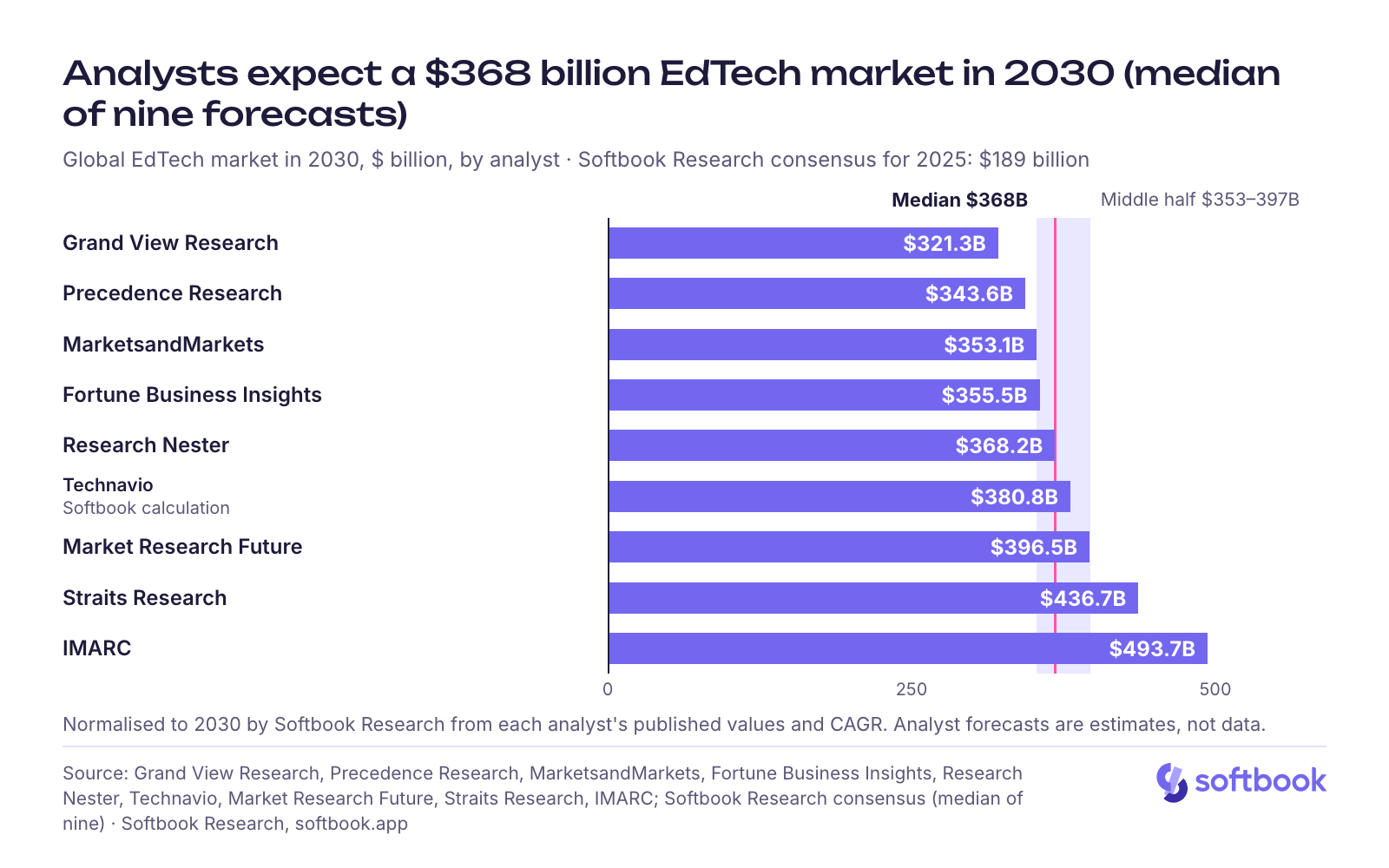
The median is stable. If we drop IMARC, whose 2025 base is far above the rest, the 2030 median moves from $368 billion to $362 billion. The median growth between 2025 and 2030 implied by each analyst’s own figures is 13.4% a year (interquartile range 12.3–15.5%). Most analysts expect EdTech to roughly double in five years.
Read that doubling soberly: methods are closed, definitions differ and some pages contradict themselves (see which numbers not to quote). The consensus shows the centre of current expectations, not a prediction to plan a business on.
What this means: analysts expect moderate growth, about 13–14% a year.
How fast is the AI in education market growing?
AI in education is the fastest-growing part of EdTech: the Softbook consensus puts it at $6.7 billion in 2025 and $27.7 billion in 2030, about 34% a year. Even so, it stays below a tenth of the EdTech market by 2030, about 7.7% in the base scenario.
| Analyst | Published forecast | 2025, normalized | 2030, normalized |
|---|---|---|---|
| Grand View Research | $8.3B (2025) → $57.2B (2033); CAGR 25.9% (2026–2033) | $8.3B | $28.6B |
| Precedence Research | $9.58B (2026) → $136.79B (2035); CAGR 34.52% | $7.1B | $31.4B |
| IMARC | $6.4B (2025) → $79.6B (2034); CAGR 31.35% (2026–2034) | $6.4B | $26.8B |
| Mordor Intelligence | $6.90B (2025) → $41.01B (2030); CAGR 42.83% | $6.9B | $41.0B |
| SNS Insider | $5.50B (2025) → $70.55B (2035); CAGR 29.07% | $5.5B | $19.7B |
| MarketsandMarkets | $2.21B (2024) → $5.82B (2030); CAGR 17.5%; narrowest definition | $2.6B | $5.8B |
| Technavio | +$4.03B growth in 2024–2029; CAGR 59.2% | ≈$0.7B* | ≈$7.1B* |
| One more analyst firm | outlier: 2025 base about 7 times the median | not shown | not shown |
| Softbook consensus (median of 8) | $6.7B | $27.7B |
* Softbook calculation based on Technavio’s increment and CAGR, extrapolated from 2029 to 2030.
The middle half of the eight estimates for 2025 falls between $4.8 billion and $7.4 billion, and MarketsandMarkets, with the narrowest definition, has $2.21 billion for 2024. The spread comes from what each firm counts as "AI in education": standalone AI tutors and tools only, or also AI features inside learning platforms and the services around them. Precedence Research, for example, says it counts AI features inside LMS as part of its estimate (Precedence Research).
What this means: AI is where the growth rate is, but not yet where the money is. In 2025, about 96 of every 100 EdTech dollars still go to things other than AI products.
Will AI make the EdTech market bigger?
AI on its own barely changes the size of the EdTech market by 2030: even if the AI segment grows at the fast end of analysts’ implied growth rates, it adds only about $6 billion to the total. A large effect, about $40 billion more, would require AI to speed up everything else as well, and that is a hypothesis.
To test this, we split the 2025 market into two parts: AI ($6.65 billion, the median for AI in education) and everything else ($182.5 billion). Each part grows at its own rate. For the non-AI part, we subtract an assumed 0.12 percentage points from the EdTech lower quartile, median and upper quartile, then round to one decimal place. This adjustment is a modeling assumption. The resulting non-AI rates are 12.2%, 13.3% and 15.4%. AI rates use the corresponding implied-growth quartiles. These are scenarios built on the spread of analysts’ implied growth rates, not forecasts:
| Scenario | What it assumes | EdTech in 2030 | Growth a year, 2025–2030 | AI share in 2030 |
|---|---|---|---|---|
| Conservative | AI replaces part of paid content. Non-AI grows at an adjusted lower-quartile rate of 12.2%, and AI at its lower-quartile rate of 28.8% | $348 billion | 13.0% | 6.8% |
| Base | Non-AI grows at an adjusted median rate of 13.3%, and AI at its median rate of 33.8% | $369 billion | 14.3% | 7.7% |
| AI-accelerated A | Only AI speeds up, to the upper-quartile implied rate (39.0%) | $375 billion | 14.7% | 9.2% |
| AI-accelerated B (hypothesis) | AI triggers replacement of platforms and content. Non-AI grows at an adjusted upper-quartile rate of 15.4%, and AI at 39.0% | $408 billion | 16.6% | 8.5% |
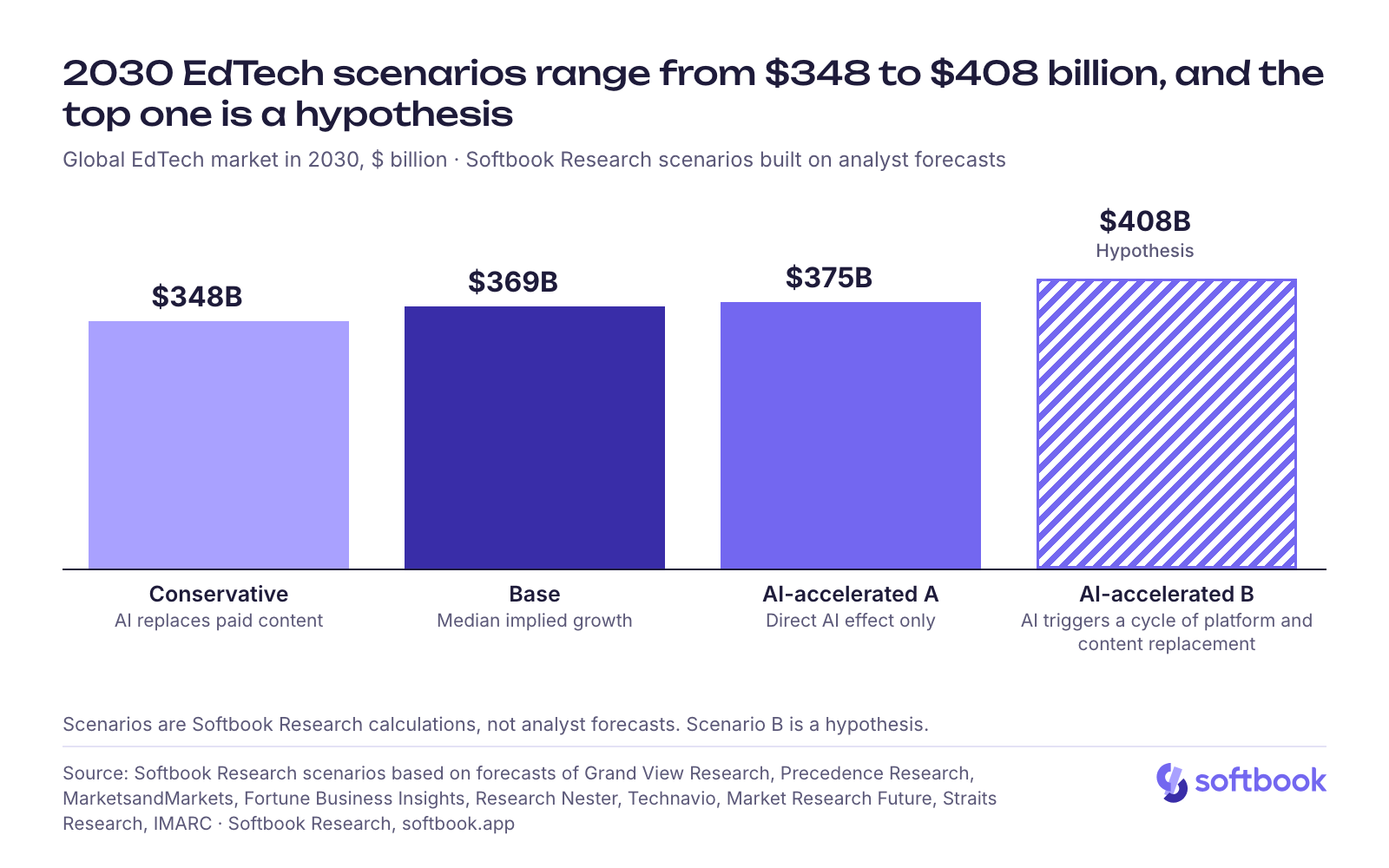
The arithmetic is simple: AI is about 3.5% of EdTech in 2025, so even fast growth of that part adds little to the whole, and scenario A lands only about $6 billion above the base. For AI to add about $40 billion, as in scenario B, it has to change spending outside "AI products": schools replacing their learning platforms, publishers rebuilding content, companies moving training budgets to new tools.
There is indirect support for scenario B. The two software segments closest to AI, LMS (17.5% a year) and AI in education (about 34%), are both expected to grow faster than EdTech overall (13.4%). But none of the reports we cite says how much of the LMS market already comes from AI features. Until one does, scenario B stays a hypothesis.
What this means: on these numbers, AI is more likely to redistribute money inside the market than to add to its size. Watch which tools and content get replaced, not the size of the "AI in education" segment.
Which parts of the market grow fastest?
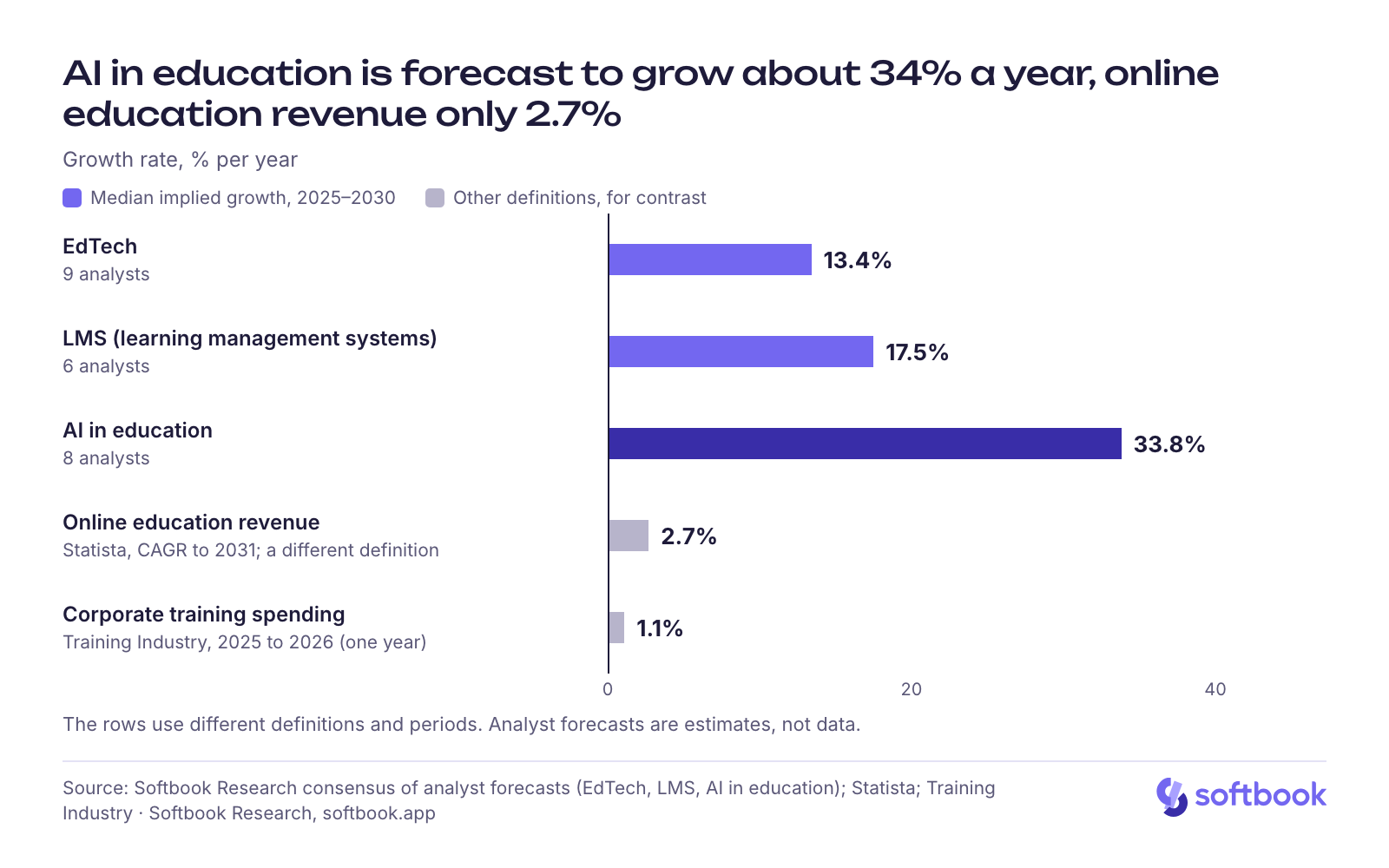
Software and AI grow fastest: AI in education about 34% a year, learning management systems 17.5%, EdTech overall 13.4%. Consumer online education and corporate training budgets barely grow, at 2.7% and 1.1%.
The LMS consensus is $27.0 billion in 2025 and $56.7 billion in 2030, a median of six analysts (interquartile range for 2030: $50.6–63.2 billion):
| Analyst | Published forecast | 2025, normalized | 2030, normalized |
|---|---|---|---|
| Grand View Research | $28.6B (2025) → $123.8B (2033); CAGR 20.2% (2026–2033) | $28.6B | $71.2B |
| MarketsandMarkets | $30.07B (2025) → $88.41B (2032); CAGR 16.6% | $30.1B | $65.1B |
| Fortune Business Insights | $24.09B (2025) → $104.04B (2034); CAGR 16.1% | $24.1B | $57.4B |
| IMARC | $26.8B (2025) → $100.6B (2034); CAGR 15.84% | $26.8B | $55.9B |
| Mordor Intelligence | $27.13B (2025) → $54.86B (2031); CAGR 12.45%; excludes authoring tools and internal portals | $27.1B | $48.8B |
| Meticulous Research | $64.96B (2032); CAGR 18.3% (2025–2032) | ≈$20.0B* | $46.4B |
| Softbook consensus (median of 6) | $27.0B | $56.7B |
* Softbook calculation from the published 2032 value and CAGR.
By region, North America is the largest LMS market at $12.54 billion in 2025, and Europe, at $7.36 billion, is expected to grow 19.1% a year (MarketsandMarkets). At Grand View Research, the academic segment accounts for 60.6% of LMS revenue in 2025 (GVR).
What this means: the software that runs courses is the part of the market where analysts expect the most growth outside AI. For a course business, the platform is the part of its stack where change is fastest.
If the market is growing, why are so many EdTech companies shrinking?
The data suggest that much of this growth is money moving between parts of the market rather than new money: corporate training budgets are estimated to grow about 1% a year and consumer online education 2.7%. These sources don’t measure the exact share. When total budgets grow slowly and one segment grows fast, another tends to lose customers.
Corporate training shows this most clearly. Global corporate spending on training was $394.5 billion in 2025 and is estimated at $398.8 billion in 2026, an increase of 1.1%; North America accounts for $186.4 billion (Training Industry, Inc.). In the United States, training spend was $102.8 billion in 2025, about 5% more, while hours of training per employee fell from 47 to 40 (Training magazine, 2025). If corporate e-learning grows by double digits inside a budget that grows by about 1%, it grows mostly at the expense of classroom training and other spending.
Consumer online education is in a similar position. Statista expects it to grow 2.72% a year from 2026 to 2031 (Statista). The public reports of listed companies show where the pressure lands:
| Company (public filing) | Period | What changed |
|---|---|---|
| Udemy (Form 10-K) | 2025 | Consumer revenue $265.8 million, −9%; enterprise revenue $524.1 million, +6%; net dollar retention 93% |
| Chegg (Form 8-K) | Q1 2025 | Revenue −30%, subscribers −31% to 3.2 million, 22% of staff cut; the company points to Google AI Overviews |
| Chegg (press release) | 2025 | Revenue $376.9 million, −39% |
The pattern is the same in both companies: paid content that answers questions loses ground when AI answers them for free, and selling to companies holds up better than selling to individuals. On May 2, 2023, Chegg shares fell 48% in a day after the company said ChatGPT was hurting its customer growth (CNBC). In October 2025, Chegg announced it would cut about 45% of its staff, 388 roles, and turn toward business customers (Chegg).
What this means: "the market is growing" doesn’t mean every course will sell more. Content that a chatbot can replace is under pressure; practice, feedback, a group and a teacher are harder to replace. Our review of online course completion rates shows which of these actually help people finish.
What happened to EdTech venture funding?
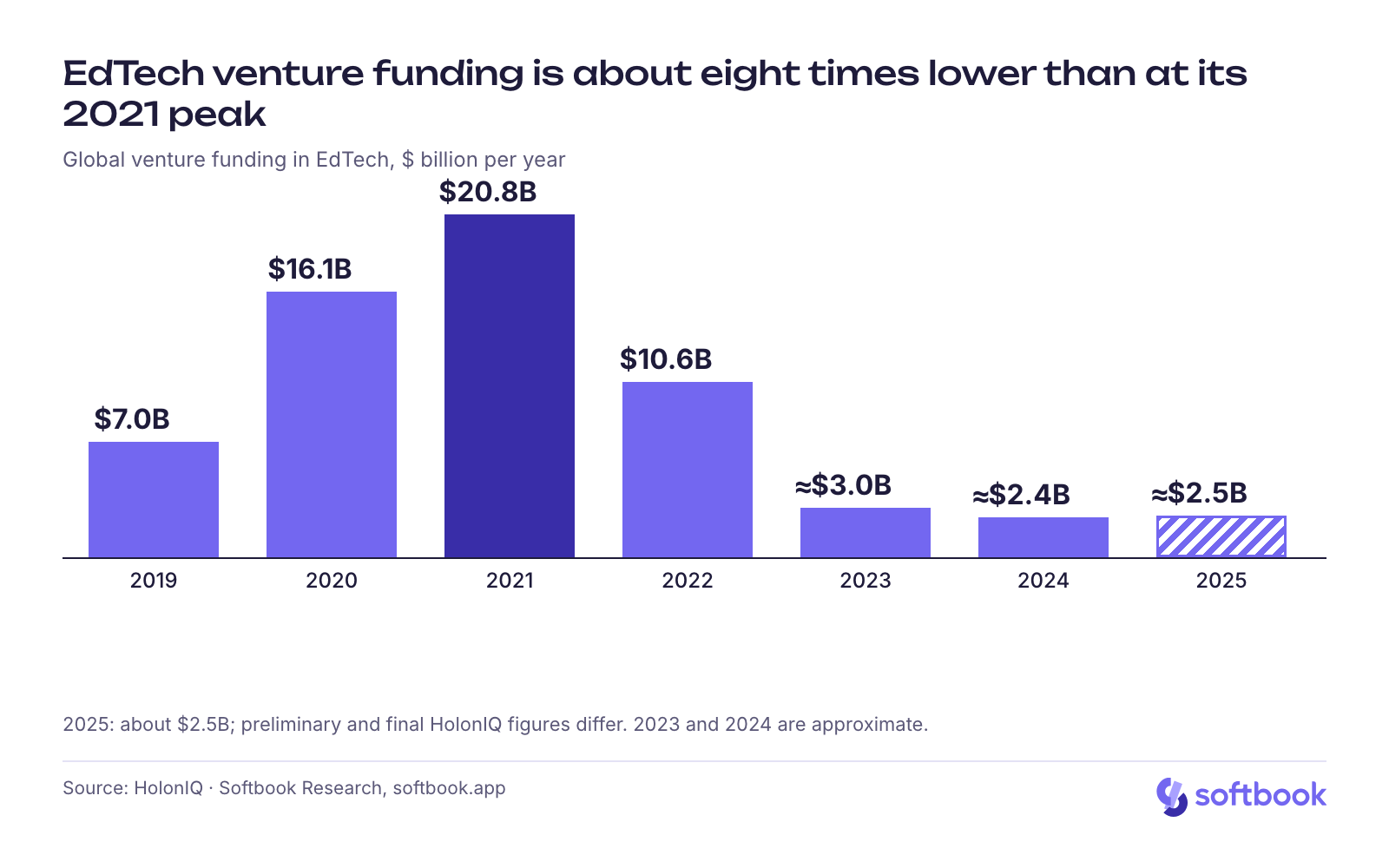
Venture funding in EdTech collapsed after the pandemic boom: from a peak of $20.8 billion in 2021 to about $2.5 billion in 2025, almost 8 times less (−88%), according to HolonIQ. The first half of 2026 brought $1.0 billion, 26% less than the first half of 2025.
| Year | Global EdTech venture funding (HolonIQ) |
|---|---|
| 2019 | $7.0 billion |
| 2020 | $16.1 billion |
| 2021 | $20.8 billion (peak) |
| 2022 | $10.6 billion |
| 2023 | ≈$3.0 billion |
| 2024 | ≈$2.4 billion, the lowest in a decade |
| 2025 | about $2.5 billion |
| H1 2026 | $1.0 billion (−26% vs H1 2025) |
Sources: HolonIQ, 2020; HolonIQ funding chart, 2010–2023; HolonIQ, 2025; HolonIQ, H1 2026. HolonIQ’s preliminary and final figures for 2025 differ, so we give the year as "about $2.5 billion".
The money that remains goes to different places. By number of deals in 2025, workforce training took 38%, K-12 36% and higher education 22%; 87% of deals were early-stage, and there were about 410 education M&A deals, including schools, childcare and universities as well as digital learning companies (HolonIQ, 2025).
What this means: analysts expect EdTech revenue to keep growing while investors stay cautious. Growth here is increasingly paid for by customers rather than by venture rounds.
What broke after the EdTech boom?
The boom of 2020–2021 priced EdTech companies as if pandemic demand would last, and three things broke when it didn’t: valuations, debt-funded growth and paid content that AI made easier to replace.
Valuations went first. Byju’s was valued at $22 billion in 2022; by June 2024, BlackRock had cut the value of its stake to zero (TechCrunch). Debt followed: 2U, the former owner of edX, filed for Chapter 11 bankruptcy in July 2024 with about $945 million of debt (Bloomberg). Then came AI: Chegg’s results in 2023–2025, described above, are a well-documented case of a paid content business losing customers to free answers.
Each case relied on one source of demand: lockdowns, cheap capital or paid answers. None of them shows online learning losing its value: analysts still expect the market to grow, and interest in online courses in the US and the UK is higher than two years ago.
What this means: the businesses that broke sold access to content or bet on demand that was temporary. A course business that sells a result, practice and feedback is exposed to a different set of risks.
What does the Softbook Demand Index show?
The Softbook Demand Index shows that search interest in learning with AI is growing much faster than interest in online courses: between Q3 2024 and Q3 2026 it grew 3.4 to 9.5 times in the US, the UK, Germany, Mexico and Brazil. Interest in classic online courses grew only in the US and the UK, by 38–40%, and fell by 8–26% in the other eight markets.
The index compares Google Trends search interest for two groups of searches in each market's language across ten markets, July–September 2024 against July–September 2026. In English, "learning with AI" covers searches such as "ai tutor" and "chatgpt for studying"; "online courses" covers "online course" and "online learning". Terms for every market are in the Methodology.
| Market | Learning with AI, Q3 2024 → Q3 2026 | Online courses, Q3 2024 → Q3 2026 |
|---|---|---|
| United States | grew 4.7 times | +38% |
| United Kingdom | grew 9.5 times | +40% |
| Germany | grew 3.4 times | −9% |
| France | below the threshold in Q3 2024 and Q3 2025, above it in Q3 2026 | −8% |
| Spain | below the threshold in Q3 2024; +58% from Q3 2025 to Q3 2026 | −14% |
| Mexico | grew 3.4 times | −17% |
| Brazil | grew 3.6 times | −17% |
| Poland | grew about 9 times from a very low base; +19% from Q3 2025 to Q3 2026 | −20% |
| Ukraine (Ukrainian and Russian searches combined) | no two-year growth rate: Q3 2024 below the threshold | −16% |
| Kazakhstan (Russian-language searches) | below the threshold in all three quarters | −26% |
Source: Google Trends, Softbook exports of October 21 and November 23, 2026; the last six markets were added in November. Relative interest, not search volume.
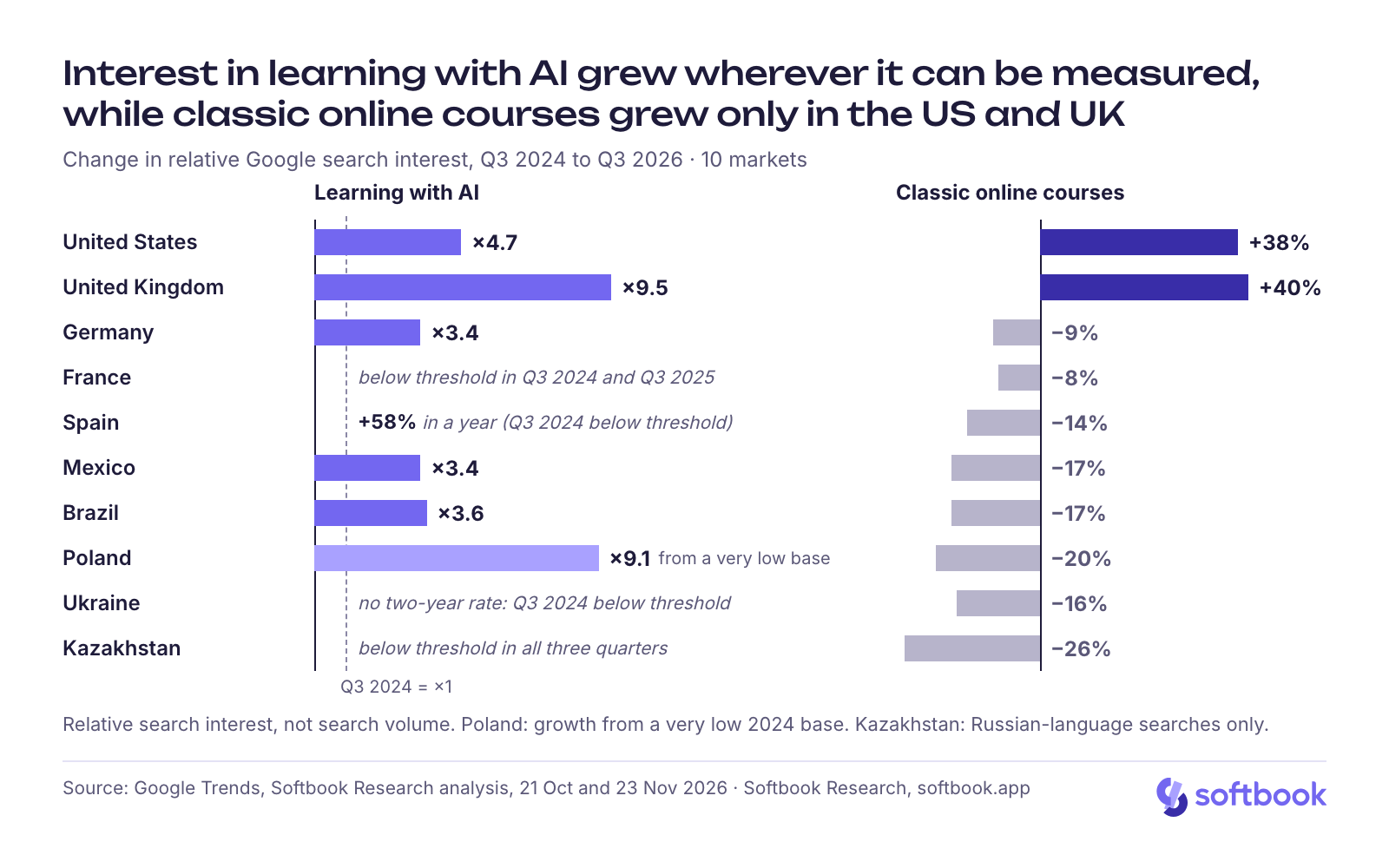
Three caveats. First, learning with AI is still a niche: in July–September 2026 it drew about 7–8% of the search interest that online courses drew in the US, the UK and Germany, up from about 1–2% two years earlier. Mexico has the highest share of the ten markets, about 21%, up from about 5%. Second, growth isn't a straight line: in the US, interest in Q3 2026 was 24% lower than in Q3 2025, while in the UK and Germany it kept rising. Third, in several markets these searches sit near or below the threshold at which Google Trends shows data. In France they were below the threshold in Q3 2024 and Q3 2025 and above it in Q3 2026, so there is no two-year growth rate. In Spain, search interest in learning with AI was below the threshold in Q3 2024. It rose 58% from Q3 2025 to Q3 2026. Search interest in online courses in Spain fell 14% from Q3 2024 to Q3 2026. In Poland, growth of about 9 times starts from a very low base, close to that threshold; from Q3 2025 to Q3 2026 it was +19%. In Ukraine, the Q3 2024 baseline was below the threshold for both language groups, so the index gives no two-year AI growth rate. In Kazakhstan, the Russian-language AI basket was below the threshold in all three quarters.
Among the most frequent AI tutor searches in the US and the UK are language learning searches, such as "ai english tutor" and "ai language tutor"; in the US, "ai english tutor free" was flagged by Google Trends as a breakout query. In Brazil, the rising searches include "melhor ia para estudar para concurso" (the best AI to study for a public-sector entrance exam), also a breakout query, and "qual melhor ia para estudar" (which AI is best for studying).
What this means: in Q3 2026, search interest in learning with AI was about 7–8% of online-course search interest in the US, the UK and Germany, and about 21% in Mexico.
Where is the online learning market growing?
By region, the EdTech market is split almost evenly between Asia-Pacific and North America, with Europe third: about 34%, 33% and 25% of the market in 2025, according to Fortune Business Insights. Asia-Pacific is expected to grow fastest, at 17.7% a year from 2025 to 2030, according to Technavio.
At country level, Fortune Business Insights puts China at about 13% of the global EdTech market, Germany at about 8% and the UK at about 7% in 2025, with the rest of the world outside the three main regions at about 8% (Fortune Business Insights). Grand View Research gives North America a larger share, 36.1% (GVR).
Country forecasts come from single analysts and use different definitions, so the rows below can’t be compared with each other or added up:
| Market | What is measured | Estimate | Analyst |
|---|---|---|---|
| Germany | online education platforms | $9.80B (2024) → $32.40B (2033); CAGR 12.7% | IMARC |
| France | EdTech | $7.88B (2024) → $21.70B (2033); CAGR 11.91% | IMARC |
| Spain | EdTech | $4.50B (2025); CAGR 11.40% (2026–2034) | IMARC |
| Poland | online education, consumer | €311.7M (2024) → €397.8M (2028) | Statista |
| Brazil | EdTech | $6.04B (2025) → $15.60B (2034); CAGR 11.12% | IMARC |
| Mexico | EdTech | $4.9B (2025) → $14.6B (2034); CAGR 12.76% | IMARC |
| China | EdTech and smart classrooms | $14.78B (2025) → $29.24B (2030) | MarketsandMarkets |
What this means: most country forecasts above put annual growth at 11–13%. For each market, the demand index shows how Google search interest in online courses changed between Q3 2024 and Q3 2026.
What drives demand for learning to 2030?
Two forces drive demand for learning to 2030: jobs and skills that change faster than people can retrain, and learners who adopted AI faster than institutions wrote rules for it.
The World Economic Forum expects 170 million jobs to be created and 92 million displaced by 2030, a net gain of 78 million, and about 39% of core skills to change; 63% of employers call the skills gap the main barrier to transforming their business (WEF Future of Jobs Report 2025).
Learners are already using AI. In the UK, 95% of undergraduates use AI and 94% use it in work that is graded (N = 1,054, December 2025, HEPI & Kortext, 2026). In the US, 60% of public-school teachers used AI during the 2024/25 school year, but only 19% say their school has an AI policy (Gallup & Walton Family Foundation, 2025). Our review of what research proves about AI in education covers what this does to learning.
Rules are coming. According to the European Commission’s FAQ on the AI Act, obligations for high-risk AI systems listed in Annex III, which include systems used in education to evaluate learning outcomes, apply from December 2, 2027 (European Commission).
What this means: the reasons to learn are growing faster than the budgets for learning. That gap is where courses that teach a specific, current skill compete.
Which EdTech market numbers should you not quote?
Many repeated EdTech numbers compare different markets or come from pages that contradict themselves. Check a figure against these eight traps before quoting it.
- One word, several markets. Broad EdTech with hardware is $187–280 billion in 2025. Online education revenue (Statista) is $281.0 billion in 2026, growing 2.72% a year. Global e-learning at IMARC is $369.7 billion in 2025, another definition again (IMARC). All spending on education and training is about $10 trillion by 2030 in HolonIQ’s outlook, as reported by QS (QS). These numbers can’t be compared or added.
- AI in education estimates differ by definition. The middle half of eight estimates for 2025 falls between $4.8 billion and $7.4 billion, around a median of $6.7 billion. MarketsandMarkets, with the narrowest definition, has $2.21 billion for 2024. One more firm puts the 2025 base about 7 times above the median; we keep it in the median calculation, where it barely matters, but don’t reproduce its figures.
- Corporate e-learning that doesn’t fit the budget. Grand View Research forecasts corporate e-learning at $335.0 billion by 2030, up from $104.3 billion in 2024 (GVR). That would be about 80% of all corporate training spend, which Training Industry puts at $394.5 billion in 2025 with growth of about 1% a year. The definition must include far more than training budgets. Estimates for this segment differ about six times at the base, so we don’t calculate a consensus for it.
- Pages that contradict themselves. Straits Research states a CAGR of 13.4%, but its own values imply 17.1%. Precedence Research shows two figures for 2025, $185.36 billion and $210.08 billion. Research Nester’s page carries a second set of numbers ($7.41 billion). IMARC’s growth from 2025 to 2026 (14.6%) is higher than its stated CAGR. Our rule: use the values, not the stated rate.
- Resellers that change the author. Report resellers republish analysts’ figures, and retellings credit them to the wrong firm: $104.32 billion and 21.7% for corporate e-learning are Grand View Research numbers. Quote only the analyst’s own site.
- Preliminary and final venture figures. HolonIQ’s preliminary and final numbers for 2025 differ, and venture databases differ from each other, so don’t mix sources in one series.
- Old forecasts in other definitions. In 2020, HolonIQ forecast digital spending on education at $404 billion for 2025 (HolonIQ). It measured a wider category than today’s EdTech estimates, so comparing it with $189 billion doesn’t show that analysts were wrong.
- Forecasts are not data. Write "analysts estimate", not "the market is".
What this means: a number with its definition, source and year is worth quoting; a number without them is a guess, however precise it looks.
What does this mean for online schools and course creators?
For an online school, the forecasts point to a market that keeps growing at a moderate pace while money moves toward software, AI-assisted learning and training for work. These steps follow from the data above; none of them is a promise of revenue.
- Sell what AI can't answer in one prompt. The Chegg and Udemy consumer numbers show the pressure on paid content sold to individuals. Build the course around practice, quizzes and feedback, which research links to learning and finishing (completion rates review).
- Use AI on the teaching side first. Drafts of lessons, examples and feedback are where AI saves teachers time, according to the surveys in our AI in education review.
- Answer the AI question on your course page. Search interest in learning with AI rose 3.4 to 9.5 times in two years in the US, the UK, Germany, Mexico and Brazil. Explain what students get from the teacher, the group and feedback on assignments.
- For companies, show what your course replaces. Corporate training budgets grow about 1% a year, so a company buying your course often stops paying for something else.
- Plan for your own market, not the global average. Over two years, interest in classic online courses grew 38–40% in the US and the UK and fell 8–26% in the other eight markets of the index. Check your market's row in the demand index table above before you plan.
- Write a short AI policy for your course. Only 19% of US public-school teachers have a school policy to rely on, and, according to the European Commission, EU high-risk rules for AI that evaluates learning apply from December 2, 2027.
Where does Softbook fit in this market?
Softbook works in the layer of this market that analysts expect to grow faster than EdTech overall: the platform that runs an online school.
Softbook is a platform for online schools: courses, sales, CRM, email and Telegram campaigns, and a website builder in one place. You can add unlimited students, and the platform takes no commission on your sales. On our online course platform, AI course generation drafts a course structure and lessons from your parameters for you to finish, and analytics shows which students are at risk of dropping out.
Methodology
Consensus forecast.
- We collected public forecasts from 9 analyst firms for EdTech, 8 for AI in education and 6 for LMS. We used only editions from 2024–2026 with figures on the analyst’s own page or press release; retellings and resellers were excluded.
- We brought every forecast to 2025 and 2030 from the nearest published point using the analyst’s own compound growth rate. Where a page’s values and its stated CAGR contradict each other, we used the values. For 2030, six rows start from the analyst’s published 2026 value: GVR EdTech $213.2B, GVR AI $11.4B, IMARC AI $9.0B, GVR LMS $34.1B, MarketsandMarkets LMS $35.23B and Fortune LMS $31.61B.
- The consensus is the median; the spread is the interquartile range (Q1–Q3). The median is robust to outliers: removing the highest EdTech source changes the 2030 median by less than 2%.
- Published 2025 bases for broad EdTech range from about $187 billion to $280 billion because definitions differ. IMARC is the outlier by size ($279.8 billion), not by growth rate; we kept it in the consensus and also show the median without it. Two bases in the table (Technavio and the back-calculated Precedence 2025 value) are our calculations and sit slightly below that range.
- For growth we use the annual rate implied by each analyst’s normalized 2025 and 2030 values, not the CAGR printed on the page, because published rates cover different periods (for example 2026–2033). The median implied rate is 13.4% a year for EdTech (interquartile range 12.3–15.5%), 33.8% for AI in education (28.8–39.0%) and 17.5% for LMS. The unrounded EdTech median is 13.45%; we show 13.4%. Quartiles use the inclusive method. The two medians themselves ($189 billion and $368 billion) imply about 14% a year: the median of growth rates and the growth between two medians are different statistics.
- Technavio does not publish market size: we reconstructed it from the published growth amount and CAGR (for AI in education, also extrapolated from 2029 to 2030). This is the weakest point and barely affects the medians.
Scenarios. 7. AI in education is treated as part of EdTech, not a separate market on top of it. If it were counted separately, the base 2030 figure would rise by about $28 billion. 8. The 2025 market is split into AI ($6.65 billion) and everything else ($182.5 billion). The base scenario uses median rates for both parts; the conservative one uses lower-quartile rates (AI replaces part of paid content); scenario A raises only AI to its upper-quartile rate; scenario B also moves the non-AI part to its upper-quartile rate, assuming AI triggers platform and content replacement. AI rates are the AI in education implied-growth quartiles, unadjusted: 28.8%, 33.8% and 39.0%. For the non-AI part, we subtract an assumed 0.12 percentage points from the EdTech lower quartile, median and upper quartile (12.3%, 13.45% and 15.5%), then round to one decimal place. This adjustment is a modeling assumption. The resulting non-AI rates are 12.2%, 13.3% and 15.4%. These are scenarios built on the spread of analysts’ implied growth rates, not forecasts. Scenario B is a hypothesis. Because the two parts grow at their own rates, the base scenario ($369 billion) lands $1 billion above the consensus median ($368 billion). 9. Each growth rate is applied evenly across years; real analyst curves may be uneven. All values are nominal US dollars, without inflation or exchange-rate effects.
Softbook Demand Index. 10. Source: Google Trends, web search, all categories, data retrieved on October 21 and November 23, 2026: the US, the UK, Germany and France in October, the other six markets in November, with the same method and the same time window. The metric is relative interest on a 0–100 scale within one query, market and period. It is not search volume and not sales. 11. Search groups were 3–5 terms in the market's language, combined with "+". Learning with AI: US and UK "ai tutor", "learn with ai", "ai for studying", "chatgpt for studying", "study with ai"; Germany "mit ki lernen", "lernen mit ki", "ki tutor", "ki nachhilfe", "lernen mit chatgpt"; France "ia pour réviser", "apprendre avec l'ia", "ia pour étudier", "tuteur ia", "chatgpt pour réviser". Spain and Mexico "tutor ia", "aprender con ia", "ia para estudiar", "chatgpt para estudiar", "estudiar con ia"; Brazil "ia para estudar", "estudar com ia", "tutor ia", "chatgpt para estudar", "aprender com ia"; Poland "ai do nauki", "nauka z ai", "chatgpt do nauki", "korepetytor ai", "sztuczna inteligencja do nauki"; Ukraine, in Ukrainian, "ші для навчання", "chatgpt для навчання", "ші репетитор", "нейромережа для навчання", "ai репетитор"; Ukraine, in Russian, and Kazakhstan "нейросеть для учебы", "ии для учебы", "chatgpt для учебы", "ии репетитор", "нейросеть для обучения". Online courses: US and UK "online course", "online courses", "online learning", "online classes"; Germany "online kurs", "online kurse", "online lernen", "online weiterbildung"; France "formation en ligne", "cours en ligne", "apprendre en ligne"; Spain and Mexico "curso online", "cursos online", "cursos en línea", "clases online"; Brazil "curso online", "cursos online", "cursos ead", "aulas online"; Poland "kurs online", "kursy online", "nauka online", "szkolenia online"; Ukraine, in Ukrainian, "онлайн курси", "курси онлайн", "онлайн навчання", "навчання онлайн"; Ukraine, in Russian, and Kazakhstan "онлайн курсы", "курсы онлайн", "онлайн обучение", "обучение онлайн". Google Trends accepts about 100 characters per group, so each group has 3–5 terms. In Ukraine, "distance learning" searches were left out because they mostly refer to school distance learning. Ambiguous searches and course-platform brand terms were excluded; searches that name an AI assistant, such as "chatgpt for studying", were kept. 12. We averaged the weekly index values for each July–September quarter. The growth multiple is the later average divided by the earlier one. The percentage change is that ratio minus one, multiplied by 100. The share of AI learning in online-course interest comes from one query with all groups on the same scale. For Ukraine, online-course interest is the sum of the Ukrainian and the Russian group from one query (Ukrainian −14%, Russian −21%). For learning with AI in Spain, where the July–September 2024 average was below the threshold, we give the change from July–September 2025 to July–September 2026; for online courses in Spain, the change covers the full two years. 13. Limits: Google Trends rounds to whole numbers and drops small values, so values below 5 are noise. The groups don't cover every way people search. Ten markets are covered: the US, the UK, Germany, France, Spain, Mexico, Brazil, Poland, Ukraine and Kazakhstan; for Kazakhstan, only Russian-language searches were collected. The six markets added in November were retrieved a month after the first four. Google Trends resamples its data. Repeat exports can give different values, particularly when the index is close to the threshold. Softbook's internal data was not used.
General limits. This is a recalculation of other firms’ models, not our own estimate of demand; definitions differ and methods are behind paywalls.
How to cite this research
Softbook Research (2026). Online learning market 2026: the $368B EdTech forecast for 2030 and what AI really changes. Softbook. https:/
/ softbook. app/ blog/ en/ online- learning- market/
When you quote the consensus forecast, the scenarios or the Softbook Demand Index, please name Softbook Research and link to this page. For a single figure, a short form works: "Softbook Research consensus of 9 analysts, October 2026".
Charts and data on this page are free to reuse with credit to Softbook Research and a link to this page (CC BY 4.0).
Run your courses, sales and students from one account. Try Softbook free for 30 days, no card required.
Related reading
- EdTech statistics 2026
- AI in education in 2026: what research proves about AI tutors and what is hype
- Online course completion rates: why 3% of MIT and Harvard MOOC participants finished, and what actually helps
- The future of learning: predictions for 2027–2030
- How to sell online courses
Sources
Market forecasts: EdTech
- Grand View Research (2026). Education Technology Market, 2026–2033 edition. https:/
/ www. grandviewresearch. com/ industry- analysis/ education- technology- market - IMARC Group (2026). Edtech Market 2026–2034. https:/
/ www. imarcgroup. com/ Edtech- Market - Fortune Business Insights (2026). Edtech Market. https:/
/ www. fortunebusinessinsigh ts. com/ edtech- market- 111377 - Technavio (2026). Edtech Market 2026–2030. https:/
/ www. technavio. com/ report/ edtech- market- industry- analysis - MarketsandMarkets (2025). EdTech and Smart Classrooms Market, press release, September 3, 2025. https:/
/ www. marketsandmarkets. com/ PressReleases/ educational- technology- ed- tech. asp - Precedence Research (2026). Educational Technology Market 2026–2035, updated September 28, 2026. https:/
/ www. precedenceresearch. com/ educational- technology- market - Straits Research (2026). EdTech Market, updated September 11, 2026. https:/
/ straitsresearch. com/ report/ education- technology- market - Market Research Future (2026). Edtech Market, updated September 15, 2026. https:/
/ www. marketresearchfuture. com/ reports/ edtech- market- 16213 - Research Nester (2025). EdTech Market. https:/
/ www. researchnester. com/ reports/ education- technology- market/ 3403
Market forecasts: AI in education
10. Grand View Research (2026). AI in Education Market. https:/
Market forecasts: LMS
18. Grand View Research (2026). Learning Management System Market. https:/
Other markets and definitions
24. Statista Market Insights (2026). Online Education, Worldwide. https:/
Training budgets
29. Training Industry, Inc. (2026). Size of Training Industry. https:/
Venture funding
31. HolonIQ (2021). $16.1B of global EdTech venture capital in 2020. https:/
Company filings and reporting
35. Udemy, Inc. (2026). Form 10-K for fiscal year 2025. https:/
Regions
42. IMARC Group. Germany Online Education Platforms Market. https:/
Demand, skills and rules 49. World Economic Forum (2025). Future of Jobs Report 2025. https://www.weforum.org/press/2025/01/future-of-jobs-report-2025-78-million-new-job-opportunities-by-2030-but-urgent-upskilling-needed-to-prepare-workforces/ 50. HEPI & Kortext (2026). Student Generative AI Survey 2026, HEPI Report 199. https://www.hepi.ac.uk/wp-content/uploads/2026/03/HEPI-Report-199-Gen-AI-Survey-2026.pdf 51. Gallup & Walton Family Foundation (2025). Six weeks a year: how AI gives teachers time back. https://www.waltonfamilyfoundation.org/learning/six-weeks-a-year-how-ai-gives-teachers-time-back 52. European Commission. Navigating the AI Act, FAQ. https://digital-strategy.ec.europa.eu/en/faqs/navigating-ai-act 53. Google Trends, data retrieved by Softbook Research on October 21 and November 23, 2026. https://trends.google.com/trends/
Frequently asked questions
How big is the online learning market in 2026?
It depends on the definition. Broad EdTech, which includes hardware, software and content, is estimated at about $189 billion in 2025, the median of nine analysts. Statista puts online education revenue at $281 billion in 2026, growing 2.7% a year to 2031. Learning management systems, the software that runs courses, are about $27 billion. These figures measure different markets and can't be added.
What is the EdTech market forecast for 2030?
The Softbook Research consensus puts the global EdTech market at about $368 billion in 2030, up from $189 billion in 2025. It is the median of nine analysts' forecasts brought to the same years; the middle half falls between $353 billion and $397 billion. The median growth between 2025 and 2030 implied by each analyst's own figures is 13.4% a year. All figures are analysts' estimates, not measurements.
How big is the AI in education market?
About $6.7 billion in 2025 and $27.7 billion in 2030, according to the median of eight analysts compiled by Softbook Research; the median growth implied by their figures is about 34% a year. The middle half of the eight 2025 estimates falls between $4.8 billion and $7.4 billion; they differ by whether AI features inside learning platforms are counted. AI is about 3.5% of the EdTech market in 2025 and around 7.7% by 2030 in the base scenario.
Will AI make the EdTech market bigger?
Not much on its own. Because AI is only about 3.5% of EdTech in 2025, even upper-quartile growth of the AI segment adds about $6 billion to the 2030 market. A larger jump, to $408 billion instead of $369 billion in the base scenario, would need AI to trigger the replacement of learning platforms and content across the market. Softbook Research treats that as a hypothesis.
How fast is the LMS market growing?
The learning management system market is expected to grow from $27.0 billion in 2025 to $56.7 billion in 2030, according to the median of six analysts compiled by Softbook Research, with median implied growth of 17.5% a year. That is faster than EdTech overall, at 13.4%. North America is the largest LMS market, and MarketsandMarkets expects Europe to grow 19.1% a year.
How much venture capital goes into EdTech?
Much less than during the boom. HolonIQ data show that global EdTech venture funding fell from a peak of $20.8 billion in 2021 to about $2.5 billion in 2025, almost eight times less. The first half of 2026 brought $1.0 billion, 26% below the first half of 2025. By number of deals in 2025, workforce training led with 38%.
Is interest in learning with AI growing?
Yes, quickly but from a low base. The Softbook Demand Index, based on Google Trends data for ten markets, shows that interest in learning with AI grew 3.4 to 9.5 times in the US, the UK, Germany, Mexico and Brazil from Q3 2024 to Q3 2026. It is still about 7–8% of the interest in online courses in the US, the UK and Germany and about 21% in Mexico. In the US it was 24% lower than a year earlier.
Why are EdTech companies struggling if the market is growing?
The data suggest that much of the growth is money moving between parts of the market rather than new money: corporate training budgets are estimated to grow 1.1% in 2026, according to Training Industry, and Statista expects online education to grow 2.7% a year. These sources don't measure the exact share. Paid content that AI can replace loses customers: Chegg's revenue fell 39% in 2025, and Udemy's consumer revenue fell 9% while its enterprise revenue grew 6%.